
Vulnerabilities in DC Fast Charging Architectures
Modern electric vehicle (EV) charging networks operate in highly exposed, dynamic electrical environments. Direct Current Fast Charging (DCFC) stations are particularly susceptible to severe atmospheric disturbances and utility grid switching transients. Because these stations sit at the immediate intersection of high-voltage grid inputs and vulnerable vehicle electronics, they face constant overvoltage threats.
The core function of a DCFC station relies on converting alternating current (AC) into high-voltage direct current (DC) at extreme speeds. This process utilizes highly sensitive rectifiers and sophisticated charge controllers that operate within extremely tight voltage tolerances. Even a microscopic microsecond voltage spike can cause immediate dielectric breakdown within these semiconductors.
The architecture of Level 3 DC fast chargers involves highly sensitive power electronics that are intolerant to voltage spikes. To safeguard these critical conversion components from severe electrical transients, engineers must integrate LSP robust industrial surge protectors designed specifically to handle high-energy dissipation and isolate fault currents before they reach the charging module or the connected vehicle.
Furthermore, these charging stations are often physically located in open parking lots or highway corridors, creating a prime target for lightning strikes. Without heavy-duty transient isolation, the energy from a nearby lightning strike can couple into the charging cables. This inductive coupling sends destructive voltage straight into the vehicle’s onboard battery management system (BMS).
The Cost of Unplanned Downtime in Commercial Charging Stations
When an electrical transient destroys a charging station’s power modules, the financial fallout extends far beyond the immediate hardware replacement costs. Commercial charging hubs operate on high-volume utilization models, meaning that every hour of downtime results in measurable revenue leakage. Replacing proprietary DC components often requires specialized technicians and long lead times.
Beyond direct repair costs, commercial operators suffer severe reputational damage when users encounter dead stations. Network reliability is the primary driver of customer retention in the EV sector. Consequently, investing in comprehensive surge protection is not just an engineering requirement; it is a critical commercial necessity to protect the facility’s overall profitability.
Strategic Placement of Surge Protective Devices (SPDs) in EVSE
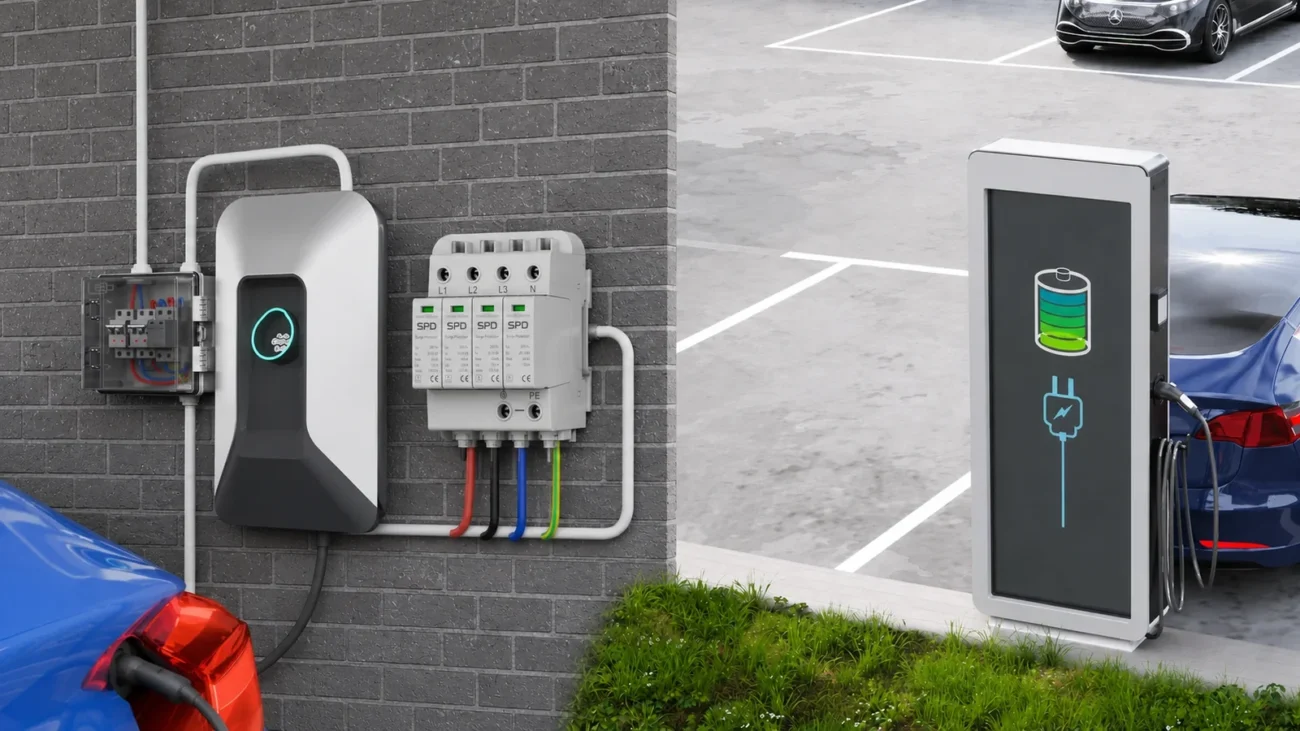
To achieve true operational resilience, Electric Vehicle Supply Equipment (EVSE) must employ a cascaded surge protection strategy. Relying on a single point of defense is entirely insufficient for commercial infrastructure. Engineers must deploy distinct layers of protection across both the AC utility input and the DC vehicle output.
A properly executed cascaded protection design prevents transient energy from bypassing primary defenses. By stepping down the voltage incrementally, the system ensures that sensitive microprocessors and communication boards remain untouched. The following structural breakdown outlines the mandatory deployment zones for SPDs:
- AC Power Infeed (Type 1 SPDs): Installed at the main distribution board, these heavy-duty devices handle direct lightning currents (10/350 μs waveforms) entering from the utility grid.
- AC/DC Rectification Node (Type 2 SPDs): Positioned immediately before the rectifiers, these units dissipate residual grid transients and internal switching surges (8/20 μs waveforms).
- DC Output to Vehicle (DC SPDs): Crucial for safeguarding the physical charging cable and the vehicle’s battery pack against inductively coupled surges during the active charging phase.
- Communication Lines (Data SPDs): Specialized low-voltage protectors must be installed on Ethernet or RS-485 lines to protect the network telemetry modules and payment gateways.
Overcoming Grounding Challenges in Urban Environments
Surge protection devices function by shunting excess electrical energy directly into the earth, making the grounding system the absolute backbone of transient mitigation. In urban environments, however, achieving a low-impedance ground path presents significant engineering hurdles. Space-constrained underground parking structures often lack access to raw earth for proper grounding rod installation.
Concrete surfaces and heavily reinforced foundational slabs inherently possess high electrical resistance. When a high-frequency transient event occurs, improper grounding can cause the surge energy to bounce back into the system rather than dissipating. This phenomenon, known as ground potential rise, can bypass the SPDs entirely and destroy the charging contactors.
To overcome this, engineers must utilize equipotential bonding networks across the entire EVSE footprint. By linking all exposed conductive parts, structural rebar, and SPD ground terminals into a unified grid, potential differences are eliminated. Additionally, using flat copper braiding instead of round wire drastically reduces the skin effect, improving high-frequency surge dispersion.
Compliance with EV Infrastructure Safety Standards
Deploying public EV charging infrastructure demands strict adherence to rigorous electrical safety protocols. Navigating the complex landscape of international standards is critical to mitigating liability and ensuring interoperability. Frameworks such as IEC 61851 outline the baseline parameters for electrical isolation and environmental resilience in charging hardware.
Integrating comprehensive overvoltage protection is not merely a best practice; it is a fundamental requirement for regulatory approval. Facilities must align with global safety frameworks governing the operation and deployment of any commercial charging station, ensuring that both the grid connection and the vehicle interface are immune to life-threatening electrical anomalies.
Failure to meet these internationally recognized safety mandates can result in failed grid interconnection inspections and voided equipment warranties. Standardized testing guarantees that the SPDs will safely degrade and disconnect at the end of their lifecycle without triggering thermal runaway or an electrical fire within the kiosk.
Conclusion
Integrating high-performance surge protection into EV infrastructure is an uncompromising prerequisite for public safety and network reliability. Proactively defending vulnerable power electronics from transient faults dramatically extends equipment lifespans and prevents catastrophic hardware failures. Ultimately, a rigorously engineered surge mitigation strategy ensures continuous operation, securing the long-term viability of commercial charging investments.
