
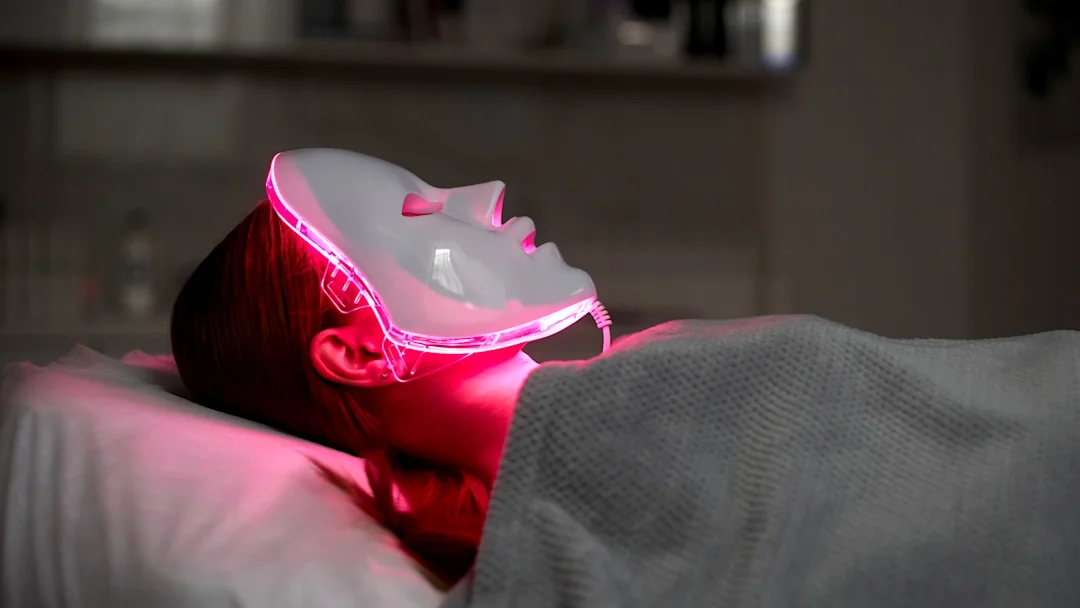
Most evening routines are built around subtraction: less caffeine, less screen time, less light. Red light therapy proposes an addition instead, a quiet ten minutes in front of a warm red glow before bed. The idea has moved from biohacker forums into mainstream bedrooms, and it rests on a real distinction in how the body responds to different colors of light.
This article covers the short version: the science, the routine, and the expectations. Readers who want the complete picture can work through how red light may support the wind-down before bed for the sleep case in full, while skin-focused red light devices covers the daytime skincare use that often ends up sharing the same panel, a pairing worth knowing about before any purchase decision.
Why the Color of Evening Light Matters
The circadian system, the internal clock that governs sleep timing, takes its primary cue from light entering the eyes. Short-wavelength blue light, roughly 450 to 490 nanometers, is the brain’s daytime signal: it suppresses melatonin, the hormone that opens the door to sleep. Phones, televisions, and standard LED bulbs all emit it in quantity, which is why evening screen use is consistently linked to delayed sleep onset.
Red light sits at the opposite end of the visible spectrum, around 630 to 670 nanometers, with near-infrared just beyond it. These longer wavelengths do not appear to suppress melatonin the way blue light does. That alone makes red a more sleep-compatible choice of evening illumination. The stronger claim, that red light actively supports sleep rather than merely not disrupting it, is where the research comes in.
What the Research Suggests
The evidence base is early but not empty. A study indexed on PubMed (ID 22894732) examined red light exposure and reported improved sleep measures in the studied group. Separately, research on near-infrared light applied to the forehead, known as transcranial photobiomodulation (PubMed ID 27896982), reported mood-related benefits. Mood and sleep travel together: a calmer nervous system in the evening is one of the conditions associated with easier sleep onset. Both studies are small and preliminary, and neither proves that a home device will improve any individual’s sleep. They establish plausibility and a direction worth testing personally.
Building the Routine
The practical pattern most users settle into looks like this. Timing: a session 30 to 90 minutes before bed, folded into the existing wind-down rather than bolted on. Duration: 10 to 20 minutes is the range most protocols use. Environment: dim the rest of the room, put the phone away, and let the session double as screen-free decompression. Light selection: if the device includes a blue channel for daytime or skin use, switch it off in the evening; blue at night works against the entire exercise. Consistency: like most sleep interventions, any effect builds across weeks of regular use, not single nights.
A Note for Skin-Focused Users
Many people arrive at red light therapy for sleep and stay for the secondary uses. The same red wavelengths used in evening sessions are the ones most studied for skin texture and collagen support, which makes a single panel a two-purpose tool: mornings or daytime for skin work, evenings for wind-down with any blue channel disabled. That dual use changes the value calculation on a mid-range panel, and the skincare guide linked at the top of this article covers the device side of it.
Keeping Expectations Realistic
Red light therapy is not a treatment for insomnia, sleep apnea, or any diagnosed sleep disorder, and it is not a substitute for the fundamentals: consistent timing, a dark cool room, and managed caffeine and alcohol. Where it plausibly fits is at the margin, as a screen-free ritual built on wavelengths that do not fight melatonin, with early research suggesting a possible active benefit on top. For a habit that costs ten quiet minutes, that is a reasonable proposition for many people, provided it is tried consistently for several weeks before judging.
Frequently Asked Questions
Can any red bulb do the job?
A simple red bulb avoids the blue-light problem and is a fine low-cost start for ambiance. Therapy panels differ in delivering specific wavelengths at meaningful, measured intensity, which is what the photobiomodulation research is actually based on.
Should the light shine on skin or eyes?
Sessions are typically taken with light on skin, face, or upper body at a comfortable distance. Users should not stare into high-intensity LEDs; devices ship with eye protection for a reason, and closing the eyes or wearing the supplied protection during close sessions is the sensible default.
How soon might sleep change?
Users and study protocols both point to weeks rather than days. Keeping a simple sleep log for a month of consistent use is the fairest personal test.
This article is general wellness information, not medical advice. Speak with a qualified healthcare provider before starting any new therapy.
