
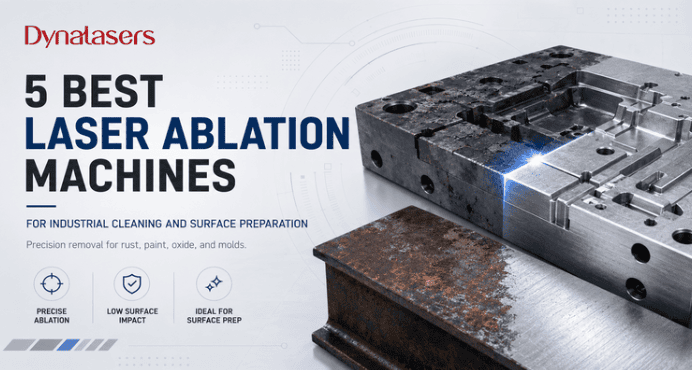
A good laser ablation machine should remove the unwanted layer without creating a new surface problem underneath. Rust, paint, oxide, grease, and mold residue all need different energy levels and cleaning speeds.
Dynalasers covers both sides of this work with the P300 pulsed cleaner for controlled ablation and the M75 CW cleaner for faster industrial stripping. That flexibility matters because precision mold cleaning and heavy rust removal may both be called “laser ablation,” but they need very different machines.
Comparison of the 5 Best Laser Ablation Machines
| Brand / Model | Laser Type | Main Strength | Main Tradeoff | Best For |
| Dynalasers P300 / M75 | 300W pulsed / up to 1800W CW | Covers precision and heavy cleaning with two compact industrial options | Two machine types are needed to cover both extremes | Workshops, repair, oxide, rust, paint and mixed surface work |
| Laser Photonics CTIC-2030 | Pulsed fiber | Dual-axis scanning, air cooling, industrial surface conditioning | Larger industrial package | MRO, coating removal, surface preparation |
| Han’s Laser HC-PD | 50–200W pulsed | Very light and portable, 2D scanning | Lower output for heavy contamination | Mobile and precision cleaning |
| PULSAR EXCALIBUR P CL 300E | 300W pulsed | Broad material range and preset cleaning modes | Higher equipment investment | Professional restoration and surface cleaning |
| KEYENCE MD-X / MD-U | Hybrid / UV laser | High precision, automation and controlled localized ablation | More suited to fixed precision processing than handheld field cleaning | Small parts, electronics and automated production |
The table shows an important difference in the market. Some laser ablation equipment is built around precision and automation, while other systems are designed to move around a workshop or job site. Laser Photonics offers air-cooled pulsed conditioning equipment, Han’s Laser emphasizes lightweight portable cleaning, PULSAR offers a 300W professional system, and KEYENCE focuses heavily on controlled automated ablation.
Dynalasers is particularly useful where the workload is mixed. P300 handles the jobs where the base surface matters most, while M75 is aimed at the jobs where square meters, thick rust, and removal speed start to matter more.
What Is Laser Ablation?
So, what is laser ablation in practical terms?
The process uses concentrated laser energy to remove a surface layer from a material. Depending on the laser and the layer being treated, the material may heat rapidly, break apart, vaporize, or be ejected as small particles.
KEYENCE lists paint, coatings, rust, oxidation, engraving, and surface treatment among common laser ablation applications. The process is also used in automated manufacturing because the laser can be directed at a very specific area without physically touching the component.
That non-contact part is important. There is no grinding disc pushing against a thin panel and no blasting media striking a precision mold.
But “non-contact” should not be confused with “impossible to damage.” A badly chosen parameter can still mark, roughen, discolor, or overheat the material underneath.
How the Laser Ablation Process Actually Removes a Layer
The useful concept is the ablation threshold.
Every contaminant or coating needs a certain amount of energy before it starts to come away efficiently. The substrate has its own threshold where unwanted surface change begins.
The working window lies between the two.
Too little energy:
oxide or paint remains on the part.
Correct energy:
the target layer comes away while the required base surface is maintained.
Too much energy:
cleaning continues into surface modification.
This is one reason Dynalasers recommends matching the cleaner to the material rather than buying by wattage alone. A pulsed machine gives more control over individual energy bursts, while a high-power CW system keeps adding heat continuously and is better suited to larger, tougher surfaces.
Scanning also matters. Slow movement or excessive overlap means the same location receives repeated energy. Move too quickly and strips of contamination can remain between passes.
A useful laser ablation system therefore needs control of more than just the ON/OFF button.
Pulsed vs CW Laser Ablation
Pulsed and continuous lasers are sometimes discussed as though one is simply a stronger version of the other. In cleaning work, that is misleading.
A pulsed system releases short bursts with high peak power while keeping average heat input lower. Han’s Laser describes pulsed cleaning as the more precise approach for heat-sensitive materials, while CW equipment is better matched to large-scale heavy cleaning.
Think about two jobs.
A machined mold has a thin layer of residue in narrow features. The objective is to remove the contamination while preserving dimensions and finish.
Now consider a large carbon-steel frame carrying thick rust and old coating. The main problem is how long the job will take.
Both are industrial laser ablation, but buying the same machine for both would be an unnecessary compromise.
That is why Dynalasers splits these jobs between P300 and M75 instead of presenting one laser cleaner as the answer to everything.
Where Laser Ablation Is Most Useful
A handheld laser ablation machine becomes attractive when mechanical cleaning creates too much secondary work.
Typical applications include:
- Rust and corrosion removal
- Oxide cleaning before welding
- Paint and coating removal
- Mold cleaning
- Carbon and grease removal
- Post-weld cleanup
- Adhesive and coating preparation
- Localized restoration
- Surface treatment before manufacturing
The real advantage is often selectivity.
A repair team may only need to strip a 30 mm area around a future weld. Grinding an entire panel adds work and may damage the existing finish. A portable Dynalasers system allows the operator to treat the required zone and move on to welding or coating.
That is especially useful on installed equipment, molds, machinery, frames, vehicle parts, and other components that cannot easily be carried to a fixed cleaning station.
Laser Ablation Paint Removal Needs More Than High Power
Laser ablation paint removal is a good example of why application testing matters.
Paint is not one material. A machine may encounter primer, epoxy, powder coating, automotive paint, old industrial layers, fillers, or several coatings stacked on top of one another.
A high-power setting might clear a thick steel panel quickly but be far too aggressive on thin aluminum or a finished component.
For localized coating removal and parts where heat control matters, Dynalasers P300 makes more sense. Its pulsed architecture is designed for controlled cleaning of oxide, light rust, thin metal, wood, leather, and precision surfaces.
When the job changes to old paint across a large steel structure, M75 becomes the more productive option.
That ability to choose the cleaning mechanism around the job is more important than simply choosing the machine with the largest power number.
Dynalasers P300 for Precision Laser Ablation
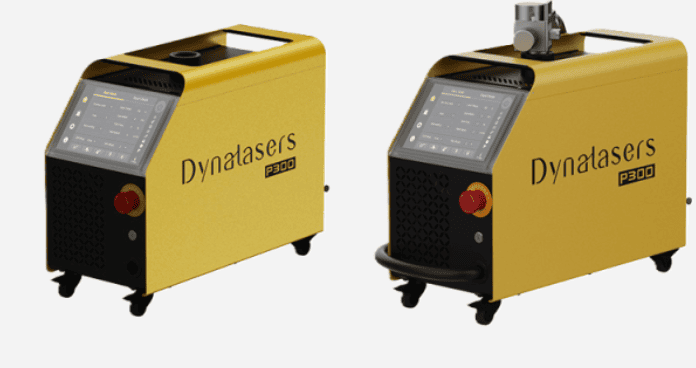
The Dynalasers P300 is the more specialized of the two cleaners.
It is a 300W-class pulsed fiber system designed around controlled surface treatment. Dynalasers positions it for oxide removal, light rust, precision parts, thin metals, molds, wood, leather, and other surfaces where excessive heat would be undesirable.
This makes the P300 a practical handheld laser ablation machine for:
mold maintenance, weld preparation, localized paint removal, oxide cleaning, restoration, precision components, and surface work on more heat-sensitive parts.
Its main selling point is not raw speed. It is the ability to work closer to the boundary between “remove the layer” and “change the material underneath.”
That can save finishing work afterward. A mold that does not need repolishing or a thin panel that stays flat may be worth far more than a few minutes saved during cleaning.
Best for: Controlled ablation, molds, oxide, localized coatings, thin metal, sensitive parts, and precision maintenance.
Dynalasers M75 for Industrial Ablation and Heavy Cleaning
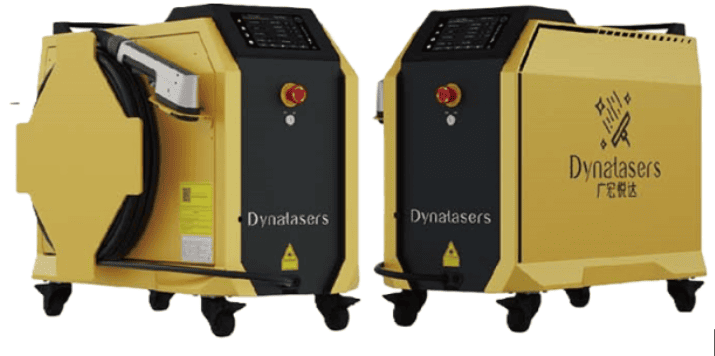
The Dynalasers M75 takes the opposite route.
Its CW laser output reaches about 1800W and is aimed at heavy rust, old paint, large metal surfaces, weld preparation, machinery, frames, and general industrial maintenance. Dynalasers specifically positions it as the faster choice for broad metal cleaning where the surface can tolerate the higher continuous heat input.
This makes M75 relevant when a workshop is replacing:
manual grinding, abrasive stripping, repeated sanding, or slower low-power cleaning on large metal components.
For a steel frame, machinery base, tank, welded structure, or maintenance component, productivity usually matters more than preserving a polished finish.
M75 therefore fits a very different commercial requirement from P300.
Best for: Heavy rust, thick oxide, old paint, structural metal, large areas, machinery and industrial maintenance.
P300 or M75: Which One Makes More Sense?
The decision can usually be made from the surface rather than the specification sheet.
Choose P300 when the job sounds like:
“Clean this surface carefully.”
Choose M75 when it sounds like:
“There is a lot of material to remove.”
P300 favors precision, lower heat input, portability, and surface protection. M75 favors cleaning speed and larger industrial areas. Dynalasers markets the two as complementary systems rather than direct substitutes.
For workshops doing restoration one week and heavy machinery work the next, real sample testing is particularly valuable. The same rust color can hide very different layer thicknesses, oils, paints, plating, or surface finishes underneath.
The Surface After Ablation Matters Too
Cleaning is not always the final operation.
If the next step is welding, the goal may simply be a clean oxide-free joint area.
The next step is adhesive bonding or coating, surface roughness may also matter.
If the part is a polished mold, changing roughness may be unacceptable.
This is an easy point to miss when shopping for laser ablation equipment. “Completely clean” is not a complete specification. The required condition after cleaning should be defined before the laser parameters are chosen.
Dynalasers can test different settings against actual workpieces, which is a more useful way to select between pulsed and CW cleaning than relying on marketing photos alone.
Fume Extraction Is Still Required
Laser ablation removes material from the part, not from the workplace.
Rust, paint, oxide, oil, carbon, plating, and other layers can become fine particles and fumes during cleaning. Laser cleaning therefore still needs suitable extraction.
Industrial systems are also Class 4 lasers. For example, both Laser Photonics and Han’s Laser identify their handheld cleaning equipment as Class 4.
A working setup needs appropriate laser eye protection, access control, beam management, fire precautions, extraction, and trained operators.
FAQs
How much does laser ablation cost?
Cost depends on laser type, power, scanner, cooling, portability, automation, extraction, safety equipment, and support. Comparing complete configurations is more useful than comparing wattage alone.
What is a laser ablation cleaning machine?
It is a laser system that removes unwanted surface material such as rust, oxide, paint, coatings, or residue without mechanical contact.
What are the disadvantages of laser ablation?
Equipment cost, Class 4 laser safety, fume extraction, and application-specific parameter testing are the main considerations. Large heavy-cleaning jobs can also favor CW systems over low-power pulsed equipment.
Is pulsed or CW laser ablation better?
Neither is universally better. Pulsed systems such as Dynalasers P300 favor controlled cleaning; CW systems such as M75 favor larger and heavier industrial work.
Conclusion
The best laser ablation machine is the one that removes the unwanted layer at the speed required without creating extra repair or finishing work afterward.
Dynalasers covers that choice with two distinct systems. P300 focuses on precise pulsed ablation for molds, oxide, thin metals, coatings, and sensitive surfaces. M75 delivers higher-power CW cleaning for rust, paint, machinery, structural parts, and large industrial areas.
For an actual project, the most useful buying test is simple: send a representative part, define what must be removed and what the finished surface should look like, then compare the cleaning result rather than the wattage alone.
