
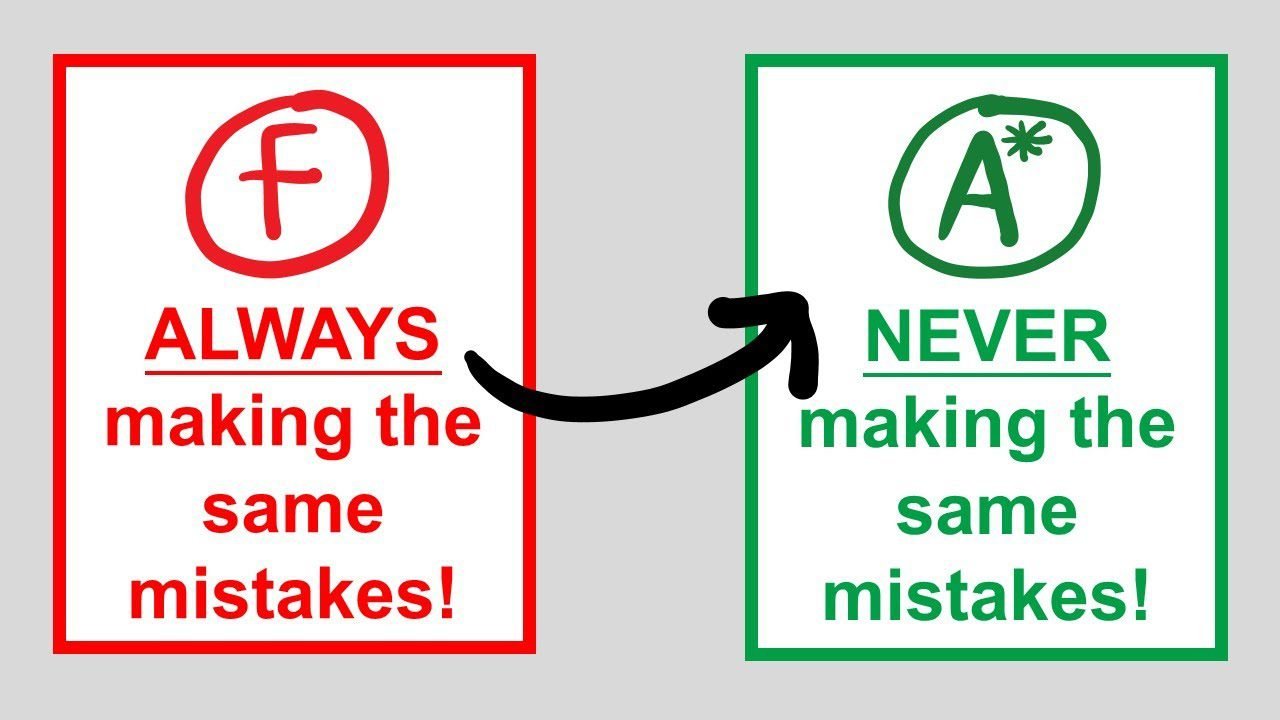
Lack of knowledge is not the only reason why students get bad grades. Usually, they don’t have the awareness of what goes wrong when they are actually writing the answers. This is the reason why the same mistake appears in the same subjects, on the same types of questions, semester after semester. Students never invest time in understanding where they are doing wrong. Understanding why you keep making the same exam mistakes is the first and most important step toward stopping them permanently.
You Never Actually Reviewed Your Last Exam
The most common reason students repeat the same exam mistakes is the simplest one. They never properly reviewed what went wrong the last time. Getting your marked paper back, glancing at the score, and feeling disappointed, and putting it away is not a review. It is avoidance. A genuine review means going through every question you lost marks on, identifying specifically why you lost them, and categorizing the error — was it a knowledge gap, a misread question, a time management problem, or a presentation issue? Without that categorization you have no information to act on and the same mistakes repeat by default.
You Are Misreading Questions without Realising It
One of the most consistent exam mistakes students make across every subject is answering the question they expected to see rather than the question that is actually on the page. Your brain is remarkably good at pattern matching — and under exam pressure it fills in gaps and completes familiar patterns automatically. This means you can read a question, feel confident you understood it, begin writing, and spend twenty minutes answering something subtly but significantly different from what was asked. The fix is mechanical rather than intellectual. Underline the command word, circle the topic, and write one sentence stating what the question is asking before you write a single word of your answer.
Your Revision Is Passive Rather Than Active
Most students revise by reading — going through notes, textbooks, and highlighted passages repeatedly until the content feels familiar. Familiarity is not the same as understanding and understanding is not the same as being able to reproduce and apply knowledge under exam conditions. Passive revision produces the feeling of preparation without the actual capability it is supposed to build. Active revision — testing yourself on material, answering practice questions without your notes, explaining concepts out loud without prompts — is significantly harder and significantly more effective. Students who revise passively consistently make knowledge application mistakes in exams because they have never practised applying what they learned under realistic conditions.
Feeling stressed about an upcoming test? Say, ‘Take my online exam for me’ to get reliable support when you need it most. Getting professional help will not only improve your grades but also your mental wellbeing.
You Are Not Practising Under Real Conditions
Knowing the content in your bedroom with your notes open and your phone nearby is completely different from retrieving and applying that content in a timed, silent exam room with no external support. If you have never practised under conditions that replicate your actual exam you are preparing for a situation you have never experienced. Timed practice papers, silent study sessions, and deliberately avoiding the temptation to check notes mid-question are not optional extras for serious students. They are the minimum preparation requirement for anyone who wants their revision to translate into actual exam performance rather than evaporating the moment the paper lands in front of them.
You Are Not Managing Your Time in the Exam
Exam time management mistakes are among the most avoidable errors students make and among the most consistently repeated. Spending too long on early questions, running out of time on later ones, and submitting with sections unanswered are all time management failures rather than knowledge failures. Students who make these mistakes in one exam almost always make them in the next one because they attribute the problem to anxiety or bad luck rather than the absence of a deliberate time plan. Calculate your time per mark before the exam starts, write your time checkpoints at the beginning of the paper, and move on when your time is up regardless of how complete your answer feels.
You Have Not Identified Your Specific Error Pattern
Every student has a specific pattern of exam errors that is unique to them — and most students have never identified what theirs is. Some students consistently lose marks on application questions but perform well on recall questions. Some consistently misread multi-part questions and answer only the first part. Some consistently run out of time in the final section of every paper. Some consistently lose marks on the same topic across every exam regardless of how much they study it. Until you identify your specific pattern you cannot address it — you can only hope it does not show up again, which it almost always does.
When your law exam starts feeling too difficult to handle, searching “take my law exam” can connect you with professional support and help ease the pressure of exam preparation.
Conclusion
The exam mistakes you keep making are not random. They follow a pattern that is identifiable, understandable, and fixable with the right approach. Review every exam result properly, identify your specific error categories, switch from passive to active revision, practice under real conditions, and manage your time deliberately rather than instinctively. Every mistake on this list is avoidable — but only for students who take the time to understand exactly what is going wrong rather than simply hoping the next exam goes better than the last one.
