
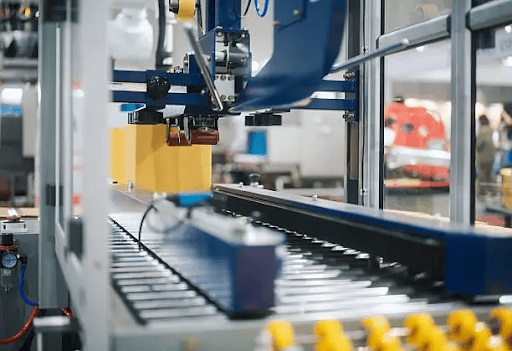
Modern manufacturing operations face unprecedented pressure to deliver consistent quality while managing rising operational costs. To remain competitive, businesses must move beyond legacy systems and adopt scalable, technology-driven solutions.
At the heart of this transformation is the integration of advanced computing with physical machinery. This synergy is redefining how production lines operate, shifting the focus from manual oversight to data-driven precision.
The Shift Towards Smart Manufacturing and Automation
Global labor shortages and persistent supply chain instability are forcing enterprises to rethink their production strategies. Relying on manual labor for high-volume tasks is no longer a viable long-term strategy. Facilities are now pivoting to automated solutions to bridge this gap.
In today’s high-stakes production environments, maintaining consistency at scale requires sophisticated mechanical intervention. For instance, analyzing the specs of specialized equipment from manufacturers like Levapack‘s automated packaging systems reveals how integrating smart sensors with high-speed rotary fillers and seamers can drastically minimize product waste and mitigate costly downtime.
By standardizing output through automation, operations managers can insulate their supply chains from external labor shocks. This strategic upgrade forms the foundation of modern Smart Manufacturing.
Core Technologies Driving Automated Packaging
Transitioning to automated packaging involves deploying specialized hardware engineered for specific production requirements. These systems rely on advanced componentry to operate continuously.
Precision Sensors and Quality Control
Modern machinery utilizes Closed-Loop Sensors to monitor production variables in real time. These sensors constantly measure liquid fill levels and verify the mechanical integrity of can seams before a product leaves the line.
If an anomaly is detected, the system can self-correct or instantly eject the defective unit. This continuous feedback loop virtually eliminates material waste and ensures strict adherence to Quality Control standards.
High-Speed Rotary and Linear Systems
When evaluating packaging architecture, engineers typically choose between rotary and linear systems. The primary differentiator here is Throughput—the rate at which products are processed.
Rotary systems are designed for continuous motion, making them ideal for high-volume, uniform production runs. Conversely, linear systems offer superior flexibility and rapid changeovers, catering to facilities that manage diverse product lines with smaller batch sizes.
Calculating the ROI of Upgrading Packaging Machinery
For business owners, adopting new technology must be justified by a clear financial return. Calculating the long-term ROI requires looking beyond the initial capital expenditure of the machinery.
Decision-makers must account for equipment depreciation alongside operational savings. The most significant financial gains typically stem from the drastic reduction in mechanical downtime and the elimination of human error.
By lowering the defect rate and optimizing material usage, automated systems quickly offset their installation costs, transforming a capital expense into a driver of steady profitability.
Key Takeaways
| Area | Key Takeaway | Impact/Data |
| Strategy | Replace manual labor with automated packaging | Insulate operations from severe labor shocks |
| Quality Control | Deploy closed-loop sensors for real-time auto-correction | Virtually eliminate material waste and product defects |
| Line Design | Match rotary systems to high-volume and linear to flexible runs | Maximize continuous throughput and changeover speed |
| Financial ROI | Factor downtime reduction and error elimination into CapEx | Quickly offset installation costs and drive profitability |
| Maintenance | Integrate IoT diagnostics to catch wear before failure | Prevent catastrophic breakdowns and extend asset life |
Industry 4.0 and the Future of Factory Connectivity
The next phase of manufacturing efficiency relies on centralized data and the Internet of Things (IoT). Machines are no longer isolated; they are interconnected nodes constantly communicating diagnostic data.
This connectivity enables Predictive Maintenance, allowing software to alert engineers to component wear before a physical breakdown occurs. Addressing mechanical friction early extends the machine’s lifecycle indefinitely.
The transition towards fully autonomous production lines is no longer merely an option for scalable operations, but a fundamental survival imperative. As detailed in the comprehensive overview of the Fourth Industrial Revolution on Wikipedia, the convergence of cyber-physical systems and industrial IoT allows factories to achieve unprecedented predictive maintenance, ensuring continuous operation.
