
Instagram influencer campaigns are now a key way for brands to reach active, interested audiences. But one big question stays the same: how do you measure results? The good news is that it’s not complicated if you follow a clear process. Set clear goals, track the right Key Performance Indicators (KPIs), use analytics tools, and work out your Return on Investment (ROI) or Return on Ad Spend (ROAS).
When you use real data, influencer marketing stops being “hope for the best” and becomes a smart, repeatable marketing method. If you want to get better results from your influencer marketing on Instagram, you need to understand how tracking and measurement works.
Influencer marketing, worth about $21.1 billion in 2023, is now a common marketing channel. About 70% of marketers say they measure ROI for influencer work, showing that the focus is now on real outcomes, not just visibility. Still, 13.6% of marketers say measuring campaigns is a major problem, which shows why a clear measurement plan matters. This article explains the key steps brands can use to check how well Instagram influencer campaigns perform, and to make sure the money spent leads to real results.
Why Measuring Instagram Influencer Campaign Results Matters for Brands
Measuring influencer campaign performance is not optional if your brand is spending money on it. If you don’t measure, you are guessing. You won’t know what content worked, which influencers drove results, or if your budget went to the right places. You also won’t know how these campaigns support bigger business goals. Good measurement helps you move past surface-level numbers like “likes” and “followers” and understand what the campaign did for your business.
In a space where 89% of marketers say influencers work at least as well as other channels, it matters to prove that with data. Tracking results helps you defend your spend, ask for more budget, and improve future campaigns. It turns “it felt successful” into proof you can show to decision-makers.
What Business Goals Can Influencer Campaigns Achieve?
Instagram influencer campaigns can support many business goals, but you need to be clear about what you want first. Most campaigns sit in one of two main buckets: brand awareness or conversions. These goals can overlap, but picking one main goal makes it easier to plan and measure.
An awareness campaign is about reaching new people and getting your brand in front of fresh audiences. Instagram is a strong platform for this, with 1 billion monthly users reported in 2018, and it’s a major platform for influencer work (with 7 in 10 hashtags being branded). A conversion campaign focuses on actions like sales, email sign-ups, or app downloads. Other goals can include promoting a specific product, improving brand reputation, growing your community, and generating leads. Your goal decides what you track and what “success” means.
How Does Measurement Guide Strategy and Budget Decisions?
Measurement helps you decide what to repeat and what to change. When you track performance in a consistent way, you learn what your audience responds to, which influencers drive the best outcomes, and what types of content push people to act. This moves your budget planning from guesswork to smarter spending.
A clear report that shows ROI can also help you secure more budget, because it proves your work created value. It helps you spot the best influencers and formats so you can invest more in what works. For example, if micro-influencers bring better conversions at a lower cost per purchase, you can move more budget to that group next time. Over time, measurement also helps you estimate future performance more accurately.
Setting Campaign Objectives and Choosing Relevant KPIs
Good measurement starts before the first post goes live. You need clear, measurable objectives, and then you need to pick the KPIs that show if you are getting closer to those goals. If you skip this step, even the best tools won’t give you useful insights.
Unclear goals often lead to unclear results. A helpful way to set goals is to use “SMART”: Specific, Measurable, Achievable, Relevant, and Time-bound. For example, “Drive 5,000 new email signups from beauty micro-influencers in Q2” is much easier to track than “Increase brand engagement.”
Mapping Objectives to Measurable Outcomes
After you set the objective, connect it to measurable outcomes. Different goals need different tracking setups and different metrics. This step makes sure you collect the data that actually answers your main question: did the campaign hit the goal?
If your goal is awareness, focus on metrics like reach (unique accounts), impressions (total views), video views, and follower growth. If your goal is consideration, you may care more about link clicks, saves, shares, time on site, and landing page visits. If your goal is conversion, focus on conversion rate, cost per acquisition (CPA), revenue, and ROAS. This one-to-one connection between goal and measurement is what makes reporting accurate.
Key Performance Indicators for Instagram Influencer Campaigns
KPIs are the exact numbers you track to judge performance. They usually fit into three groups: campaign performance metrics, sales/ROI metrics, and awareness/sentiment metrics. The KPIs you choose should match your campaign goal.
If your main goal is awareness, reach and impressions matter most. If the goal is engagement, you’ll track likes, comments, shares, and saves. If the goal is sales, conversions, revenue, and ROAS matter most. Other useful KPI areas include follower growth, website traffic, brand mentions, and share of voice. Try not to focus on one “vanity metric” alone. A mix of KPIs gives a clearer picture.
Core Metrics Brands Should Track on Instagram
Instagram gives you a lot of data. If you track the right metrics in a consistent way, you can understand what worked and what didn’t. Here are the main metrics brands should track:
1. Reach and Impressions
If your campaign goal is visibility, you need reach and impressions. Reach is the number of unique users who saw the content. Impressions are the total number of views, including repeat views by the same people. Reach shows how many different people you touched, while impressions show how often your brand message was seen.
For example, NeoReach ran a campaign for Laifen and tracked views and impressions closely. Eight creators produced 43 posts and generated 14.6 million impressions and 12 million views. That kind of data shows how influencer work can drive wide exposure.
2. Audience Growth and Follower Gains
Follower growth shows whether people liked what they saw enough to connect with your brand directly. Track how many followers your brand gains during the campaign and shortly after it ends. This helps you see if you are building a stronger community, not just getting views.
O-Cedar’s influencer campaign is a clear example. The Influencer Marketing Factory tracked follower growth as part of the results. After working with 83 influencers with a combined audience over 50 million, O-Cedar gained more than 114,000 new followers on TikTok. It shows how influencer campaigns can grow your brand’s social audience fast.
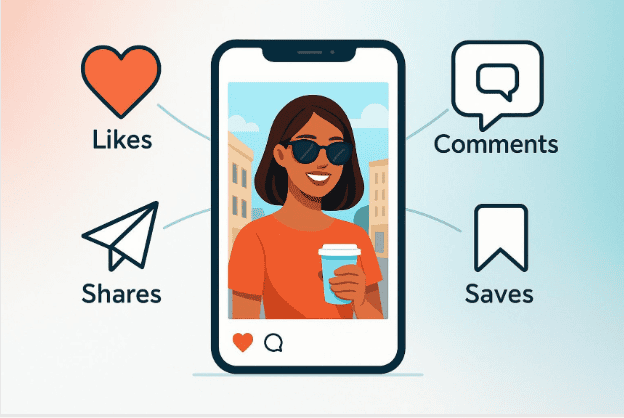
3. Engagement Metrics (Likes, Comments, Shares, Saves)
Engagement shows how much people actually care about the content. Even though Instagram has made like counts less visible to users, brands can still track them through insights. Engagement rate is often calculated as total interactions (likes, comments, shares, saves) divided by reach or follower count, so you can compare across creators.
Engagement Rate = (Total Interactions / Follower Count) * 100
High engagement suggests the content connected with the audience. Tim Hortons’ Christmas campaign with House of Marketers reached a 1.3% engagement rate on Instagram and 5.17% on TikTok. Beyond the numbers, reading comment sentiment can help you understand if people are excited, confused, or ready to buy.
4. Click-Through Rates and Website Traffic
If the goal is to get people off Instagram and onto your site, you need to track click-through rate (CTR) and website traffic. CTR is the percentage of viewers who clicked a link. Website traffic tracks the number of visits to your landing page or store that came from the campaign.
To track this well, use unique links with UTM parameters so you can see which influencer and which post sent the traffic. This helps you identify which partnerships send high-quality visitors who are likely to take action.
5. Conversions and Sales
Many brands run influencer campaigns to drive actions like purchases, sign-ups, app installs, or subscriptions. These conversion metrics show direct business impact.
USIMS worked with NeoReach to promote an eSIM product, aiming for awareness and downloads. The campaign led to over 300,000 downloads. HelloFresh also used influencer promo codes (managed by House of Marketers) and drove more than 500 monthly sales through those codes. Examples like these show why promo codes and affiliate links matter for tracking sales.
6. Brand Mentions and Share of Voice
Influencer campaigns can also create “buzz.” Brand mentions track how often people talk about your brand online. Share of Voice (SOV) compares your mentions against competitors so you can see how visible you are in the market conversation.
Pernod Ricard’s campaign with The GOAT Agency for Beefeater Pink gin used the hashtag #OnWednesdaysWeDrinkPinkm. The hashtag trended in the U.K. and led to a 1,500% increase in organic user-generated content. That shows strong conversation growth and stronger SOV.
7. Sentiment Analysis and Brand Perception
Numbers like reach and mentions tell you how much people talked, but sentiment tells you how they felt. Sentiment analysis looks at the tone of comments and discussions to see if reactions are positive, negative, or neutral.
This is useful for checking if a campaign improved how people see your brand. Nivea’s “Living in My Skin” podcast with influencers aimed to support their community with advice and comfort. By tracking impact, they reached close to 100% positive sentiment, showing how influencer content can shape brand perception.
8. Earned Media Value (EMV)
Earned Media Value (EMV) estimates what the exposure from influencer content would have cost if you paid for it through ads. EMV is not the same as profit or revenue, but it helps explain value for awareness campaigns.
A common EMV method is to multiply impressions by a benchmark CPM (cost per 1,000 impressions), often with adjustments for engagement. For example, 500,000 impressions at a $12 CPM is about $6,000 EMV.
Earned Media Value = (Total Impressions / 1000) * Benchmark CPM
MLB ran an influencer campaign with The GOAT Agency to introduce baseball to the U.K., and the campaign produced an earned media value of £32,992. Tools like the inBeat CPM Calculator can help with EMV estimates.
Calculating ROI and ROAS for Instagram Influencer Campaigns
Financial return is the main proof many stakeholders want. For influencer campaigns, that usually means ROI and ROAS. These metrics show the real value your influencer partnerships produced.
ROI and ROAS are related but different. ROAS focuses on revenue per dollar spent, which is common in performance marketing. ROI is wider and focuses on profit. Using both gives a fuller financial view.
ROI and ROAS: Formulas and Data Sources
To calculate ROI and ROAS you need revenue from the campaign and total campaign cost. The math is simple, but the results are only as accurate as your tracking.
- ROAS (Return on Ad Spend):
ROAS = Revenue Generated ÷ Total Campaign Cost
Example: if a campaign costs $2,800 and generates $18,000 in tracked revenue, ROAS is 6.4x (you earned $6.40 per $1 spent). - ROI (Return on Investment):
ROI = (Revenue Generated − Total Campaign Cost) ÷ Total Campaign Cost × 100
Using the same numbers, ROI would be 542%.
Revenue data usually comes from UTMs, promo codes, and affiliate links, combined with GA4 and your e-commerce system. Some influencer platforms (like LTK) can also calculate these numbers for you.
Factoring in All Campaign Costs and Influencer Fees
One common mistake is counting only the influencer fee and ignoring other costs. That makes ROAS look better than it really is. For accurate ROI, include every cost connected to the campaign.
Costs to include:
- Influencer payments (flat fees and commissions)
- Product gifting and samples (use the product value)
- Content production costs (brand-created assets, editing, shoots)
- Platform or agency fees
- Usage rights for reusing content
- Paid amplification (boosting posts, paid ads using influencer content)
- Internal team time (planning, creator management, reporting)
When you include all costs, you get a more honest view of performance.
Measuring Revenue Lift, Customer Acquisition, and Lifetime Value
Direct sales matter, but influencer campaigns can also create value in other ways. Wider metrics like revenue lift, customer acquisition, and Customer Lifetime Value (CLV) help show long-term impact.
Revenue lift is the increase in overall sales tied to the campaign. Customer Acquisition Cost (CPA) shows how much you paid to get each new customer:
CPA = Total Campaign Cost ÷ Number of Verified Acquisitions
Example: if you spend $2,800 and get 140 purchases, CPA is $20. CLV can also matter if your customers buy more than once:
CLV = Customer Value x Average Customer Lifespan
If customers gained through influencers stay longer or buy more, the campaign can be worth more than the first sale shows. Tools like the inBeat CPA Calculator can help with these calculations.
Comparing Results to Other Promotional Channels
After you calculate ROAS and ROI, compare the results against other channels like paid search, paid social, email, or traditional ads. This helps you see where influencer marketing fits in your overall budget.
You can compare cost per engagement, cost per click, or cost per lead across channels. Research suggests influencer marketing can be about 10.52 times more cost-effective than paid media. In simple terms, to get similar results, you may need to spend $10.52 on paid ads for every $1 spent on influencers. This kind of comparison helps you decide where to invest next.
Continuous Optimization: Improving Future Instagram Influencer Campaigns
Measurement is not a one-off task. It should feed into a loop where you review, learn, and improve. The results from one campaign should help you run the next one better.
When you review performance regularly, you can create a clear action plan: improve messaging, adjust budgets, pick better creators, and repeat what worked. Over time, this builds a stronger influencer program.
Identifying Top-Performing Influencers and Content Types
Start by ranking influencers by metrics that matter to your goal, such as ROAS, CPA, engagement rate, and conversion rate. Often, a small group of creators drives most of the results, so spotting them early is valuable.
Also compare content formats: static posts vs Stories vs Reels, and themes like reviews, tutorials, or unboxings. For example, YouTube tutorials can convert better than Instagram posts because creators can explain more. If you don’t have the resources to run this analysis after every campaign, All 4 Comms and similar agencies handle engagement analysis and reporting as part of the process, which makes the patterns easier to spot across cycles. Once you know what works best, you can update your creative briefs and focus your budget on the strongest combinations.
Testing Variables: Messaging, Timing, and Format
Improvement comes from testing. After you see what worked, test smaller changes to keep improving.
Things you can test include:
- Messaging: which benefits drive more clicks or sales (time-saving vs luxury, for example)
- Calls-to-action: “Shop now” vs “Use code” vs “Learn more”
- Timing: day of week, time of day, and posting frequency
- Content sequence: a series (teaser → review → follow-up) vs one post
Small gains from testing can add up to much better performance over time.
Using Campaign Data for Future Planning and Growth
Past data helps you plan future campaigns with more confidence. Over time, your results become a guide for what to expect, what to spend, and which creators are likely to perform well.
Some platforms (like Meltwater Influencer Marketing) offer predictive features where you enter expected deliverables and get estimated results based on past data, such as reach, engagements, and EMV. This supports budget planning and goal setting. With consistent tracking and review, brands can improve influencer selection, build stronger ambassador relationships, and get better results from future campaigns.
