
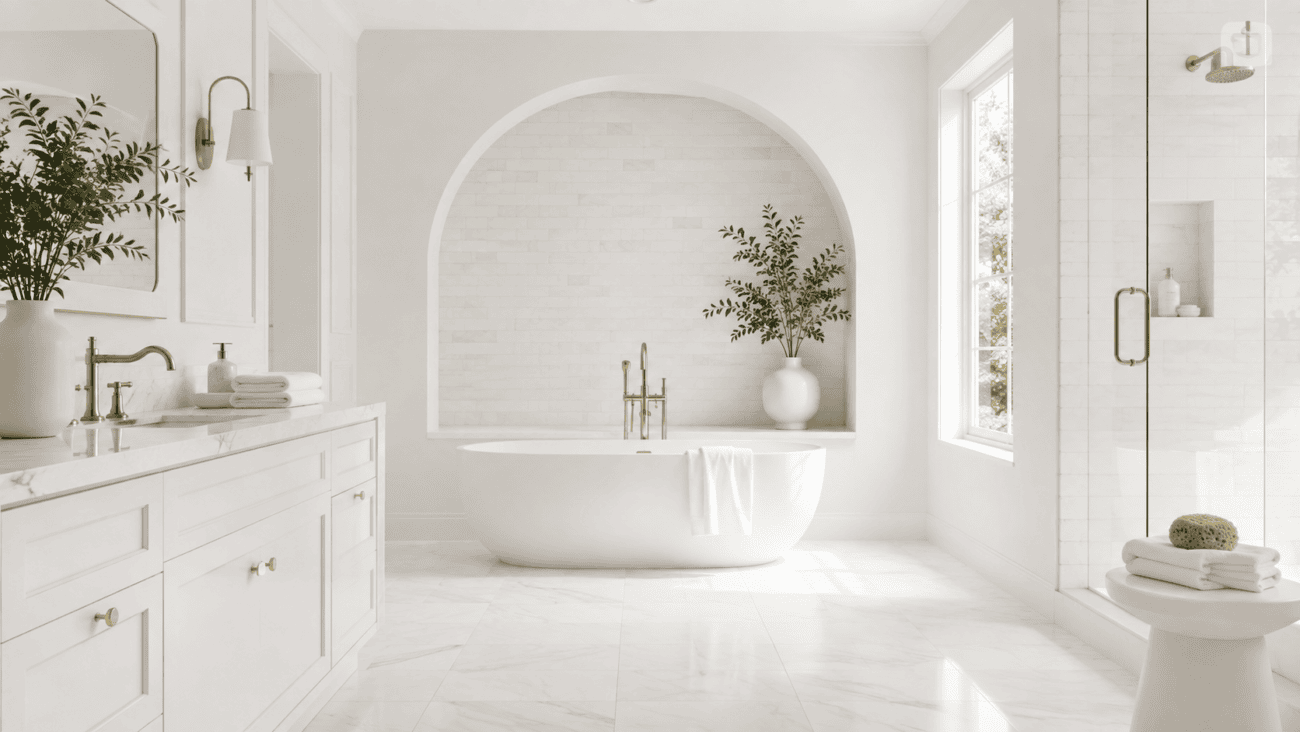
A few years ago, everyone wanted deep greens, moody blues and terrazzo everything in the bathroom. Bold was in. But scroll through any interiors feed in 2026 and you’ll notice that white bathrooms are back, and in a big way. The funny thing is, they never really left. White has always been the default for bathrooms, but there’s a difference between “default” and “deliberate.”
What’s changed is how people are using white now, with more thought given to texture, finish and material contrast than ever before. Stay with us as we get into why the all-white bathroom works so well, what stops it from feeling flat and where most people go wrong.
Why White Keeps Coming Back
Every decade has its colour trends for bathrooms. Avocado green in the seventies, peach in the eighties, grey everything in the 2010s. They all date themselves eventually. White doesn’t, and that’s a big part of its appeal. It won’t clash with a new floor tile or a different mirror frame five years down the line.
There’s also a psychological reason. White reads as clean, open and calm. In a small room like a bathroom, those three things matter a lot. A dark colour scheme can look stunning in a large space, but in a boxroom en-suite it’ll often make the walls close in. White bounces light around, and that makes even a compact bathroom feel bigger than it is.
Then there’s the resale angle. Estate agents will tell you that neutral bathrooms sell houses. Buyers can picture their own things in a white space. They can’t always do that with a bold teal feature wall.
How to Stop White From Feeling Clinical
This is where most white bathrooms fail. If everything is the same shade, the same material and the same finish, the room will look and feel like a hospital corridor. The trick is variation.
Start with the walls. A mix of finishes will give the room depth without adding colour. Matt tiles next to white wall cladding sheets in a satin or gloss finish, for example, will catch light differently and create subtle contrast across the surfaces. That contrast does a lot of the heavy lifting in an all-white scheme.
Think about texture on the floor too. A white hexagonal tile with a slightly rough surface won’t look the same as a glossy white large-format tile. Both are white, but the feel of the room will be completely different.
And don’t forget the grout. Matching grout colour to tile colour gives a seamless look. Going slightly off-white or light grey with the grout will make the tiles stand out more and add definition to the space.
Warm White vs Cool White
Not all whites are the same, and picking the wrong one is an easy mistake. Cool whites have a slight blue or grey undertone. They’ll look crisp in a bathroom with lots of natural light, but in a north-facing room with no window, they can feel cold and unwelcoming.
Warm whites lean towards cream, ivory or soft yellow. They’re more forgiving in low-light bathrooms and tend to pair better with natural wood, brass fittings and earthy accessories. If you’re going all-white, it helps to stick to one end of the spectrum rather than mixing warm and cool tones together. When you mix them, neither looks right.
A good test is to hold a sample against a piece of plain white paper. If there’s a visible difference, you’ve got a tinted white, and that’s fine as long as the rest of the room matches.
Where to Add Interest Without Adding Colour
An all-white bathroom doesn’t mean the room has to be devoid of character. Hardware is one of the easiest places to add contrast. Brushed brass taps, a matte black shower rail or even a simple chrome towel ring will all pop against a white backdrop.
Plants are another quick win. A trailing pothos on a shelf or a small fern on the windowsill will bring life into the room without breaking the colour scheme.
Mirrors deserve more thought than they usually get too. An oversized round mirror with a thin brass frame, for example, will become a focal point in a way that a standard rectangular cabinet mirror won’t.
- Brass or black fixtures for contrast against white surfaces
- Woven baskets or wooden shelves for warmth and texture
- Patterned towels in white-on-white or neutral tones for subtle layering
A White Bathroom That Actually Lasts
Trends are cyclical, and the bathrooms that hold up best are the ones that don’t lean too hard into any single moment. An all-white bathroom done with intention, where the finishes vary, the textures are considered and the details are carefully chosen, won’t feel tired in five or ten years. It’ll just feel like home.
