
The Changing Financial Dynamics of Fleet and Commercial Auto Maintenance
The commercial automotive sector is experiencing a massive shift in how operators approach asset lifecycle management. For decades, fleet managers and rental executives relied heavily on reactive maintenance, accepting cosmetic degradation and aftermarket repainting as inevitable costs of doing business.
However, modern fleet economics demands a more proactive strategy. Environmental factors like road debris, ultraviolet (UV) radiation, and chemical corrosion rapidly deteriorate factory paint, significantly impacting the TCO (Total Cost of Ownership). To combat this, the industry is transitioning rapidly toward preventive asset protection.
As the global auto detailing market scales toward enterprise-level operations, business success hinges on supply chain reliability and raw material integrity. Leading service providers increasingly bypass intermediary distributors to partner directly with a specialized FlexiPPF that provides premium TPU formulations and custom OEM specifications.
Securing a direct manufacturing partnership ensures consistent film thickness, optical clarity, and long-term warranty support without eroding profit margins. By integrating these advanced protective solutions at the acquisition phase, fleet operators are effectively freezing the exterior condition of their vehicles, securing higher valuation models at the end of the lifecycle.
Material Science in Action: Why TPU Outperforms Traditional Coatings
Understanding the superior economics of modern protective films requires a brief look into material science. Historically, automotive detailing shops relied on carnauba waxes, polymer sealants, and eventually ceramic coatings. While ceramic options offer chemical resistance, they fail to provide physical impact protection against rock chips or deep scratches.
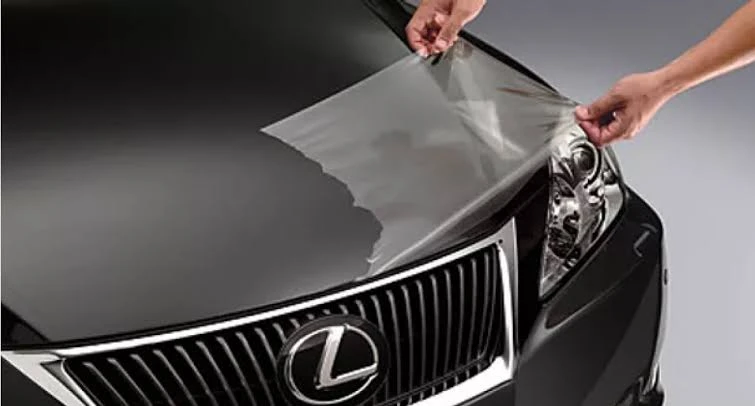
Modern paint protection films utilize Thermoplastic Polyurethane (TPU), an advanced elastomer that absorbs and dissipates impact energy. This molecular structure offers significant advantages over outdated PVC (Polyvinyl Chloride) films and liquid coatings. The core physical properties that make TPU essential for asset preservation include:
- Self-healing capabilities: The elastomeric topcoat responds to ambient heat or warm water by rearranging its polymer chains, effectively erasing micro-scratches and swirl marks without human intervention.
- Anti-yellowing technology: Premium films are engineered with advanced aliphatic polyurethanes that resist UV-induced oxidation, preventing the film from turning yellow or degrading over extended periods of sun exposure.
- Hydrophobic properties: The integration of a specialized Hydrophobic Topcoat repels water, environmental fallout, and chemical contaminants, significantly reducing the frequency and cost of fleet washing operations.
- Puncture resistance: The dense, multi-layered substrate acts as a highly resilient barrier, absorbing blunt force from gravel and road debris that would otherwise fracture the factory clear coat.
Calculating ROI: Mitigating Residual Value Loss in High-Mileage Vehicles
For commercial fleets and luxury auto investors, the justification for premium film installation is purely mathematical. Vehicles used for commercial transport or luxury rentals accrue high mileage quickly, which generally accelerates depreciation. Protecting the physical integrity of the vehicle is one of the few variables operators can control.
Advanced window tint and ceramic thermal rejection films also play a crucial role in operational efficiency. By drastically reducing infrared heat transfer into the cabin, these films lower the strain on automotive HVAC systems. For internal combustion engines, this translates to reduced fuel consumption; for electric vehicle (EV) fleets, it directly preserves battery range and lifecycle efficiency.
The most substantial financial return, however, is realized during asset liquidation. Vehicles with intact original factory paint command significantly higher resale values. According to established automotive economic resources detailing vehicle depreciation factors, cosmetic damage and repainted panels drastically reduce wholesale and retail pricing. A vehicle protected by PPF maintains its “factory-new” aesthetic, maximizing the residual value.
Future Trends & Supply Chain Optimization in Film Technology
The automotive aftermarket is evolving at a breakneck pace, heavily influenced by advancements in nanotechnology and automated installation processes. One of the most significant trends is the widespread adoption of digital OEM customized film cutting systems. These software-driven plotters eliminate manual blade-work on the vehicle, ensuring flawless application and saving countless labor hours for high-volume detailing shops.
Looking ahead, material scientists continue to refine elastomeric formulations to enhance the Hydrophobic Topcoat and thermal recovery speed. Originally developed during the military era to protect helicopter rotor blades from gravel erosion,modern paint protection films have evolved into high-tech, multi-layer polymer matrices that naturally self-heal under heat exposure.
As these technologies become more accessible, the barrier to entry for commercial adoption continues to drop. However, the varying quality of raw materials in the global market makes strategic vendor selection more critical than ever.
Key Takeaways
| Area | Key Takeaway | Impact/Data |
| Supply Chain | Partner directly with specialized TPU manufacturers | Bypasses markup; secures factory warranties |
| Surface Protection | Deploy self-healing TPU over legacy PVC/waxes | Absorbs gravel impacts; auto-heals scratches |
| Fleet Efficiency | Install ceramic heat-rejection window films | Reduces HVAC strain; preserves EV battery range |
| Resale Value | Protect original factory paint from acquisition | Prevents depreciation; boosts liquidation price |
| Shop Operations | Standardize on digital computer-cut plotters | Eliminates blade damage; reduces labor hours |
Strategic Sourcing for Automotive Service Providers
For automotive aftermarket service providers and enterprise fleet managers, optimizing the supply chain is paramount. Sourcing protective films is not just about finding the lowest price per roll; it is about mitigating liability and ensuring long-term product performance.
Purchasing managers must rigorously evaluate factory-level quality control (QC) standards and request comprehensive weather resistance testing reports. A reliable supplier should provide transparent data on adhesive tack stability, tensile strength, and clear-coat compatibility.
Furthermore, robust long-term warranty support from the manufacturer protects the service provider from liability related to delamination or adhesive failure. By partnering directly with technically capable manufacturers, detailing businesses can offer enterprise-grade warranties, scale their operations, and secure a dominant position in the B2B vehicle preservation market.
