
The jobs that need a trailer are smaller than people assume
Most Canadian households that buy a utility trailer are not hauling machinery. They are moving yard waste to the transfer station, bringing home a load of soil or paving stones, and shifting furniture twice a year, and a four by six deck covers all of it.
The appeal of a utility trailer is that these are exactly the loads that treat a vehicle badly. Wet garden waste, bagged soil, and scrap lumber leave a truck bed scratched and filthy, and they will not go in a car at all without ruining the interior.
Small is what makes it usable rather than limiting
A compact utility trailer is light enough that a mid-sized vehicle tows it without strain and short enough that reversing it into a driveway is a manageable skill rather than a weekend of practice. That combination is why it gets used. A large trailer sits unhitched because taking it out is an event, while a small one gets attached for a single trip to the garden center on a Saturday morning.
Loading is a balance problem before it is a volume one
The instinct is to fill from the back forward, and it is the wrong order. A load stacked toward the rear lifts weight off the coupler and lets the trailer sway behind the vehicle at speed. The heavy items go in first and sit slightly ahead of the axle, with lighter material filled in around them. That keeps a firm downward pressure on the hitch, which makes the trailer track behind the vehicle instead of steering it.
Anything loose will move, and moving loads are the danger
A load that shifts on the road changes the balance that was carefully set in the driveway, and it does so at the worst moment, usually mid-corner or during braking. Ratchet straps run over the load and down to the tie-down points are what prevent that, and they are tightened until the load and the trailer move as one object.
Light material needs covering more than heavy material needs strapping
Grass clippings, leaves, foam packaging, and cardboard weigh almost nothing, which means airflow at highway speed lifts them straight out of an open deck. A mesh cargo net or a tarp pulled over the top and tied down at the rails solves it, and in most places losing material onto the road is an offense as well as a nuisance.
A mesh deck and drop rails decide what loads on easily
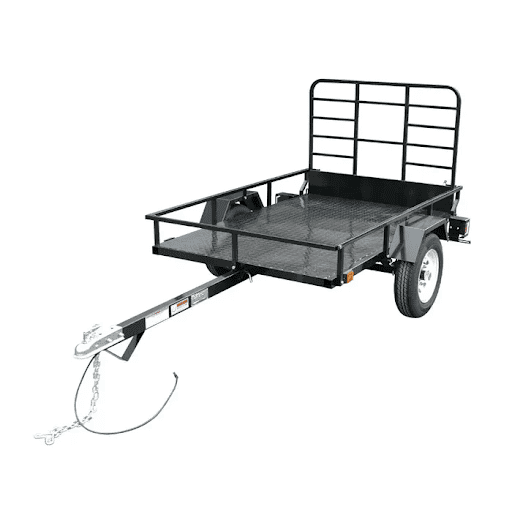
How material gets onto the deck matters as much as the deck itself, since a mower or wheelbarrow has to be rolled up rather than lifted over a rail. Sides that drop turn an awkward lift into a walk-up. An open mesh floor also lets rain drain straight through instead of pooling, which keeps a utility trailer from carrying standing water on top of whatever else is in it.
Where it lives between jobs is a real consideration
A utility trailer used a dozen times a year spends the rest of its life parked, and a four by six sits in the space a single car would occupy along the side of a house or at the back of a driveway. Standing it on end against a garage wall is common with trailers this size, and a cover keeps leaves and water out through the months it is not used.
The loading routine that keeps a trip uneventful
- Heavy first: place weight just ahead of the axle
- Strap it down: load and trailer move as one
- Cover light loads: netting or a tarp on top
- Walk around: check straps before pulling out
Where a small trailer wins and where it runs out
- Strength: keeps dirty loads out of the vehicle
- Strength: light enough to tow and to store
- Limit: a single axle suits modest payloads
- Limit: long material overhangs a short deck
Weighed against renting a utility trailer when needed, ownership costs storage space and a little upkeep, and returns the ability to decide on a Saturday morning that today is the day the yard waste finally goes. Anyone who has waited on a rental counter on a Saturday morning understands that difference.
Households keep taking on jobs they once paid to have hauled
As delivery and disposal fees climb, owners increasingly move their own material rather than paying for a truck to do it, and the equipment that suits that shift is small enough to live at a suburban house. A compact deck is the version of that capability a suburban lot can accommodate.
That change in what people handle themselves is why the towing equipment that TMG Industrial supplies runs down to decks a family car can pull.
