
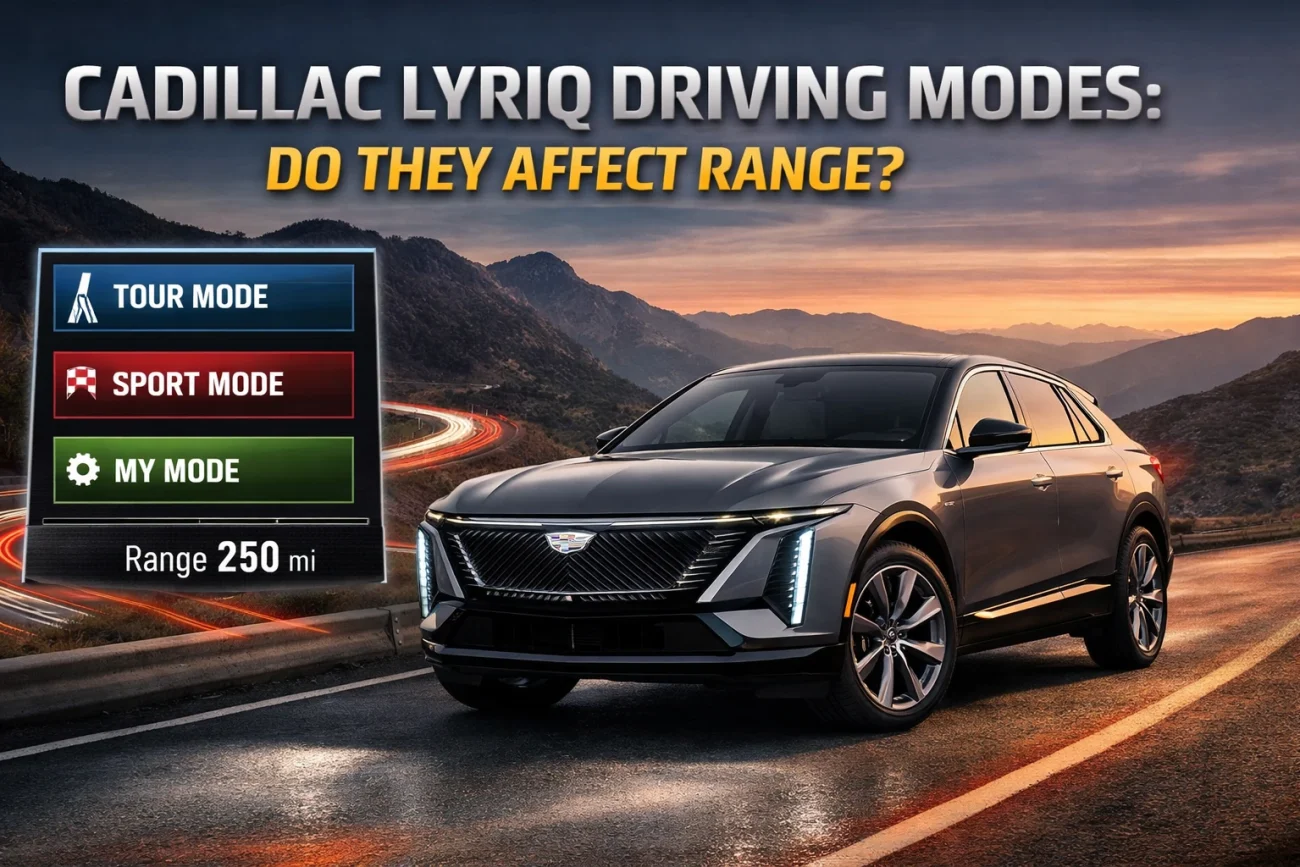
Most electric vehicle buyers expect a simple answer to a simple question: if a car has multiple driving modes, one of them must deliver better range. With the Cadillac Lyriq, that assumption isn’t quite right. The modes don’t come with separate official mileage ratings, and they don’t change the battery itself. But they do influence how the vehicle behaves, and that behavior can quietly shape how far you actually travel on a charge.
That’s where confusion starts. Owners switch from Tour to Sport, watch the range estimate shift, and assume the mode itself has a fixed “range penalty.” What’s really happening is more subtle, and more interesting. If you’re trying to get the most out of your Lyriq’s battery—or just understand what your dashboard is telling you—this is worth unpacking carefully.
What Cadillac officially says about driving modes and range
Cadillac keeps its messaging around drive modes fairly straightforward. The Lyriq offers Tour, Sport, Snow/Ice, and a customizable My Mode, and the company describes them as ways to adjust the “overall driving experience.” That phrasing matters because it avoids promising any direct change to range or battery capacity.
Instead, official range figures are tied to hardware. For the 2025 Cadillac Lyriq, the Environmental Protection Agency lists up to 326 miles for rear-wheel-drive models and up to 319 miles or 303 miles for different all-wheel-drive configurations. Those numbers are based on drivetrain and equipment, not which mode you select on a given day.
But here’s the thing. Cadillac’s own owner’s manual quietly acknowledges that performance modes can affect the vehicle’s range estimate. It also points out that acceleration habits, climate control use, and driving conditions all play a role. So while the company doesn’t assign a specific mileage number to Sport or Tour, it clearly expects those modes to influence real-world energy use.
Why driving modes don’t change battery size—but still affect range
At a technical level, the Lyriq’s battery doesn’t care which mode you choose. The SUV uses a battery pack rated around 102 kWh, and that capacity doesn’t expand or shrink when you rotate through modes. There’s no hidden “eco reserve” or performance buffer tied to a specific setting.
So what actually changes? It comes down to how energy is used. Range in an EV is simply the result of how efficiently the vehicle converts stored electricity into motion. If a mode encourages quicker acceleration, firmer throttle response, or more aggressive driving behavior, the vehicle will draw more energy per mile.
Think of it like fuel economy in a gasoline car. Two drivers can use the same engine but get very different mileage depending on how they drive. The Lyriq works the same way, except the feedback is immediate. The dashboard’s range estimate updates based on recent driving patterns, so even a short period in a more aggressive mode can shift what the car predicts.
How each Lyriq driving mode influences energy usage
Tour mode: the baseline for everyday efficiency
Tour mode is Cadillac’s default setting, and it’s designed to balance comfort, responsiveness, and efficiency. If you’re driving through mixed city and highway conditions without pushing the vehicle hard, this is the mode most likely to reflect the official range expectations.
What makes Tour effective isn’t magic. It simply avoids extremes. The accelerator response is smooth, the steering is neutral, and the vehicle doesn’t encourage sudden bursts of speed. For most drivers, that leads to steadier energy consumption and more predictable range estimates.
In practice, many owners treat Tour as their “control group.” If you’re experimenting with different modes, this is the one to compare against because it represents Cadillac’s intended everyday behavior.
Sport mode: sharper response, higher energy demand
Switching into Sport mode changes the character of the Lyriq almost immediately. The accelerator becomes more responsive, steering tightens, and the vehicle feels more eager to move. That can make the SUV more engaging to drive, especially on open roads or during quick merges.
Here’s where it gets interesting. Sport mode doesn’t force you to use more energy, but it makes it easier to do so. A more sensitive throttle means even small inputs can lead to quicker acceleration, and repeated bursts of speed add up in terms of energy consumption.
Drivers who enjoy that responsiveness often see a noticeable drop in projected range, especially in stop-and-go conditions. But if you drive gently even in Sport, the difference can be smaller than expected. The mode sets the tone, but your driving still decides the outcome.
Snow/Ice mode: traction over efficiency
Snow/Ice mode serves a completely different purpose. It softens throttle response and adjusts how power is delivered to improve traction on slippery surfaces. On all-wheel-drive models, it also changes how the front and rear motors work together.
This isn’t an efficiency mode, and Cadillac doesn’t present it that way. In fact, using Snow/Ice on dry pavement can feel sluggish and may not improve energy use at all. The goal here is stability and control, not maximizing miles per charge.
That said, smoother power delivery can reduce wheelspin in poor conditions, which might help avoid wasted energy in those scenarios. But the bigger story is safety. If roads are icy or wet, Snow/Ice mode is the right choice regardless of any minor impact on range.
My Mode: customizable, unpredictable outcomes
My Mode is where things get more personal. Cadillac lets drivers adjust acceleration feel, steering weight, braking response, and even interior sound. That flexibility means My Mode doesn’t have a single identity.
If you configure it with relaxed acceleration and softer responses, it can behave similarly to Tour and support efficient driving. On the other hand, if you dial everything toward Sport-like behavior, it will likely consume more energy.
So what does this actually mean? My Mode is only as efficient as the settings you choose and how you drive afterward. It’s a tool, not a fixed solution, and its effect on range varies from one driver to another.
Why your range estimate changes when you switch modes
One of the most common questions Lyriq owners ask is why the range number on the dashboard shifts after changing modes. It can feel like the car is “losing” miles instantly, even though the battery percentage hasn’t dropped.
The answer lies in how the estimate is calculated. The Lyriq uses recent driving data to predict how far you can go. If you switch into a mode that leads to more aggressive acceleration, even briefly, the system recalculates based on that higher energy use.
That doesn’t mean the battery suddenly drained faster in that moment. It means the car expects you to continue driving in a similar way. If you return to calmer driving, the estimate can recover just as quickly.
This dynamic behavior is intentional. Cadillac wants the estimate to reflect real conditions, not a fixed theoretical number. It can be frustrating at first, but it’s actually more honest than a static range display.
This transparency is exactly why modern electric vehicles are becoming so popular, particularly for professionals looking to maximize their value. Driving an advanced EV like the Lyriq becomes an even sweeter deal when you secure a salary sacrifice through an employer scheme. This type of arrangement lets you pay for the vehicle from your gross salary before tax, meaning you save significantly on income tax and National Insurance while hitting the road with cutting-edge range management technology.
Other factors that matter more than drive modes
Focusing only on drive modes can miss the bigger picture. In most cases, other factors have a larger impact on range than the mode selector.
Speed is one of the biggest influences. Driving at highway speeds increases aerodynamic drag significantly, which means the vehicle uses more energy to maintain momentum. Even in Tour mode, sustained high speeds can reduce range far more than switching into Sport for short bursts.
Climate control is another major factor. Heating and cooling the cabin draws energy from the same battery that powers the motors. On very hot or cold days, this can noticeably reduce available range, especially during longer trips.
Then there’s driving style. Rapid acceleration, frequent braking, and stop-and-go traffic all increase energy use. Cadillac’s own guidance emphasizes smooth driving, steady speeds, and planning ahead for stops as the most effective ways to extend range.
If you are planning a longer trip, you may also click here to compare tyre options and make sure your vehicle is prepared for changing road conditions and safer long-distance travel.
Regenerative braking and One-Pedal Driving
Many Lyriq owners also wonder how regenerative braking fits into the equation. While it isn’t technically a drive mode, it plays a key role in how efficiently the vehicle uses energy.
One-Pedal Driving allows the car to slow down using regenerative braking when you lift off the accelerator. This process captures some of the energy that would otherwise be lost as heat and feeds it back into the battery.
Cadillac’s manual suggests that using One-Pedal Driving when appropriate can improve efficiency, especially in urban environments with frequent stops. There’s also a Regen on Demand paddle that lets you increase regeneration manually.
There’s a catch, though. Regenerative braking isn’t always at full strength. It can be limited when the battery is nearly full or when temperatures are low. That means the benefit varies depending on conditions, which is another reason range isn’t tied to a single setting or mode.
Common misconceptions about Lyriq driving modes and range
One misconception is that the Lyriq must have an “eco mode” hidden somewhere in its settings. It doesn’t. Cadillac relies on Tour and customizable My Mode to cover efficiency-focused driving rather than offering a dedicated Eco label.
Another misunderstanding is treating the range estimate as a promise. It’s not. It’s a prediction based on recent behavior, and it can change quickly if your driving style changes.
Here’s what most people get wrong. They assume the mode itself is the main driver of efficiency, when in reality it’s just one piece of a larger puzzle. Your habits, the environment, and the vehicle’s configuration all play a bigger role than the label on the screen.
Practical advice for getting the most range
If your goal is to maximize range, the approach is surprisingly simple. Stick with Tour mode or a relaxed My Mode, accelerate smoothly, and avoid unnecessary bursts of speed. That alone can make a meaningful difference.
Pay attention to climate settings as well. Using seat heating or ventilation instead of blasting the entire cabin can reduce energy use, especially in extreme temperatures. Small adjustments like these often add up over the course of a drive.
And don’t ignore the car’s own data. The Lyriq provides detailed energy usage screens that show where power is going. Watching those trends over time will teach you far more than switching modes back and forth without context.
Frequently Asked Questions
Do Cadillac Lyriq driving modes change official range ratings?
No, they don’t. Official range ratings are based on the vehicle’s configuration, such as rear-wheel drive or all-wheel drive, and are certified through EPA testing. Driving modes influence behavior but don’t have separate published mileage figures.
Does Sport mode always reduce range?
Usually, yes in real-world driving. Sport mode makes acceleration more responsive, which often leads to higher energy use. But if you drive gently even in Sport, the difference can be smaller than expected.
Which mode is best for maximizing range?
Tour mode is generally the safest choice for efficiency. A carefully configured My Mode with relaxed settings can also work well, but it depends on how you set it up and how you drive.
Does Snow/Ice mode improve battery efficiency?
Not really. Snow/Ice mode is designed for traction and control on slippery roads, not for saving energy. Its impact on range depends on conditions rather than offering a consistent benefit.
Why does my range estimate drop after switching modes?
The estimate is based on recent driving behavior. If a mode leads to more aggressive acceleration, the system predicts higher energy use and adjusts the projected range accordingly.
Does One-Pedal Driving increase range?
It can help, especially in stop-and-go traffic. Regenerative braking recovers some energy during deceleration, but the benefit depends on driving conditions and battery state.
Conclusion
Driving modes in the Cadillac Lyriq don’t rewrite the rules of range, but they do influence how those rules play out. The battery stays the same, the official numbers don’t change, and yet your real-world experience can shift depending on how the vehicle responds to your inputs.
What matters most isn’t the label of the mode but the behavior it encourages. Sport invites quicker acceleration, Tour supports balance, and My Mode reflects your own preferences. The difference shows up not in the battery itself, but in how quickly you use what’s stored inside it.
If you’re trying to stretch every mile, focus on smooth driving, moderate speeds, and thoughtful use of climate controls. The mode you choose should support that goal, not replace it. And as EV technology continues to evolve, expect these systems to become even more adaptive, shaping efficiency in ways that go beyond a simple switch on the dashboard.
