
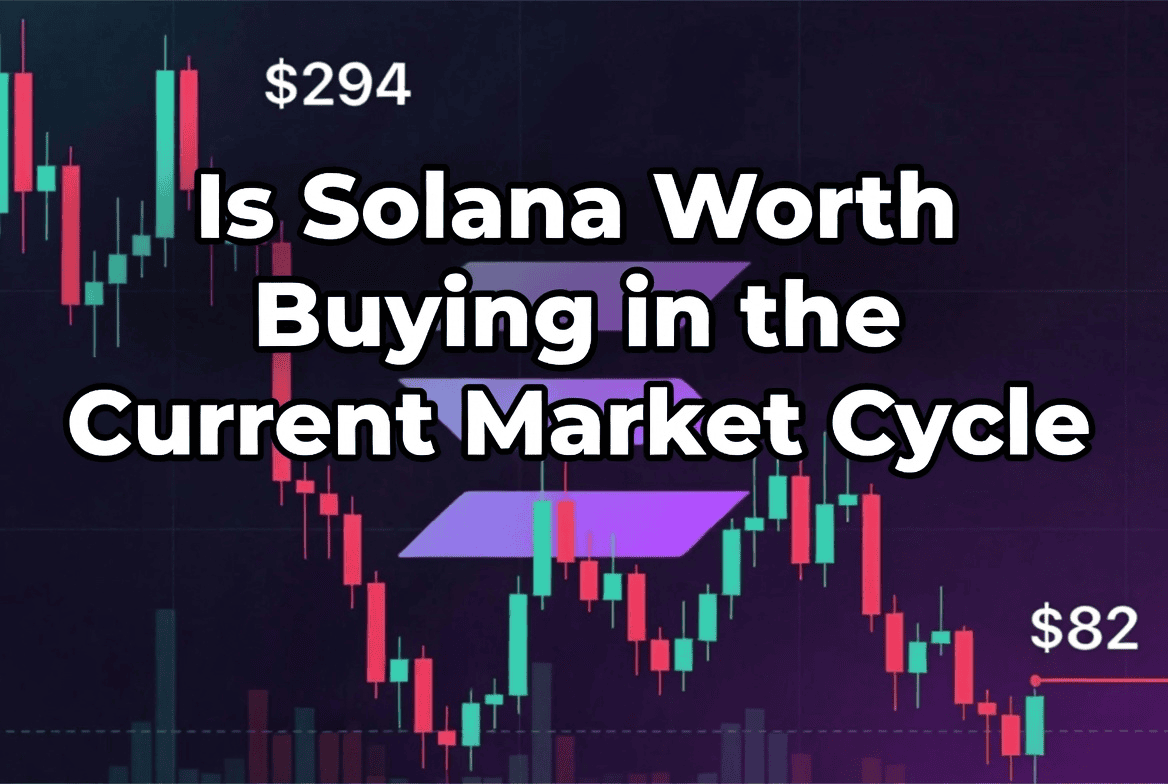
Solana has one of the more dramatic track records in crypto. It went from near-zero credibility after the FTX collapse in 2022, when SOL fell to around $10, to an all-time high near $294 in early 2025. It then gave back more than half of those gains.
As of late May 2026, SOL is trading around $82, sitting roughly 72% below its peak. The question most investors are asking right now is whether this is a buying opportunity in an ongoing bull cycle or the beginning of a longer consolidation. To answer that properly, you need to understand what Solana actually is, how it performed, and what the risks look like from here.
What Makes Solana Different From Other Blockchains
Solana’s technical foundation is what separates it from older networks. It uses a hybrid consensus model combining Proof of Stake with a proprietary mechanism called Proof of History, which creates cryptographic timestamps for each transaction. This allows the network to process transactions in parallel rather than sequentially, which is how Solana achieves throughput that older blockchains cannot match.
In practice, the network handles around 1,000 to 4,700 transactions per second under real-world load, with a theoretical ceiling above 65,000 TPS. Transaction fees remain fractions of a cent even during heavy usage. For comparison, Ethereum processes 15 to 30 TPS at much higher cost. That performance gap is what makes Solana the preferred chain for high-frequency applications like decentralized exchanges, gaming, and payment infrastructure.
The ecosystem numbers reflect genuine adoption. In 2025, the Solana network generated roughly $1.4 billion in protocol revenue and applications on the chain produced another $2.39 billion. DEX trading volume on Solana reached $95 billion in February 2026 alone, with around $4 billion in average daily spot volume. The network is not a speculative ghost chain. It is handling real traffic.
What Happened to the Price and Where It Stands Now
SOL peaked at around $294 in early 2025, carried by Bitcoin’s halving cycle, institutional interest, and the launch of Solana spot ETFs in late 2025. Bitwise and Fidelity both launched Solana ETF products, and total assets across these funds surpassed $1 billion relatively quickly. That institutional on-ramp was a genuine structural development, not just sentiment.
The Q4 2025 correction was sharp. SOL fell roughly 39% in that quarter, ending the year around $125 to $138 as the broader market turned risk-off. The slide continued into 2026. As of late May 2026, SOL is trading around $82, sitting near the top of what analysts describe as a historical accumulation zone between $80 and $100.
The table below captures the key price and network metrics at the current point in the cycle:
| Metric | Current value (May 2026) |
| SOL price | ~$82 |
| All-time high | ~$294 |
| Distance from ATH | ~72% below |
| Market cap | ~$47-49 billion |
| Rank by market cap | #7 |
| Circulating supply | ~578 million SOL |
| Average daily DEX volume | ~$4 billion |
| DeFi TVL | $8-10 billion |
| Solana ETF AUM | >$1 billion |
What the Bull Case Looks Like
The bull case for SOL rests on a few specific pillars. For investors wondering is Solana a good investment at current prices, the network’s performance metrics are the most reassuring data point. Daily active wallets stayed around 3.2 million, developer count exceeded 15,000 active contributors, and fee revenue remained substantial. These are signs of a network that retained users and builders even as the token price fell.
Second, the institutional entry through ETFs changes the supply-demand dynamic structurally. When regulated products with custody solutions exist, capital that previously could not enter crypto now can. The $1 billion-plus already in Solana ETFs is the early stage of that flow, not the peak.
Third, Solana passed Ethereum in total real-world asset holders in March 2026, with tokenized asset value on the network exceeding $2 billion. The RWA narrative is one of the few crypto use cases with clear institutional demand and regulatory backing, and Solana is winning market share there.
The Risks That Could Derail the Trade
No investment case is complete without an honest look at what can go wrong. Solana has a history of network outages, though recent upgrades have significantly reduced their frequency. The 2022 FTX collapse demonstrated how exposed SOL was to a single counterparty: FTX and Alameda Research held and sold large amounts of SOL, which amplified the drawdown dramatically.
Competition from Ethereum and its Layer 2 ecosystem remains real. Ethereum has the largest developer community and the most institutional familiarity. If Ethereum’s scaling solutions close the performance gap further, Solana’s technical advantage shrinks. Aptos, Sui, and other high-throughput chains are also competing for the same DeFi and gaming use cases.
The broader crypto cycle dependency is unavoidable. SOL does not trade independently of Bitcoin. In risk-off environments, it falls faster and further than BTC, which is typical for altcoins. If Bitcoin enters an extended consolidation or decline, SOL will follow.
Conclusion
Solana at $82 is a fundamentally different proposition from Solana at $294. The network is more mature, ETF infrastructure now exists, institutional awareness is higher, and the price is sitting 72% below the all-time high with genuine on-chain activity supporting it. That does not make it risk-free or guaranteed to recover. The volatility is real, the competition is real, and the cycle dependency on Bitcoin is real. For anyone considering exposure, the honest framework is to treat it as a high-risk, high-volatility asset within a broader portfolio, size the position accordingly, and have a clear exit plan in both directions before entering.
