
Today, trampoline are used everywhere, from private gardens and fitness centres to professional sports. However, they were not always used for fun. Moreover, trampolines have a long history of use, in which they have served not only for entertainment but also for training and even for purposes that may seem surprising at first glance. So what was the first trampoline uk, and where did the idea of jumping on a stretchy surface come from? Let’s take a look at the history of the invention of the trampoline.
Did you know that the trampoline you occasionally see someone using in a garden somewhere has had multiple purposes? First, it was a training device for gymnasts, then it was used to prepare astronauts for landing on the moon! This amazing equipment eventually evolved into what we know now as an Olympic sport. How cool is that?
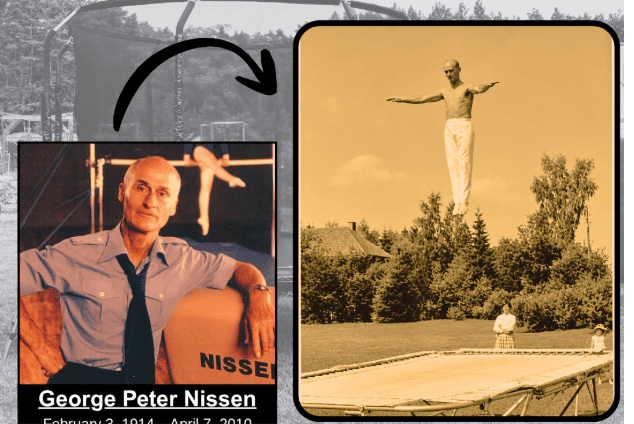
A gymnast, George Nissen, in Iowa in the 1930s, put together a few pieces of scrap iron, some canvas, and many old rubber inner tubes. He came up with a creation that would lead to an Olympic sport and become a staple in school gymnasiums, a rehabilitative exercise for physiotherapists, and the most popular garden gadget in Britain.
If you’ve ever wondered how a bouncy mat on springs became an astronaut training tool and a fighter pilot’s aid, then you’ve come to the right place. We’ll take you through the whole fascinating history of invention and development behind the best trampoline UK. We’ll explore its uses, from serious sports to simple fun, its design development, the differences between the types of trampoline available, and the accessories you need to get the most from it. We will also take a look at the safety improvements and how trampoline safety has evolved over the lifetime of the equipment.
The Fascinating Story Behind the Trampoline
The trampoline didn’t start life as an idea that somebody thought up one day and then went away and built. The truth is far more interesting, as there is more than one claimed ‘inventor’, and experts disagree on which one might have had the bigger part in the development of the product. It is known that circus performers used to jump from stretched safety nets to catch other circus performers, and this helped inform their ideas behind the creation of a bouncing device. Some historians even believe that it was Inuit tribespeople who used to toss each other into the air using stretched animal skin as a means of celebration, although this is less frequently agreed upon, and many regard it as doubtful.
It is, however, known that early twentieth-century trapeze artists would use the safety nets that had been put in place to catch them if they fell as a springboard and that some of their moves would evolve directly from this.
Who Invented the Modern Trampoline?
The rectangle trampolines that we know today was the result of the work of a single gymnast, George Nissen. Nissen, who was studying at the University of Iowa, was inspired to create the product after seeing acrobats in a circus bounce off their safety nets. He thought that the ability to do similar movements would be a great boon to gymnasts, and so he set about constructing something to allow them to perform similar movements. He worked on this development with his gymnastics coach, Larry Griswold, and in the early 1930s they created the prototype for a modern trampoline. Nissen would go on to patent the design, and, as legend has it, the word ‘trampoline’ itself was invented by him and comes from the Spanish word ‘trampolín’, meaning ‘diving board’.
The reason behind the development was simple – gymnasts needed a way to practise their acrobatics, which required them to be launched into the air several times per practice.
How the First Trampoline Was Built
Materials Used
Angle iron formed the skeleton of George Nissen’s original trampoline, over which canvas was stretched and attached using recycled springs.
Challenges During Development
The early trampoline development was fraught with challenges, as getting the right spring tension to allow a safe and effective bounce proved incredibly difficult. Nissen and Griswold had to go through numerous iterations before they managed to create a trampoline that was safe and effective.
The First Successful Bounce
According to the majority of sources, the successful prototype was built in 1936, and soon Nissen was demonstrating his invention to gymnastic clubs and subsequently marketing it. The novelty of ‘bouncing’ appears to have seen the sport grow considerably throughout the United States in the years that followed its introduction.
How the Trampoline Has Evolved Over the Decades
1930s–1940s: The Early Years
The 1930s and 1940s saw the first trampolines being purchased and used primarily by gymnasts. Nissen would eventually take his invention to market in an effort to introduce it to more people, and in doing so, he would invent the modern-day trampoline.
Military and Pilot Training
As the Second World War broke out, the US Navy and Army Air Corps began using trampolines as a means of training pilots to better understand spatial orientation.
NASA’s Use of Trampolines
NASA also used trampoline training for astronauts, helping them to get used to disorientation and movement in space.
Schools and Gymnastics Clubs
Throughout the 1950s and ’60s, the trampoline became a fixture in school PE classes and gymnastics clubs as a means of teaching students body awareness and building confidence.
The Rise of the Backyard Trampoline
The backyard’s best garden trampoline and outdoor trampoline were the result of decreased manufacturing costs in the 1970s and 80s, but there were also significant safety concerns during this time.
Commercial Trampoline Parks
The 2010s saw the rise of commercial trampoline parks, which saw the sport take on a new leisure and entertainment-focused role.
Modern Fitness Revolution
Fitness influencers have driven an explosion in the popularity of rebounding on a mini trampoline as a fun, low-impact alternative to traditional cardio.
The Different Types of Trampolines Available Today
Above-ground Trampolines
Above-ground trampolines tend to be the most popular in the UK, as they are generally more affordable than their in-ground counterparts. They are usually placed on top of the ground using legs and are simple to set up. Above-ground trampolines can be enjoyed by children and adults alike, provided that there is a suitable enclosure to prevent users from flying off the edge of the jumping area.
In-ground Trampolines
In-ground trampolines, or in floor trampoline, are buried into the ground so that the jumping surface is level with the surrounding ground. They generally have better safety credentials than above-ground trampolines, as there is no risk of falling off the edge of the structure. However, they require a more complicated installation process and have more specific drainage requirements.
Flatground Trampolines
Flatground trampolines are the latest addition to the in-ground trampoline family and offer similar benefits to their fully buried cousins without requiring the owner to dig up their garden.
Mini Trampolines
Mini trampolines are smaller and generally intended for use indoors. They are often used by families with young children, as they provide a good value option which can allow kids to expend energy on a rainy day.
Rebounders
Rebounders are designed for fitness purposes and often recommended by physiotherapists as a means of low-impact rehabilitation. Many physiotherapists recommend that people who suffer from poor ankle or knee function use a rebounder as part of their rehabilitation. The reduced impact offered by a rebounder trampoline can make it much easier to exercise without putting undue stress on the joints.
Professional and Competition Trampolines
Professional-grade competition trampolines are much larger and use higher tension to allow competitors to jump to much greater heights. They are generally not available for purchase by the general public.
Trampolines aren’t just a thrill—they’re a transformative tool in today’s leading play centres, deliberately integrated to fuel both physical mastery and cognitive growth. Far beyond mere entertainment, consistent trampoline use sharpens balance, hones coordination, builds muscular strength and deepens spatial awareness with every bounce. This dynamic form of movement doesn’t just activate the body—it ignites confidence, drives sustained engagement, and fosters real, meaningful connections among children through the power of active, shared play.
How Trampoline Design Has Improved Over Time
Stronger Frame Pads
Modern trampoline frame pads are made from stronger, more durable materials.
Better Springs
The trampoline spring used in most modern trampolines are generally far superior to those used in the early days of the product’s life. They are often weather-resistant and so do not suffer from the same issues of deterioration as those used in the early 20th century.
Higher Performance Mats
The woven polypropylene mats utilised in most modern trampolines are far better than the canvas ones used exclusively in the early days of the product’s life. They offer a much better degree of performance and durability.
UV Resistance
The mats and covers used in modern trampolines tend to utilise materials that are more resistant to UV light than those used in the past, which meant that older mats tended to degrade after only a few years of use.
Longer Lifespan
Modern trampoline components are generally made to much higher standards and so tend to last longer than their predecessors.
Trampoline Accessories That Improve Performance and Safety
Socks
Trampoline socks can help to improve grip and hygiene on your trampoline and are often required in indoor trampoline parks.
Safety Enclosures
Nets are one of the most important trampoline spares for a trampoline, as they prevent users from bouncing off the edge of the jumping surface and falling to the ground.
Ladders
Ladders make it much easier for younger children to get on and off the trampoline. They can also be useful for in-ground trampolines.
Weather Covers
Weather covers are essential for anyone who wants to prolong the lifespan of their trampoline. By preventing moisture from getting to the jumping surface, they reduce the risk of rot and decay.
Anchor Kits
Anchor kits stop the trampoline from moving or shifting during strong winds, which can be much more of a problem than you might think.
Spring Covers
Spring covers are useful for protecting your hands and feet from the sharp edges of the springs on your trampoline.
Replacement Jump Mats
Jump mats should be replaced every few years as a matter of course.
Basketball Hoops and Other Accessories
There are a variety of fun accessories that can be added to your 10ft trampolines, such as basketball hoops. They can make your trampoline much more enjoyable without compromising your safety.
Why Has Trampoline Safety Improved So Much?
Earlier Safety Challenges
Trampoline safety has come a long way over the last century, but it was not always the case. Early backyard trampolines had a number of inherent safety challenges that are much less of a concern today.
Modern Safety Standards
Modern-day trampolines are generally much safer than their predecessors. Most trampolines sold in the UK are manufactured to British Standards, which means that they have been tested and approved to meet the appropriate standards for domestic use. Reputable retailers will also make mention of RoSPA (Royal Society for the Prevention of Accidents) guidelines for garden trampoline safety.
Choosing the Right Accessories
A trampoline without a safety enclosure is not the same product as one that has one. If you are purchasing a trampoline for your children to use, then enclosure nets should be non-negotiable.
Simple Maintenance Tips
There are several simple steps that can be taken to reduce the likelihood of accidents occurring on your trampoline, such as checking the condition and tension of your trampoline’s springs at the start of each season.
How Did Trampolining Become an Olympic Sport?
Early Competitive Events
Competitive trampolining soon began to develop after the introduction of the sport, with early competitions taking place in the United States in the late 1940s and early 1950s. These competitions were instrumental in developing the rules and structure of the sport, and they allowed many future Olympic competitors to hone their skills.
International Recognition
The sport began to gain greater recognition around the world during the 1960s and 1970s, eventually leading to its adoption by the International Gymnastics Federation in 1999.
The First Olympics
Trampoline gymnastics made its debut at the Sydney 2000 Olympic Games, which marked the beginning of its rise as a global sport.
Olympic Trampoline Events Today
Individual trampoline events continue to be a large part of Olympic gymnastics, with both men’s and women’s competitions taking place. Each competitor has one attempt at the compulsory and one at the optional routine, with the time spent in the air being an important factor.
Famous Olympic Trampoline Athletes
Britain has produced some truly wonderful trampoline gymnasts throughout the sport’s history, including Bryony Page, Izzy Songhurst, and Corey Walkes. British athletes have had regular success at the Olympics and World Championships throughout this time.
Trampolines Are Used Beyond Recreation
Trampolines have found their way into the odd places you might not have expected. The equipment is used in domestic settings, as well as being a feature of physiotherapy practices. They have been used to help rehabilitate those suffering from joint problems as well as being utilised in children’s development and motor skills clinics. Their use extends to military and NASA training programmes as well as being a feature of sport and recreation and even continuing to be used to help train astronauts.
If you are hosting a birthday party in Exeter, a well-maintained trampoline can make the event a lot more enjoyable for the children and be as important for their parents.
The Future of Trampolines
The future for the trampoline looks bright, as manufacturers work to develop new products to suit a diverse range of needs. More and more companies are looking to produce smart trampolines that offer more performance and functionality, as well as working to create more eco-friendly products.
The leisure industry is seeing a boom in interactive fitness equipment, and there are already a number of examples of screen-based trampoline training becoming available to the consumer.
Some companies have begun to work on using artificial intelligence to coach users on their technique in real-time. This same technology is being utilised in the development of new safety technologies, such as smart mats that can sense when a user has landed incorrectly.
As an industry, trampolines and their accessories have plenty of future innovation left ahead of them.
As trampoline technology advances, the improvements it brings to the experience are making this pastime even more fun. See why trampoline parks have become a popular spot for people of all ages to have fun and enjoy an active adventure.
Interesting Facts About Trampolines
- The word comes from the Spanish for diving board.
- It has been used by astronauts at NASA.
- It has featured in the Olympics since 2000 and has had over sixty years of development since its invention.
- The best trampoline gymnasts routinely jump to heights of eight metres.
- Trampoline parks are set to be one of the fastest-growing leisure industries in the UK and worldwide.
Conclusion
From the humble beginnings of a single inventor’s curiosity, the trampoline has gone on to change the world. It has been used in ways that its creator could barely have imagined, touching the lives of people all around the globe. As you consider which type of trampoline is right for you, keep in mind just how much this piece of equipment has impacted the world. Whether you are looking to try out a new fitness regimen or are seeking to get more out of your trampoline, you are sure to find something to suit your needs in our comprehensive guide.
