
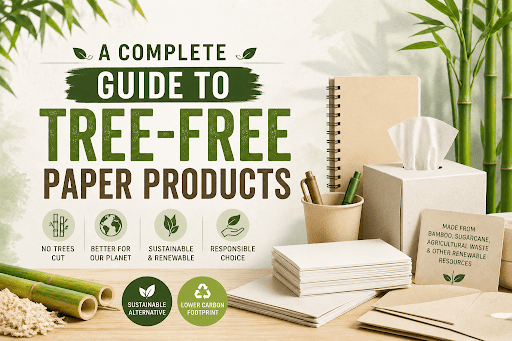
Why are people talking about paper without trees?
Paper has been part of everyday life for centuries. We use it without giving it much thought. From tissues and notebooks to kitchen rolls and packaging, paper surrounds us every day. Yet very few people stop to ask a simple question. Does paper always have to come from trees?
That question is becoming more important as people learn more about forests, natural resources and the growing demand for paper products. Every year millions of tonnes of paper are produced around the world. While responsible forestry has improved in many places, there is also growing interest in finding materials that reduce the need to rely on trees alone.
This is where Tree Free Paper Products enter the conversation. They offer a different approach by using fast-growing plants and agricultural fibres instead of traditional wood pulp. They are no longer unusual products found in small eco-friendly shops. Today they are becoming part of everyday life in homes, offices and businesses across the UK.
What are Tree Free Paper Products?
The name sounds straightforward, but many people are still unsure what it actually means.
Tree Free Paper Products are paper items that are manufactured without using wood from trees as their main raw material. Instead, manufacturers use fibres taken from plants that grow much faster or from materials that would otherwise become waste.
Some of the most common sources include bamboo, sugarcane residue, wheat straw, hemp and recycled cotton fibres. These plants produce usable fibres that can be processed into paper with qualities similar to traditional paper products.
The idea is not to replace every tree-based paper product overnight. Instead, it provides another option that helps reduce pressure on forests while making use of renewable resources that regenerate much more quickly.
Why is traditional paper no longer the only option?
For many decades wood pulp was the obvious choice because forests provided a reliable source of fibre. Technology was also developed around processing timber, so paper production naturally followed that route.
Things have changed during the last twenty years.
Consumers now pay closer attention to where products come from. They want to know how materials are sourced and whether better alternatives exist. Businesses have also started looking for ways to reduce their environmental impact without sacrificing quality.
As a result, manufacturers began investing in different plant fibres that could produce strong, soft and reliable paper while reducing dependence on slow-growing trees.
Bamboo has become one of the leading alternatives
Among all tree-free materials, bamboo has received the most attention.
Unlike many tree species that need decades before harvesting, bamboo reaches maturity within just a few years. After harvesting, new shoots grow naturally from the same root system without needing to be replanted. This continuous growth cycle makes bamboo an attractive renewable resource.
Its fibres are also naturally long and strong. This allows manufacturers to create paper products that remain durable while still feeling soft enough for everyday use.
These qualities explain why bamboo has become one of the most recognised materials in modern paper manufacturing.
Bamboo grows differently from trees
One reason bamboo attracts attention is its growth pattern.
Trees grow slowly and require many years before they can be harvested responsibly. Bamboo behaves more like grass than a tree. New stems appear every growing season while the underground root system remains alive.
Because harvesting does not remove the entire plant, production can continue without starting from scratch each time. This creates a steady supply of raw material while reducing land disturbance.
That does not mean bamboo has no environmental impact. Farming, transportation and processing still require careful management. However, its rapid growth offers clear advantages over slower growing timber sources.
How tree-free paper is made
Many people imagine that plant fibres simply become paper after being pressed together. The process is more detailed than that.
First, fibres are separated from the plant material. They are then cleaned, refined and turned into pulp. This pulp is mixed with water before being spread into thin sheets. Finally, the sheets are pressed, dried and rolled into finished products.
Modern manufacturing focuses on using resources efficiently while improving fibre quality and reducing waste during production.
Although the raw material changes, the basic paper-making process remains similar to traditional manufacturing.
Everyday products made without trees
Tree-free paper is no longer limited to specialist products.
Many households now purchase bamboo toilet roll because they offer a balance between softness and durability. These products perform much like conventional toilet paper while relying on rapidly renewable fibres instead of wood pulp.
The same approach is now being used across many household categories, showing that tree-free materials have become practical rather than experimental.
Do tree-free products perform as well as traditional paper?
One of the first questions people ask is whether tree-free paper feels different during everyday use. Years ago the answer may have been yes because early products were often rougher and less refined. Today the gap is much smaller.
Modern production methods have improved the quality of plant fibres. Manufacturers can now produce paper that is soft, absorbent and durable enough for everyday tasks. The final result depends more on the quality of the manufacturing process than on the plant itself.
For most households the difference is hardly noticeable. In many cases people switch to tree-free products and continue using them without changing their daily routine.
Softness and strength can exist together
Many people believe paper has to sacrifice one quality to improve another. They think soft paper tears too easily or that strong paper feels rough.
That is not always true.
The way fibres are blended and pressed during production has a greater influence on performance than people realise. Longer fibres help create strength while careful processing improves softness.
For example, many households choose bamboo tissue because it offers a comfortable feel without becoming fragile during use. This combination makes it suitable for everyday needs rather than occasional use.
What are the environmental benefits?
The biggest advantage of Tree Free Paper Products is that they reduce reliance on traditional timber sources. Using fast-growing plants allows manufacturers to diversify raw materials while easing pressure on forests.
Many alternative plants also grow with fewer resources than slow-growing trees. Some require less land over time because they can be harvested more frequently.
Another benefit is the use of agricultural by-products. Instead of allowing crop waste to be discarded, manufacturers can turn it into useful paper products. This makes better use of materials that already exist.
Although every product has an environmental footprint, using renewable plant fibres creates another pathway for responsible paper production.
Common myths about tree-free paper
As these products become more popular, several misunderstandings continue to spread.
One myth is that tree-free paper always feels rough. That may have been true for some early products but manufacturing has improved significantly.
Another misconception is that all tree-free paper is automatically chemical free. Like traditional paper, alternative fibres still require processing before becoming finished products. The exact methods vary between manufacturers.
Some people also believe tree-free products are only for environmentally conscious shoppers. In reality many consumers simply choose them because they perform well and meet their everyday needs.
Understanding these facts helps people judge products based on quality rather than assumptions.
Things to consider before buying
Not every product is manufactured to the same standard. Looking beyond marketing claims helps you make better decisions.
Read product descriptions carefully and check what fibres have been used. Reliable manufacturers usually explain where their raw materials come from and how their products are made.
It is also worth paying attention to certifications and packaging information. These details provide a clearer picture than promotional slogans alone.
Quality should always be considered alongside sustainability. The best product is one that performs well while also using resources responsibly.
How tree-free products fit into everyday life
The move towards alternative paper is happening gradually because people want products that fit naturally into their routines.
Kitchen cleaning is one example. Many families now keep bamboo kitchen rolls at home because they handle everyday spills while offering an alternative to conventional paper products.
The change does not require people to rethink their lifestyle completely. Instead, it simply replaces familiar products with versions made from different raw materials.
This gradual approach makes it easier for households to adopt new choices without sacrificing convenience.
The future of paper is becoming more diverse
Paper manufacturing is changing because consumer expectations are changing. People want products that combine performance, responsible sourcing and everyday practicality.
Manufacturers continue exploring different plant fibres while improving production methods. Better technology is helping create paper that uses resources more efficiently and delivers consistent quality.
For this reason, Tree Free Paper Products are likely to become even more common over the next decade. They will not completely replace traditional paper, but they will continue offering consumers more choice.
Innovation is no longer focused only on producing more paper. It is also focused on producing better paper using materials that can be renewed more quickly.
Final thoughts
Paper is something most of us use every single day, yet we rarely think about where it begins. Learning about Tree Free Paper Products shows that paper no longer has to depend entirely on forests. Fast-growing plants and agricultural fibres are proving that practical alternatives already exist.
Whether it is bamboo toilet rolls, bamboo tissue or bamboo kitchen rolls, these products demonstrate how renewable materials are becoming part of ordinary households. They offer familiar performance while encouraging a broader conversation about how everyday goods are produced.
The future of paper is unlikely to rely on one material alone. Instead, it will be shaped by smarter choices, responsible manufacturing and a wider range of renewable resources. Understanding Tree Free Paper Products is the first step towards making informed decisions that benefit both consumers and the environment.
