
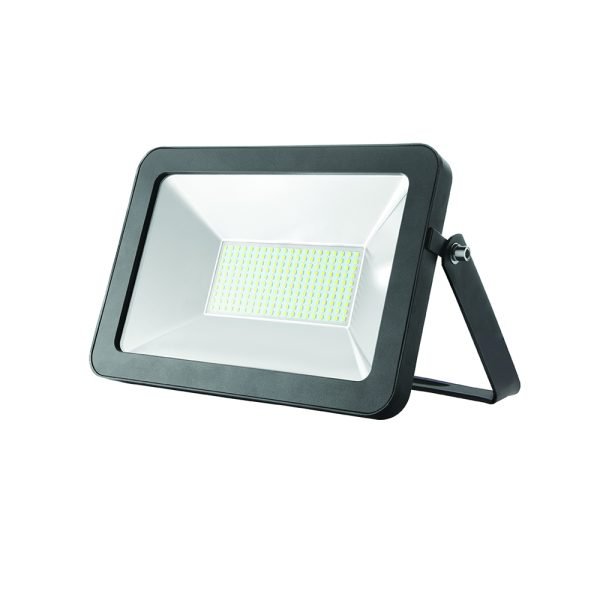
A 100 Watt LED Flood Light is a practical choice for outdoor areas that need strong, focused illumination without the power consumption of traditional high-wattage floodlights. It can be used for driveways, parking areas, building exteriors, warehouses, sports areas, gardens, security lighting, and commercial properties.
The right fixture, however, is not determined by wattage alone. Lumen output, beam angle, mounting height, color temperature, IP rating, and the size of the area all affect real-world performance.
What Is a 100 Watt LED Flood Light?
A 100 Watt LED Flood Light is an outdoor fixture that uses LED technology while consuming approximately 100 watts of electrical power at its rated operating load.
Unlike traditional halogen or metal halide floodlights, LED floodlights convert a larger portion of their electrical power into useful light. Modern LED fixtures also use optical lenses or reflectors to direct illumination toward the target area.
A 100W floodlight can be suitable for both residential and commercial applications, but the required light output varies between products. Two 100W fixtures can produce different amounts of light because LED efficiency, driver quality, optics, and thermal design are not identical.
How Bright Is a 100W LED Flood Light?
The brightness of a floodlight should be judged primarily by its lumen output, not its wattage.
A 100W LED floodlight may produce different lumen levels depending on its LED efficiency and design. Therefore, check the manufacturer’s rated lumens before comparing products.
The actual illumination received by the ground or surface also depends on mounting height, beam angle, distance, and surrounding conditions.
For example, a 100W fixture mounted high above a large parking area may spread its light over a much larger surface than the same fixture mounted close to a small driveway.
Where Can You Use a 100 Watt LED Flood Light?
The versatility of 100W LED floodlights makes them useful in many applications.
Driveways and Residential Areas
A 100W fixture can provide security and general illumination around driveways, entrances, yards, garages, and exterior walls.
Parking Lots
Commercial properties can use 100W LED flood lights to illuminate smaller parking areas, access roads, loading zones, and pedestrian areas.
Warehouses and Industrial Areas
Outdoor loading zones, entrances, storage yards, and building perimeters can benefit from high-output LED flood lighting.
Sports Areas
A 100W fixture may work for small recreational areas or specific zones around sports facilities. Larger football fields and professional sports grounds generally require specialized high-output sports lighting and a proper photometric design.
Building Security
Floodlights can illuminate entrances, gates, walls, walkways, and other areas where visibility is important after dark.
Benefits of a 100 Watt LED Flood Light
Lower Energy Consumption
A 100W LED floodlight consumes approximately 100 watts when operating at its rated power. Compared with older high-wattage lighting technologies, this can reduce electrical consumption while providing substantial illumination.
The actual energy savings depend on what technology the LED fixture replaces and how many hours it operates.
Long Operating Life
Quality LED floodlights are designed for long-term operation. Their service life can reduce the frequency of lamp replacement compared with older lighting technologies.
However, actual lifespan depends on the LED chips, driver, operating temperature, electrical conditions, and fixture construction.
Instant-On Lighting
LED floodlights normally reach their operating brightness almost immediately. There is no lengthy warm-up period like some traditional discharge lamps.
This is useful for security lighting and areas where lights are switched on only when required.
Better Directional Control
Floodlights can use reflectors and optical lenses to direct light toward a specific area. Good optical control helps reduce wasted light and can improve illumination where it matters.
Outdoor Durability
Many 100W LED floodlights are designed for outdoor environments. Look for an appropriate IP rating when the fixture will be exposed to rain, dust, humidity, or other harsh conditions.
Important Features to Check
Lumen Output
Check the fixture’s actual lumen rating rather than assuming every 100W floodlight has the same brightness.
Beam Angle
Beam angle determines how widely light spreads.
A narrow beam can project light farther, while a wider beam covers more area at shorter distances. Choose the beam pattern according to the mounting height and area being illuminated.
Color Temperature
Common outdoor LED floodlights are available in different color temperatures.
Cooler white light can provide a crisp appearance and strong visual contrast, while warmer color temperatures create a softer appearance. The best option depends on the application and personal preference.
IP Rating
For outdoor installation, check the fixture’s IP rating. The rating indicates the level of protection against solid particles and water.
Do not assume that every 100W LED floodlight is equally suitable for exposed outdoor conditions.
Surge Protection
Outdoor fixtures can be exposed to electrical surges, particularly during storms. A suitable surge protection system can help protect the LED driver and other electronic components.
Heat Management
LEDs generate heat, and excessive operating temperatures can affect long-term performance.
A quality aluminum housing and properly designed heat sink can help transfer heat away from the LED components and driver.
100W LED Flood Light vs. Traditional Floodlight
A 100W LED floodlight can provide several advantages over older halogen, metal halide, or other conventional floodlighting technologies.
LED technology generally offers:
- Lower power consumption
- Instant start-up
- Longer service life
- Reduced routine maintenance
- Better optical control
- Compatibility with modern lighting controls
However, replacing an existing fixture should not be based only on wattage.
The new LED fixture should provide sufficient lumen output and the correct beam distribution for the application. A lower-wattage LED fixture can sometimes provide comparable or better illumination than a higher-wattage conventional fixture because of differences in efficiency and optical performance.
Installation Tips
Correct installation is essential for getting good performance from a 100W LED flood light.
Before installation, determine the best mounting position and aiming direction. Avoid pointing the fixture directly toward windows, roads, or neighboring properties where it may create unnecessary glare.
Use appropriate mounting hardware for the surface and fixture weight. Outdoor electrical connections should also be properly protected from moisture.
For larger installations, consider professional electrical installation and lighting design.
How to Choose the Right 100 Watt LED Flood Light
Before purchasing, compare the complete specification rather than focusing only on the 100W rating.
Look for:
- Verified lumen output
- Suitable beam angle
- Appropriate color temperature
- High-quality LED chips
- Reliable driver
- Suitable IP rating
- Effective heat dissipation
- Surge protection
- Correct mounting hardware
- Warranty and manufacturer support
Also consider the actual application. A fixture designed for general outdoor lighting may not be appropriate for a high-mast sports installation or demanding industrial environment.
Conclusion
A 100 Watt LED Flood Light can provide an effective balance between light output and electrical consumption for many residential, commercial, industrial, and outdoor applications.
The best fixture is not necessarily the one with the highest claimed lumen rating. Look at the complete lighting system, including optics, beam angle, mounting height, IP protection, thermal management, driver quality, and the area you need to illuminate.
For small and medium outdoor areas, a well-designed 100W LED floodlight can provide dependable illumination while keeping energy use under control. For larger projects, a photometric design can help determine exactly how many fixtures are required and where they
