
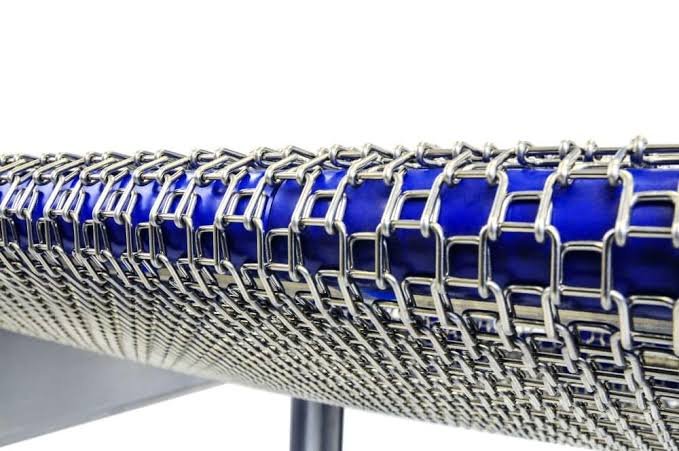
Conveyor belts are often viewed simply as equipment for moving products from one point to another. In practice, however, the construction of a belt can influence product stability, airflow, drainage, cleaning, and overall conveyor performance. When products are small, delicate, wet, coated, or exposed to heat, the conveying surface needs to provide reliable support without unnecessarily restricting the movement of air or liquids. A Compact-Grid Conveyor Belt offers one approach to balancing these requirements.
Supporting Smaller Products More Effectively
Small products can be difficult to transport on belts with large openings. They may become unstable, shift position, or partially enter the spaces between the wires. A closely spaced grid provides more contact points across the conveying surface, helping products remain in a more consistent position as they move along the conveyor.
This can be useful when products pass through processes such as coating, cooking, cooling, drying, or baking. Rather than creating a completely solid surface, the grid combines product support with openings that allow air and liquids to move through the belt.
Open Area Has a Practical Purpose
The open structure of a conveyor belt serves a functional purpose. It can affect how readily air, heat, and liquids pass through the conveying surface. Compact-Grid designs provide a relatively open structure while maintaining close spacing between the wires, creating a balance between product support and airflow.
In thermal applications, an open surface can allow circulating air to reach the product more effectively. During washing, coating, or similar processes, openings can also provide pathways for excess liquid to drain away. The appropriate open area depends on the product and process, so a larger opening is not automatically the right choice.
Why Belt Tracking Matters
A conveyor belt needs to remain properly aligned as it travels around the system. Poor tracking can cause uneven movement, increase wear, and create problems around the edges of the conveyor. Tracking is therefore an important consideration when selecting both the belt and its drive arrangement.
Compact-Grid belts use a positive-drive system in which the belt engages with the drive components rather than relying solely on friction. This arrangement provides controlled belt movement and helps maintain consistent operation.
The drive system still needs to be matched to the conveyor’s operating conditions. Factors such as belt tension, sprocket arrangement, conveyor geometry, load, and running speed can all influence performance.
Cleaning and Maintenance Considerations
In processing environments, maintaining a conveyor involves more than monitoring mechanical wear. Food particles, moisture, coatings, and other residues can accumulate around the conveying surface and increase cleaning requirements.
The open construction of a grid belt can provide access for cleaning and inspection. Compact-Grid is also designed for clean-in-place applications, while its construction differs from some traditional wire belts that use welded crossbars.
However, the belt itself is only one part of the cleaning system. Conveyor frame design, drainage, spray coverage, cleaning methods, product characteristics, and surrounding components can all affect how easily a conveyor can be maintained.
Choosing the Right Mesh Size
The size of the openings should correspond with the products being conveyed. Smaller items generally require closer support, while larger products may work with a more open surface.
Compact-Grid is available in 10 mm and 15 mm mesh options. The tighter 10 mm configuration can provide greater support for smaller products, while the 15 mm option provides a somewhat more open conveying surface.
Mesh selection should also take into account product dimensions, weight, temperature, moisture, airflow requirements, transfer points, conveyor speed, and the processing conditions. A Conveyor Belt Manufacturer can use these factors to help determine which belt construction is appropriate for a particular system.
How Belt Construction Affects Conveyor Performance
The physical construction of a belt can influence the demands placed on the rest of the conveyor. Belt mass, for example, can affect the amount of work required from the drive system, particularly when the conveyor operates continuously or includes long conveying distances.
Compact-Grid is designed as a lightweight metal belt for applications where an open conveying surface is required without relying on a heavier construction. Its suitability, however, should be considered alongside factors such as product load, conveyor length, operating tension, drive power, and supporting components.
Looking only at belt weight can therefore provide an incomplete picture. A suitable belt needs to work effectively with the entire conveyor rather than being selected on one specification alone.
Designing Around the Entire Process
A conveyor belt does not operate independently. Its performance depends on how it interacts with sprockets, drives, transfers, support components, the conveyed product, and the surrounding processing equipment.
For this reason, belt selection should begin with the actual operating conditions. Product size, weight, temperature, moisture, conveying speed, cleaning requirements, and transfer geometry can all influence the appropriate belt design.
Considering these factors together can help prevent problems that may otherwise appear after installation. It also makes it easier to identify whether a particular grid pattern and belt construction are suited to the intended process.
Conclusion
Compact-Grid conveyor belts show how belt geometry can influence several aspects of material movement, from product support and airflow to drainage, tracking, and maintenance. Their closely spaced grid structure can be useful when products need stable conveying while the process still requires an open surface.
For businesses comparing different metal belting options, looking at the complete conveyor system is more useful than concentrating on a single belt specification. Wire Belt is associated with Compact-Grid conveyor technology and offers different configurations for conveying applications where product support and an open belt surface need to work together.
