
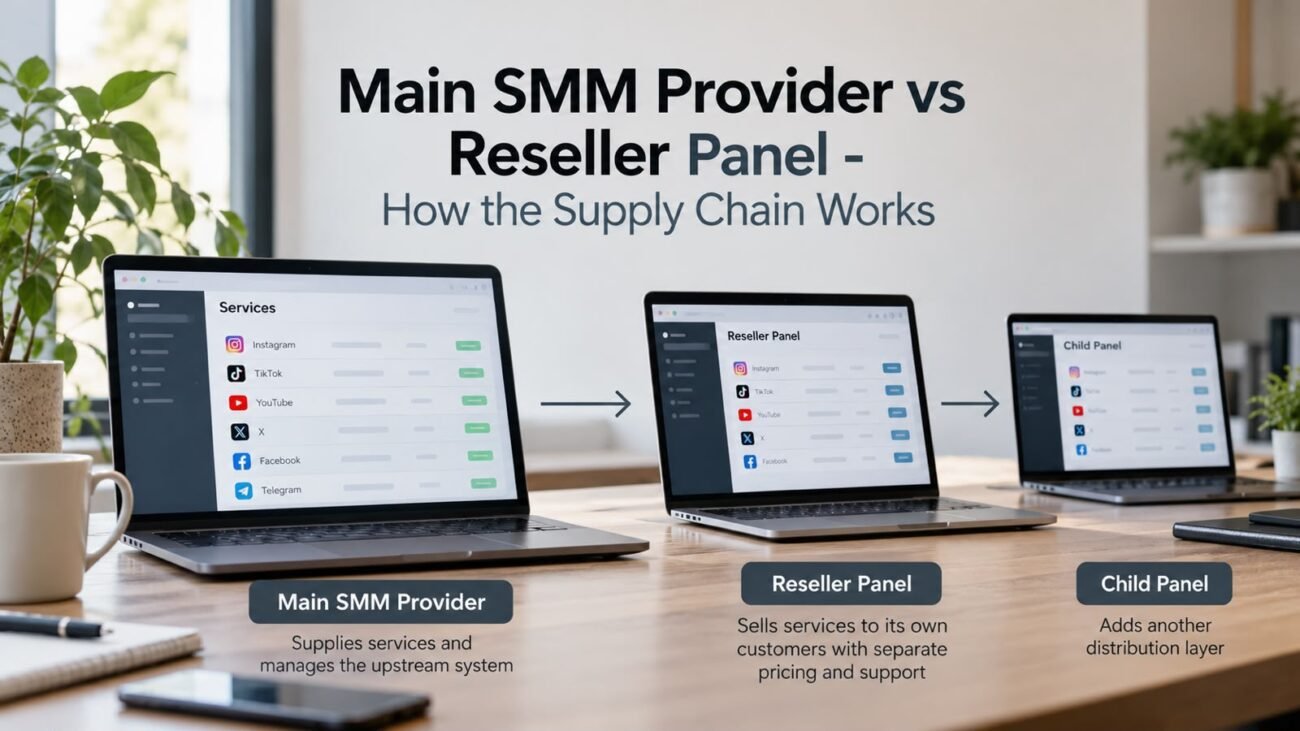
An SMM provider and a reseller panel can sell similar social media services, but they occupy different positions in the supply chain. The provider supplies access to services and manages an upstream order system, while the reseller presents those services to its own customers, usually with separate pricing and support. Child panels add another distribution layer. Understanding these relationships helps agencies identify where their orders go, how costs accumulate, and who is responsible when something goes wrong.
OZSM is an smm provider serving resellers, agencies, and individual users since 2021. Its panel offers social media services through direct ordering and API integration, giving businesses different ways to manage their order workflows. The distinction between direct purchasing and reselling matters because an attractive storefront does not necessarily reveal how many systems handle an order before fulfillment.
What Does Each Layer of the SMM Supply Chain Do?
The SMM industry commonly uses several commercial layers to connect customers with social media services. These labels describe business relationships rather than universally defined technical categories.
| Layer | Primary responsibility | Typical customer |
| Main provider | Maintains a service catalog, accepts orders, manages upstream processing, and provides order information. | Resellers, agencies, and direct buyers |
| Reseller panel | Offers provider services through its own storefront, sets customer prices, and handles customer relationships. | Agencies, businesses, and individual buyers |
| Child panel | Operates an additional customer-facing storefront connected to a parent panel or another upstream system. | Smaller resellers and specialized audiences |
Importantly, a main provider is not necessarily the original producer of every service. Some providers coordinate several fulfillment sources, while others manage more of the infrastructure themselves. Similarly, a reseller may use multiple providers instead of relying on one supplier.
The meaningful distinction is who controls the commercial relationship, service configuration, order routing, and customer support at each stage.
How Does an Order Move Through the Supply Chain?
Consider an agency purchasing YouTube views through a reseller storefront connected to an upstream provider. The visible transaction may involve only one dashboard, but several separate operations can occur behind it.
- Service selection: The agency selects a service and enters the required video link and quantity.
- Order creation: The reseller panel records the request and assigns an internal order identifier.
- Provider submission: The reseller forwards the request through an API or another supported ordering method.
- Order processing: The upstream system accepts the request and processes it according to the selected service’s conditions.
- Status reporting: The reseller retrieves available order information and displays it to the agency.
If a child panel sits between the agency and the reseller, another system may handle the request before it reaches the upstream provider. Each additional connection introduces another opportunity for mismatched order identifiers, outdated statuses, or delayed communication.
An order marked completed by an intermediary should not automatically be interpreted as independently verified performance. Resellers need to understand what each status represents and how their supplier handles disputed or partially completed requests.
How Does an SMM Panel API Connect Providers and Resellers?
An SMM panel API is a machine-readable interface that allows one system to exchange order information with another. It reduces the need for a reseller to submit and check every request manually.
A typical integration starts with an authenticated request for the provider’s service catalog. The reseller maps the returned service identifiers to products in its own storefront. When a customer purchases a product, the reseller submits the corresponding provider service ID, target link, and required parameters.
OZSM documents API actions for retrieving services, adding orders, checking individual or multiple order statuses, requesting refills, submitting cancellation requests, and checking account balances. These operations provide the technical foundation for an automated reseller workflow.
However, an API request being accepted does not mean every requested action will succeed. Refill and cancellation eligibility depends on the service and order conditions. Integration software must handle rejected requests, unavailable services, and responses that differ from expected results.
Resellers should also protect API keys, avoid storing them in public-facing code, and maintain a reliable mapping between customer order IDs and upstream order IDs. Without that mapping, customer support becomes substantially more complicated.
Why Do Prices Increase Across Reseller Layers?
Each commercial layer generally needs enough margin to cover its expenses. A provider establishes a service rate, the reseller sets a customer-facing rate, and an additional child panel may apply another markup.
For example, a reseller purchasing Instagram likes from an upstream provider may incorporate payment processing expenses, software maintenance, customer support, and expected operational risk into its selling price. A downstream reseller purchasing from that storefront must account for its own expenses as well.
The result is a cumulative pricing structure, although additional layers do not always produce a higher final price. Different purchase volumes, negotiated commercial arrangements, and operating costs can change the comparison.
Resellers should distinguish three figures:
- Provider cost: The amount charged by the upstream service supplier.
- Operating cost: Payment fees, software expenses, support workloads, and other business expenses.
- Customer price: The amount charged to the final buyer.
The difference between the customer price and provider cost is not automatically profit. Refund adjustments, order problems, and administrative work can reduce the amount a reseller ultimately retains.
Why Do Resellers Prefer Working Closer to the Main Provider?
A shorter supply chain can make costs and responsibilities easier to understand. When a reseller connects directly to an upstream provider, it may avoid intermediary markups and communicate with the organization that manages its orders.
Direct relationships can also simplify troubleshooting. Instead of passing an order question through several storefronts, the reseller can contact its supplier with the relevant provider order identifier.
API maintenance is another consideration. Every intermediary may transform service names, quantities, status labels, or product identifiers. Fewer integration layers can reduce these translation problems.
Nevertheless, direct access is not automatically the right arrangement for every business. A reseller panel may provide localized support, specialized service selection, a familiar interface, or operational assistance that a customer values more than direct supplier access.
The decision should depend on total operating cost, integration requirements, service availability, and support arrangements rather than the number of intermediaries alone.
Where Does OZSM Fit Into This Structure?
OZSM operates as an SMM panel and provider serving different purchasing models. Its service catalog covers followers, likes, views, members, subscribers, watch time, and other social media service categories.
Supported platforms include Instagram, TikTok, YouTube, Telegram, Twitter (X), Facebook, Spotify, Twitch, Kick, Discord, LinkedIn, Threads, and SoundCloud.
Customers can place relevant orders using a link or username without supplying their social media account passwords. For resellers handling multiple customer requests, OZSM also provides mass ordering, drip-feed functionality, and API access.
Refill options are available on many services, subject to the applicable service conditions. Payment options include PayPal, cryptocurrency, Binance-related payment methods, and cards. Balance top-up bonuses may also be available.
These features support different operating arrangements. A smaller reseller might submit orders manually, while an agency maintaining its own customer dashboard could use the API to connect ordering and status management.
Service availability and eligibility still need to be evaluated individually. Buyers should review the applicable terms and understand that social media platforms maintain their own rules concerning artificial engagement and account activity.
What Should Resellers Check Before Choosing an Upstream Supplier?
Before integrating an SMM provider panel, resellers should assess the relationship from both technical and commercial perspectives.
- Service coverage: Confirm that the catalog supports the platforms and service types customers actually request.
- API documentation: Review authentication, service identifiers, required parameters, status responses, and error handling.
- Order policies: Understand how partially completed orders, refill eligibility, and cancellation requests are handled.
- Price transparency: Examine the full purchasing cost rather than comparing catalog rates in isolation.
- Customer support: Establish how technical issues and disputed orders can be escalated.
- Platform compliance: Evaluate whether proposed services conflict with the relevant social platform’s policies or the agency’s client commitments.
A limited operational test can help establish whether the available tools suit the reseller’s workflow. The purpose should be to examine documentation accuracy, order tracking, error responses, and support procedures, not to assume future performance from a small sample.
Can a Reseller Panel Also Become a Provider?
Yes. The terms describe a panel’s role in a particular transaction rather than a permanent business classification. A business might purchase services from an upstream supplier while offering its own API to smaller resellers. From the smaller reseller’s perspective, that business becomes its provider.
This explains why identifying the original fulfillment source can be difficult. A professional-looking dashboard, extensive service catalog, or publicly accessible API does not establish where fulfillment originates.
For agencies building a sustainable resale operation, the practical objective is not necessarily to remove every intermediary. It is to establish a supply relationship with understandable costs, traceable orders, documented responsibilities, and sufficient technical control. Working closer to an upstream provider can support that objective when its services and operating model match the agency’s requirements.
