
Introduction: The E-Commerce Fulfillment Bottleneck
Rising Consumer Expectations for Fast Delivery
The global expansion of e-commerce has compressed order fulfillment windows across B2B and B2C channels. Modern buyers demand accurate, fast, and damage-free deliveries. For warehousing hubs, manual order bagging and sealing have become severe structural bottlenecks that limit daily shipping capacity during seasonal peak demands.
The Hidden Costs of Manual Packaging Errors
Manual packaging lines introduce significant invisible costs to warehouse operations, including:
- Varied Material Usage: Excessive tape and oversized bags increase dimensional weight shipping fees.
- Product Mislabeling: Human error during manual sorting leads to expensive return logistics.
- Inconsistent Seal Integrity: Poorly sealed bags result in product damage during transit.
Integrating Smart Packaging Machinery Into Fulfillment Hubs
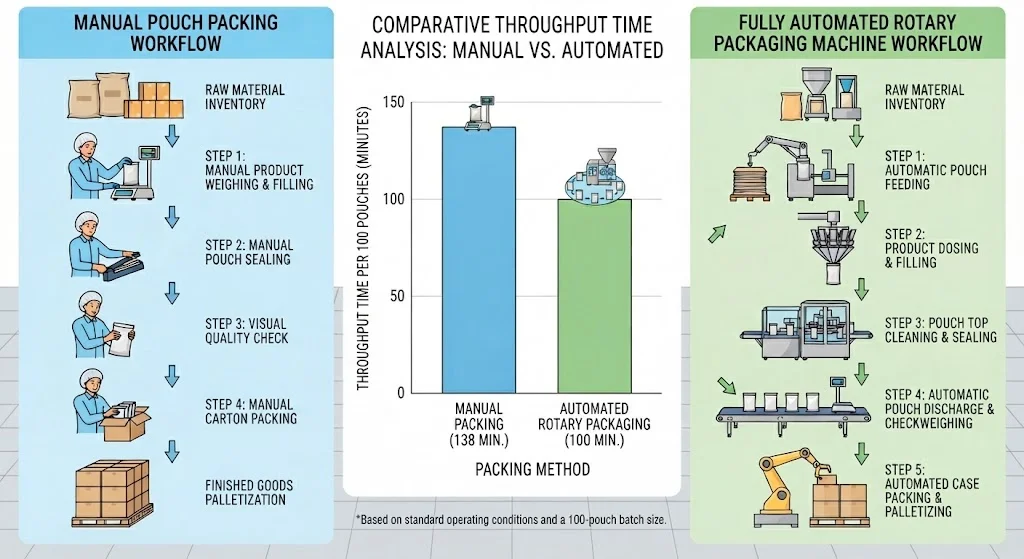
As fulfillment operations scale, space and speed dictate profitability. Integrating a modular Levapack into a packaging line allows logistics and manufacturing centers to streamline product bagging, reduce footprint requirements, and maintain consistent output speeds across high-demand shifts.
Compact Rotary Solutions for Small-to-Mid Sized Facilities
Unlike traditional sprawling conveyor systems, modern compact rotary platforms deliver high automated throughput within a tight footprint. Facilities can deploy these systems in modular configurations, enabling rapid integration into existing warehouse management system (WMS) workflows without costly facility overhauls.
Reducing Material Overhead Through Precision Sealing
Automated systems eliminate material waste by utilizing pre-measured pouches and precise thermal sealing bars. By standardizing bag sizing and guaranteeing air-tight seals, fulfillment centers minimize volumetric weight penalties charged by freight carriers while eliminating product loss from broken packages.
Calculating the Total Cost of Ownership (TCO) and ROI
Labor Optimization and Shift Scaling
Transitioning from manual packing tables to integrated rotary systems dramatically changes facility economics. An automated packaging station maintains consistent output speeds without fatigue, allowing fulfillment hubs to scale output during peak sales events without doubling headcount.
Key Takeaways
| Area | Key Takeaway | Impact/Data |
| Speed | Automate order bagging | Eliminate peak bottlenecks |
| Logistics | Standardize pouch sizes | Lower dimensional freight fees |
| Capacity | Deploy compact rotary lines | Scale output without extra headcount |
Conclusion: Future-Proofing Your Warehouse Operations
Industry data compiled in reports by Supply Chain Digital indicates that facilities implementing end-to-end automated packaging workflows experience a notable drop in shipping discrepancies and material wastage. Upgrading to high-efficiency packaging machinery provides the operational foundation required to sustain profitability and scale fulfillment operations seamlessly into the future.
