
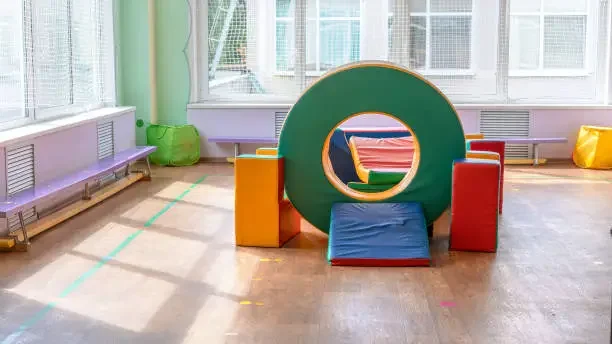
Introduction
The Early Years Foundation Stage (EYFS) framework establishes physical development as one of the three prime areas of early childhood learning. Developing robust gross motor skills, postural stability, and sensory integration between ages two and six lays the essential groundwork for later academic performance and emotional self-regulation.
However, modern nursery managers and primary educators face growing challenges as early physical inactivity and sedentary habits increase. Implementing specialized physical and sensory play infrastructure within nursery settings provides children with dynamic movement opportunities, bridging critical developmental gaps through structured active play.
The Role of Gross Motor and Sensory Play in Early Childhood Development
Balancing Proprioception and Spatial Awareness in Early Years
Neurological development in young children relies heavily on continuous sensory feedback received through environmental interaction. Structured active play directly stimulates the vestibular system—which governs balance and spatial orientation—and the proprioceptive system, which provides awareness of muscle position and joint tension.
Between ages two and six, children transition from basic locomotion to complex motor planning. Navigating uneven terrain, balancing on elevated narrow paths, and judging stepping distances train the brain to calculate spatial trajectories, significantly improving bilateral coordination and body control.
Addressing Physical Inactivity and Sensory Deprivation in Modern Nurseries
Increased screen exposure and restricted outdoor movement have contributed to declining core strength and postural stability among early years learners. Children exhibiting poor core strength often struggle with prolonged sitting, leading to fatigue and diminished concentration during classroom activities.
Nurseries equipped with dedicated active play zones counteract these sedentary habits. Engaging children in rhythmic jumping, balancing, and climbing activities fosters physical resilience, strengthens stabilizing muscle groups, and restores sensory processing balance.
Structural Design and Safety Standards for Educational Play Equipment
Material Safety, Non-Toxic Polymers, and Anti-Slip Ergonomics
Institutional play equipment used in high-traffic early years settings must satisfy rigorous engineering and safety standards. Equipment constructed from low-grade commercial plastics risks structural fatigue, cracking, and toxic chemical off-gassing under continuous usage.
Essential material and ergonomic criteria include:
- High-Density Non-Toxic Polymers: Heavy-duty, BPA-free thermoplastics that resist high impact and physical degradation.
- Tactile Anti-Slip Surface Engineering: Molded surface textures and rubberized base rims that prevent slippage on indoor wooden floors or outdoor turf.
- Ergonomic Safety Contours: Smooth, rounded edge geometries that eliminate sharp impact hazards during active group play.
Designing Modular Active Play Pathways (River Stones & Balance Elements)
Creating flexible sensory paths in nursery settings requires stepping elements engineered for spatial adaptability and dynamic weight distribution. Modular stepping stones and tactile balance boards constructed from high-density, impact-resistant polymers provide low-impact stability while enhancing ankle strength and core balance. For instance, commercial developmental play solutions developed by Startinal incorporate textured anti-slip surfaces and interlocking stability features manufactured under strict ASTM and CE safety compliance standards, making them suitable for both high-traffic classroom environments and occupational therapy spaces.
Configuring stepping pathways with variable heights and sloped angles encourages children to adjust their foot placement dynamically. This progressive challenge refines motor planning, builds physical confidence, and allows educators to adjust obstacle difficulty as children advance.
Compliance Benchmarks and Long-Term Procurement Strategy
Navigating Global Safety Certifications for Early Years Facilities
Procurement officers and facility directors must ensure that early years equipment complies with mandatory international toy safety standards prior to classroom deployment. Regulatory audits evaluate structural load capacity, mechanical shear risks, and chemical safety.
Aligning play space design with official early childhood physical development goals is critical for both public and private educational institutions. According to developmental guidance set out by the UK Department for Education (DfE), regular participation in structured active play during the foundation stage directly correlates with improved cognitive retention, motor planning abilities, and overall classroom readiness.
Core compliance benchmarks for educational play assets include:
- BS EN 71 / CE Marking: European safety compliance governing mechanical properties, flammability, and chemical toxicity.
- ASTM F963 Standards: American standard consumer safety specifications for toy safety and structural integrity.
- CPC (Children’s Product Certificate): Mandatory documentation confirming third-party lab safety testing for educational products.
- BSCI Audit Trails: Verified ethical manufacturing and social compliance standards throughout the production lifecycle.
Lifecycle Management and Durability in High-Traffic Educational Settings
When evaluating capital expenditure for nursery facilities, procurement directors assess the total cost of ownership rather than initial purchase price alone. Consumer-grade play items designed for light domestic use rapidly wear down under daily multi-child classroom engagement.
Commercial-grade developmental play equipment features UV-stabilized polymer matrixing and reinforced structural wall thickness. Investing in durable, certified educational equipment minimizes recurring replacement costs, reduces maintenance overhead, and ensures consistent safety for early years settings.
Conclusion
Optimizing physical development in Early Years Foundation Stage (EYFS) environments requires integrating safe, modular, and sensory-rich play equipment. Stepping stones, balance beams, and tactile play pathways provide the necessary proprioceptive and vestibular challenges children need to build lifelong physical coordination.
By prioritizing certified, commercial-grade equipment built with non-toxic polymers and anti-slip ergonomics, educational leaders create safe, stimulating active play environments. Strategic investment in durable sensory play infrastructure ensures long-term facility resilience while supporting early childhood health and classroom readiness.
