
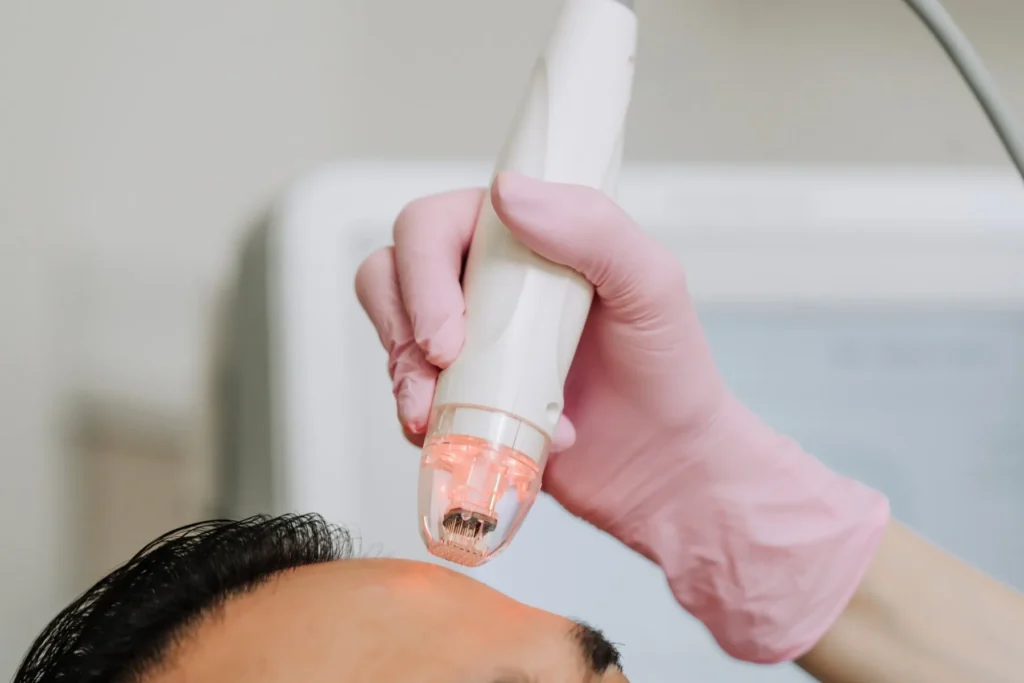
This article explains how radiofrequency (RF) microneedling works, drawing on clinical studies of acne scars and skin laxity. It also looks at the treatment’s limits when your main concern is a loss of facial fullness.
You’ll find questions to ask at a consultation about the equipment, treatment plan and possible risks. These can help you decide whether the proposed treatment fits your needs and understand what results you can reasonably expect.
How the Device and Treatment Plan Work Together
RF microneedling combines fine needle penetration with radiofrequency energy that produces localised heating within the skin. The American Academy of Dermatology describes the added heat as a way of stimulating collagen production alongside the repair response triggered by microneedling. The aim is to change the treated tissue as it heals and remodels.
Collagen helps support the dermis, the layer of skin beneath the surface. Facial fullness also depends on fat and deeper supporting structures. A treatment directed at the skin’s collagen framework therefore needs to be assessed against a skin-related goal, such as the appearance of a scar or fine creasing. Restoring a fuller cheek involves a different anatomical question.
Needle design helps define where energy is delivered. Some designs insulate the shaft, leaving an exposed tip to deliver RF. Non-insulated designs can deliver energy along the inserted needle. The insertion-depth setting describes how far the needle enters; the needle construction and RF settings add further detail about how energy reaches the tissue.
RF microneedling systems also give practitioners choices about how treatment is delivered. In fotromed‘s range, for example, needle depth and RF energy are adjustable, with cartridge options that vary between models. A clinic should explain how its chosen device and settings fit the treatment area and the change it hopes to achieve.
The device and proposed course belong in the same discussion. A study of a particular machine and treatment protocol gives the clinician something specific to compare with their plan. The shared label “RF microneedling” leaves those details unanswered.
Why the Shape of an Acne Scar Matters
A description such as “rough skin” leaves several possibilities open. Dry, irritated skin needs a different assessment from a depressed acne scar. Even within depressed scars, the shapes vary. The American Academy of Dermatology describes ice-pick scars as small but deep, rolling scars as wide and shallow, and boxcar scars as round or oval depressions. Its guidance recommends an individual plan based on the scar pattern, sometimes using more than one treatment.
At a consultation, ask which scars are being targeted and what a worthwhile improvement would look like. A person with several scar shapes needs an explanation of which part of that pattern the proposed treatment is intended to address.
Qu and colleagues’ 2025 pilot trial in Acta Dermato-Venereologica offers one example of how scar improvement can be measured. Thirty participants received a specific non-insulated RF microneedling treatment on one side of the face and fractional carbon dioxide laser on the other, with one session per side. At six months, the RF-side mean ECCA scar-severity score had fallen from 118.37 to 76.38. The trial reported comparable efficacy between the approaches.
The score records scar severity within that study. It helps make “improvement” more concrete while keeping the outcome tied to scarring. A lower score does not tell someone how much cheek fullness they will gain, or promise that individual scars will disappear. For a person who has both pitted scars and broader hollowing, the surface and the surrounding contour need separate goals and follow-up.
What a Tightening Result Actually Measures
People asking about “tightening” may want to soften fine lines, see firmer-looking skin or change the position of sagging facial tissues. These goals ask different things of a treatment. Before assessing the proposed benefit, establish whether the intended change concerns fine surface lines or the position of the tissues forming the facial contour.
In a 2024 randomised split-face study in the Journal of Cosmetic Dermatology, Liu and colleagues enrolled 21 people; 18 completed treatment and follow-up. One side received vacuum-assisted RF microneedling and the other remained untreated. The course involved three sessions at monthly intervals, with assessments up to six months after the final session. Researchers reported improvements in wrinkle measurements and changes in midface contour. At six months, the treated side’s mean three-dimensional midface volume measurement had fallen by 0.55 mL.
That last finding needs to be read in the direction reported: it was a reduction in a surface-contour measurement. For someone seeking fuller cheeks, a smaller measured contour is a different outcome from replacing lost volume. The scan alone also cannot establish how much of any change came from a particular underlying tissue. It should not be relabelled as a direct measurement of fat loss.
The treatment course matters to expectations, too. These results followed several sessions, and the six-month follow-up clock started after the last one. When a clinic proposes an rf Microneedling device for a laxity concern, it should explain how its planned course relates to the evidence and what degree of visible change it expects.
The two trials answer different questions. Qu’s compared two active treatments for acne scars. Liu’s compared treatment with an untreated side for wrinkles and contour. Their results help a discussion when the patient’s concern matches the outcome studied; neither trial establishes a universal result across devices, more severe laxity or longer follow-up.
When Preserving Fullness is Part of the Goal
Hollow cheeks or temples call for an assessment of the contour and its underlying support. The American Society of Plastic Surgeons explains that facial ageing includes changes in facial fat, and its patient guidance distinguishes restoring volume from improving skin appearance. Fat is one part of that support, so the cause of a hollow-looking area needs an individual assessment.
Where the main wish is a fuller cheek, the treatment discussion should address that wish directly. Improving the skin’s surface may leave the deeper cause of the hollow unchanged. The clinician should explain which options, if any, are appropriate and whether the expected change addresses the feature the person finds troubling. Whether an injectable treatment is needed depends on that assessment.
Existing fullness also belongs in the discussion before an energy-based procedure. In its October 2025 safety communication, the US Food and Drug Administration described reports of serious complications with certain uses of RF microneedling, including unintended fat loss, burns, scarring and nerve damage. It provided no incidence rate or evidence that every device carries identical risks.
For someone already concerned about hollowing, the practical question is how the proposed treatment accounts for existing facial fullness. The clinician should explain the target in each area and the reason for the planned treatment intensity or depth. A suggestion to treat more deeply needs a clinical rationale linked to that person’s anatomy and concern.
Agreeing What Will Count as an Improvement
Describe the desired change before discussing the procedure. “I want the small pits on my cheeks to be less noticeable” gives the clinician a scar-related objective. “I want my cheeks to look fuller” points to a volume-related one. If both matter, record them separately so that a better surface and an unchanged hollow can be discussed clearly at review.
A useful plan connects the concern to the proposed course and an assessable result. Ask which feature is expected to change, how many appointments are proposed and when the result will be reviewed. The answers should explain why that course makes sense for the intended outcome. They should also leave room to decide that a modest skin change would not resolve the main concern.
Follow-up needs the same care. In Liu’s study, photographs used consistent lighting, camera settings and positioning. Applying that discipline to before-and-after images makes the comparison more useful. The review should return to the original concern: whether the scars look less noticeable, the fine creasing has softened, or the desired change in fullness has occurred. Each outcome deserves its own assessment.
