
Venice tells much of its history through buildings that face the water. Along the Grand Canal and quieter waterways, palaces once announced the position of families whose fortunes were tied to commerce, politics and the wider Mediterranean. Their façades were public statements, while the rooms behind them accommodated business, art collections, ceremonies and private life. Together, these buildings reveal something that monuments alone cannot: how the Venetian Republic translated power into architecture.
Why is the Doge’s Palace the starting point for understanding Venice?
The Doge’s Palace was much more than the residence of Venice’s elected head of state. It contained the machinery of the Republic.
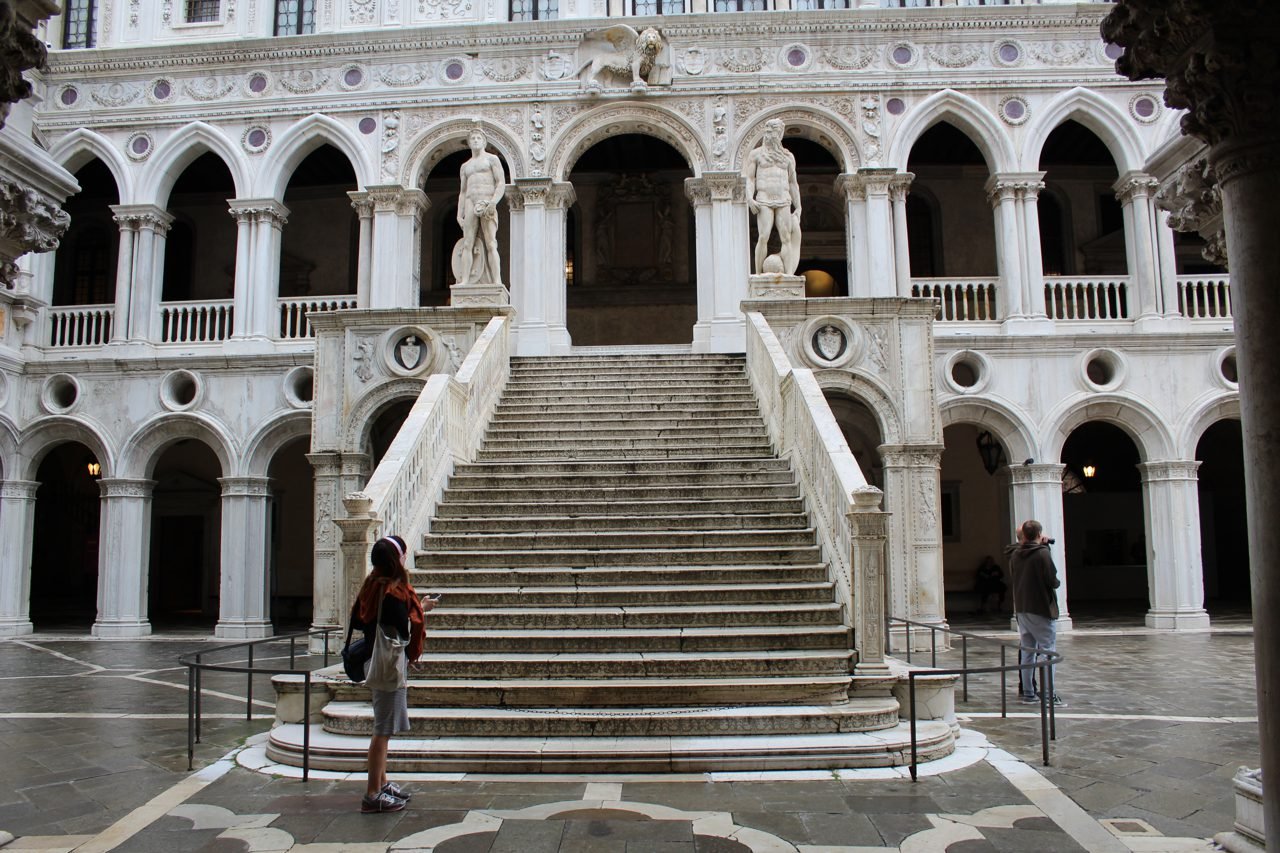
Government councils met here, ambassadors were received, justice was administered and decisions affecting Venetian territories were made inside rooms whose scale reflected the importance of the institutions using them. The building visible today developed through several major phases, particularly between the fourteenth and sixteenth centuries.
Its architecture also challenges expectations. Rather than presenting a heavy fortress to the lagoon, the palace places delicate arcades beneath broad upper walls. The visual effect is remarkably light for a building associated with such concentrated political authority.
Inside, ceremonial spaces turn government into spectacle. Paintings, decorated ceilings and enormous halls communicated an image of Venice as stable, prosperous and protected by divine favour. Behind that splendour, however, were offices and chambers devoted to the practical administration of a complex state.
What does Ca’ d’Oro reveal about merchant wealth?
Private palaces tell a different story.
Ca’ d’Oro was commissioned in the fifteenth century by the wealthy Venetian merchant Marino Contarini. Its famous façade once incorporated intense colour and gilded details, explaining the name by which the building is still known: the “House of Gold.”
The important detail is not simply that a rich merchant could build something beautiful. Venetian prosperity was closely connected to maritime commerce, and private architecture became one way of converting commercial success into lasting social visibility.
A Grand Canal façade could be seen by residents, visitors and trading partners arriving by water. Position mattered, as did appearance.
Ca’ d’Oro therefore captures a fundamental Venetian relationship: wealth generated through exchange became architecture designed to endure.
Why were Venetian palaces built around the canal?
In most European cities, the grand entrance of an aristocratic residence faced a street or square. Venice required a different arrangement.
Water was one of the city’s principal routes of movement. Goods and visitors could arrive directly by boat, making the canal entrance an essential part of palace design.
This helps explain why travelling along the Grand Canal feels like moving through a continuous architectural exhibition. The façades were never incidental backs of buildings. They were designed to be seen from the water.
Looking for this relationship between palace and canal changes the experience of Venice. Windows, balconies, entrances and decorative stonework begin to reveal how architecture responded to a city without conventional streets.
For travellers interested in exploring this urban landscape over several days, choosing a base through Venice collection at https://www.vretreats.com/en/luxury-hotel-venice/ can make it easier to experience the city beyond a single route between major landmarks.
What makes Palazzo Grimani so unusual?
Palazzo Grimani offers evidence that Venetian architecture was never stylistically isolated.
The residence near Santa Maria Formosa belonged to the powerful Grimani family and was substantially transformed during the sixteenth century. Its architecture brought Venetian traditions into conversation with ideas associated with Rome and central Italy. The resulting courtyard, loggias and interior decoration stand apart from the more familiar Gothic image of the Venetian palace.
The family’s collecting is equally revealing.
Classical sculpture and antiquities were not simply decorative possessions. They demonstrated education, taste and connections with the intellectual culture of the Renaissance. Members of the Grimani family donated important parts of their collections to the Republic, contributing to Venice’s public artistic heritage.
Here, the palace becomes a record of cultural ambition as much as political status.
How did palace life change in eighteenth-century Venice?
Ca’ Rezzonico belongs to a later chapter.
Its story is particularly revealing because construction began for the Bon family in the seventeenth century but stopped when the project became financially unsustainable. The unfinished building was eventually acquired by the Rezzonico family, whose recent rise into the Venetian nobility was followed by an even greater success when Carlo Rezzonico became Pope Clement XIII in 1758.
The palace was finally completed during this period of family advancement.
Today, as the Museum of Eighteenth-Century Venice, Ca’ Rezzonico presents interiors, paintings and furnishings that evoke the domestic and social world of the Republic’s final century.
The atmosphere is very different from the Doge’s Palace. Instead of councils and state ceremony, attention shifts towards private display, entertainment and aristocratic life.
What can palace interiors tell us that façades cannot?
Venice is so visually powerful from the outside that interiors can easily become secondary. Yet entering a palace reveals how differently its spaces functioned.
The ground level had to accommodate a city connected to water. The principal residential floor above provided the setting for reception rooms and family life. Large central halls could establish a formal sequence through the building, while private rooms offered more intimate spaces.
Decoration added another language.
A ceiling fresco, sculpture collection or elaborate staircase could communicate education and family prestige. Architectural choices might demonstrate awareness of fashions elsewhere in Italy. Paintings could celebrate ancestors, political connections or the mythology surrounding Venice itself.
A palace was therefore not simply a luxurious house. It was a carefully constructed representation of the people who occupied it.
Which Venetian palaces should you visit first?
The answer depends on which part of the Republic interests you.
For political history, begin with the Doge’s Palace. Its institutional rooms explain how authority was organised and publicly represented.
For Venetian Gothic architecture and merchant wealth, Ca’ d’Oro provides a different perspective, although the museum is currently undergoing major works and the Italian museum authority expects it to reopen in spring 2027.
Palazzo Grimani is particularly rewarding for Renaissance architecture and collecting, while Ca’ Rezzonico is the clearest choice for understanding eighteenth-century aristocratic interiors.
Trying to visit several in one day is unnecessary. One palace studied slowly often reveals more about Venice than a hurried sequence of grand rooms.
Why do these palaces still matter to the story of Venice?
The Serenissima was not created by architecture, but architecture preserves the structures and ambitions that sustained it.
The Doge’s Palace expresses government. Ca’ d’Oro speaks of commercial fortunes and social visibility. Palazzo Grimani reveals intellectual curiosity and Renaissance collecting, while Ca’ Rezzonico captures the refinement and changing elite of the Republic’s later years.
Together, they complicate the familiar image of Venice as a beautiful city suspended over water.
Behind the façades was a society concerned with trade, rank, family reputation, political institutions and cultural influence. The palaces were places where these forces became tangible.
Venice becomes easier to understand once its palaces are read as historical documents rather than decorative backgrounds. From a canal, they create one of Europe’s most extraordinary cityscapes. From inside, they reveal the people and institutions that made that cityscape possible.
