
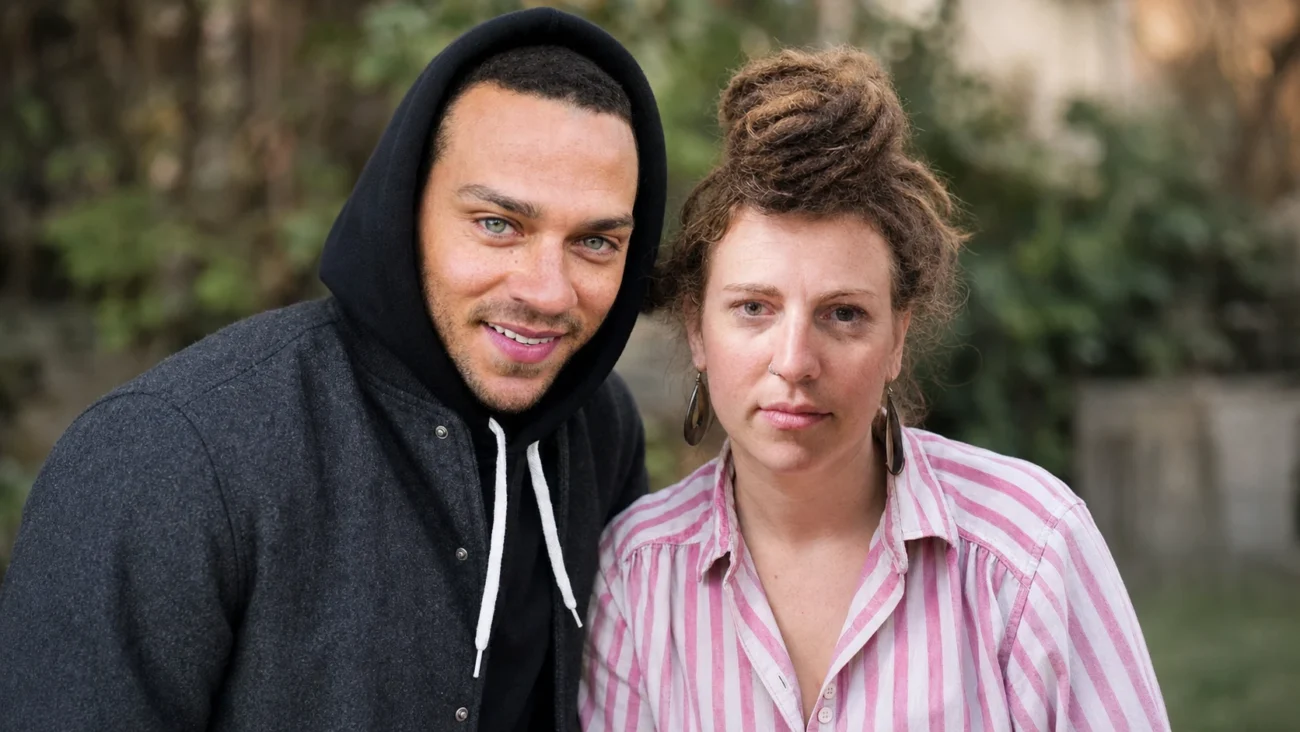
Johanna Chase is a ceramic artist, painter, and retired art educator whose public identity is often reduced to one family connection: she is the mother of actor and activist Jesse Williams. That description is accurate, but it leaves out a long career built through formal art training, independent pottery production, gallery work, public-school teaching, and a later return to studio practice on the coast of Maine.
Chase has never pursued celebrity in the way her eldest son has. She has maintained a relatively private life while developing functional ceramics, teaching young artists, organizing community art projects, and exhibiting her work through regional institutions. Her exact age and several details about her early life remain undisclosed, but her professional history offers a clear picture of an artist whose work began well before Williams became famous.
Early Life and Family Background
Johanna Chase’s full date of birth, age, and birthplace are not publicly confirmed. Reliable public records do not provide enough information to state those details with confidence, and estimates published by unsourced biography sites should be treated cautiously.
Chase is American and has documented Swedish ancestry through her maternal family. Her family history received wider attention in 2024 when Jesse Williams appeared on the PBS genealogy series Finding Your Roots. Researchers traced part of his mother’s line to Inga Sofia Ekström, a Swedish singer born in Burseryd on April 1, 1855.
Ekström left her rural home as a teenager to study music in Stockholm. She later performed with the Swedish Ladies Quartet, toured Europe, and traveled to the United States during the 1870s. Her story gave Williams and viewers a clearer understanding of the artistic tradition on Chase’s side of the family.
The same genealogy research uncovered more difficult family history, including an ancestor connected to the Salem witch trials and the enslavement of a woman named Hannah. Williams responded publicly by acknowledging both the painful record and the distance between those historic actions and the values of his immediate family. Chase herself did not turn the episode into a public campaign or media tour.
Education and Artistic Training
Chase studied at the School of the Art Institute of Chicago from 1988 to 1991, according to her professional résumé. She later attended the University of Massachusetts Dartmouth, where she earned a Bachelor of Fine Arts degree in ceramics and art education in 1996.
Her decision to combine studio ceramics with art education shaped the rest of her working life. The degree prepared her to build objects for sale while also teaching students how to work with clay, design, sculpture, and visual composition.
During the 1990s, Chase received several forms of recognition and support for her ceramics. Her professional record lists a ceramics department award from the University of Massachusetts Dartmouth, a scholarship to the Watershed Center for the Ceramic Arts, and grants from the Dartmouth Cultural Council.
Her work also appeared in exhibitions. She participated in the Strictly Functional Ceramics Exhibition in Lancaster, Pennsylvania, and showed recent work in a three-woman ceramics exhibition in Dartmouth, Massachusetts. Later, she was included in an arts and crafts exhibition at the Providence Art Club in Rhode Island.
These early credits placed Chase within the regional studio-craft community. Ceramic artists often develop their careers through juried exhibitions, grants, workshops, gallery relationships, open studios, and direct sales rather than national media attention.
Building Johanna Chase Ceramics
After completing her degree, Chase operated Johanna Chase Ceramics in New Bedford, Massachusetts. Her professional résumé dates the business from 1996 to 2006, giving her roughly a decade of experience running a full-time ceramics operation.
The business focused on original slip-cast tableware. Slip casting uses liquid clay poured into a porous mold, allowing an artist to reproduce a designed form while controlling thickness, surface, finishing, glazing, and firing. The process is useful for producing coordinated groups of functional objects such as cups, plates, and serving pieces.
Running a ceramics business required Chase to manage far more than design. Clay, molds, glazes, kiln firings, electricity, breakage, packaging, sales, shipping, and gallery commissions all affected the cost and pace of production. Her work during this period shows that she was a professional maker rather than someone who adopted pottery only after gaining attention through her son.
Chase also worked at Rogers Gallery and Framery in Mattapoisett, Massachusetts, for several years. That position placed her close to the commercial side of regional art, where artists must communicate with buyers, prepare work for display, price objects, and understand how galleries operate.
Teaching Art at Braintree High School
Chase moved into public education after years of independent ceramics work. She began teaching sculpture, ceramics, and portfolio art at Braintree High School in Massachusetts in 2007. Her later studio biography states that she spent about 12 years teaching high-school art before retiring.
Before or around the start of that position, she also taught ceramics and employment-related skills through a summer youth program in New Bedford. The work connected art instruction with discipline, planning, and practical development for teenagers.
One of Chase’s best-documented school achievements was a large community mural completed at Braintree High School in 2012. More than 100 students contributed to the installation, which measured approximately 12 feet by 6 feet and combined ceramic relief tiles, glass, and mirror.
Chase developed the project, sought funding, and worked with visiting mural artist David Fichter. Students moved from sketches to carved and fired ceramic elements, learning how individual pieces could fit into a shared public artwork.
The finished mural included school activities, community scenes, and local landmarks. It was supported by cultural grants and local contributors, showing Chase’s ability to organize a project that joined teaching, fundraising, technical production, and public presentation.
Ceramics education can be demanding because students must understand material safety, drying, structure, glaze chemistry, and kiln behavior. Pieces can crack, warp, or change color during firing, making patience and revision central to the process. Chase brought years of professional studio experience into that environment.
Return to Studio Work in Maine
After retiring from teaching, Chase settled in coastal Maine and returned to an independent studio routine. She now works under the name J. Chase Ceramics and is also known professionally as Josie Chase.
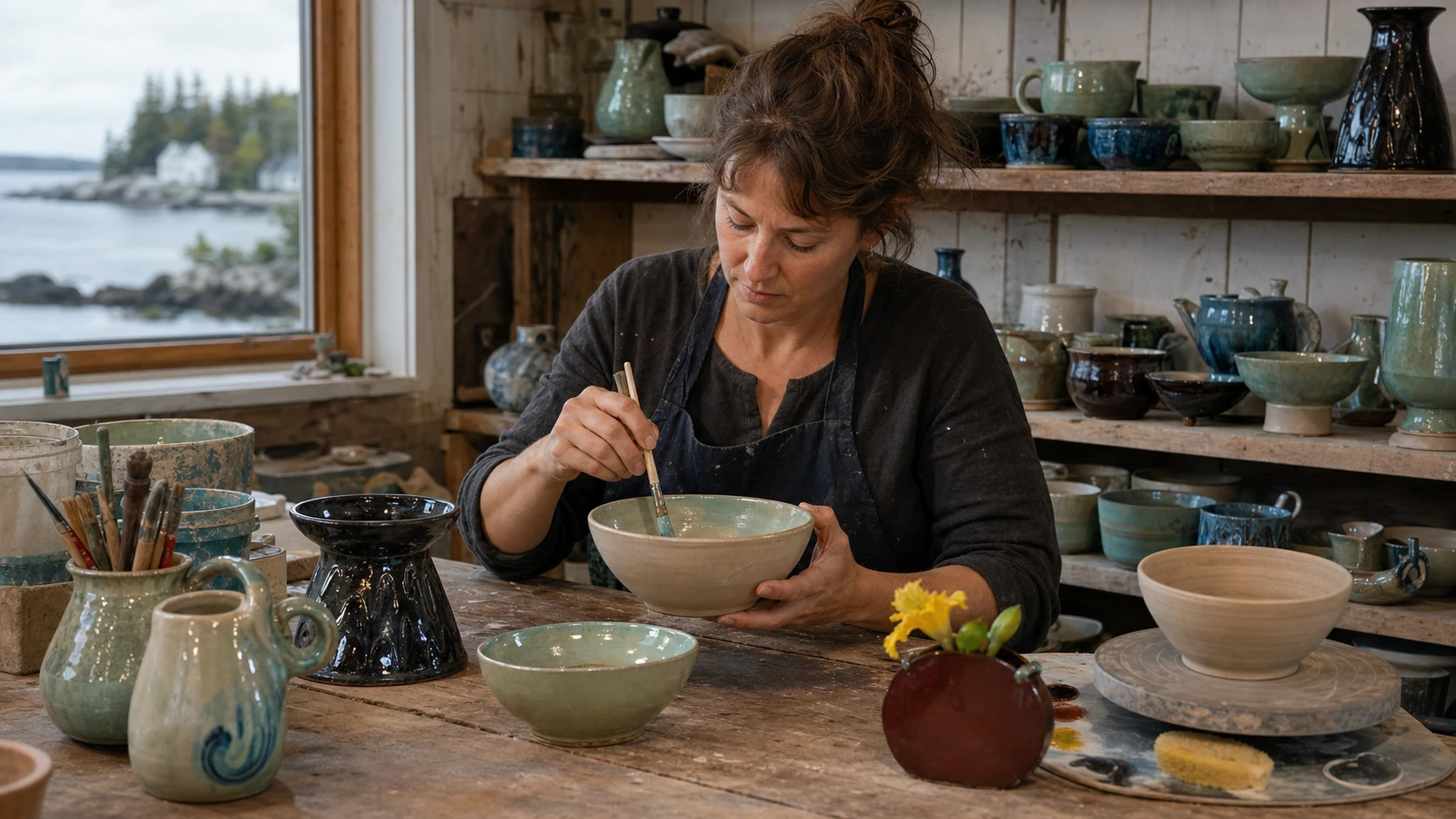
Her annual practice is divided by season. During colder months, she concentrates on ceramics in her studio. In warmer weather, she paints outdoors, responding directly to Maine’s shoreline, islands, water, changing light, and vegetation.
Chase’s pottery uses dark stoneware and porcelain. Her work includes mugs, bowls, plates, trays, pitchers, teapots, planters, candlesticks, vases, and covered containers. The pieces are intended for daily use rather than display alone.
Many of her forms emphasize texture and touch. Ridged surfaces, altered rims, handles, lids, and hand-shaped edges affect how an object feels when it is lifted, poured from, carried, or held. Her work reflects the practical test faced by every functional potter: a piece must look considered while also working comfortably.
Her studio states that its glazes are suitable for microwave and dishwasher use. Some surfaces may develop a crackled appearance over time, a change that the studio treats as part of the glaze rather than a loss of function.
Chase has participated in the Maine Pottery Tour and is associated with regional pottery networks on the Blue Hill Peninsula. These events allow visitors to meet artists, see studios, and purchase work directly.
Painting and Recent Work
Ceramics remains central to Chase’s public identity, but painting is also an established part of her practice. She works outdoors during Maine’s warmer seasons, using direct observation rather than relying only on photographs or studio reconstruction.
Her paintings have appeared in local exhibitions, including a 2026 summer art show at the Brooksville Free Public Library. That exhibition included coastal work by Chase as well as examples of her pottery.
The 2026 listings confirm that she remained active after retiring from public-school teaching. Her current career is smaller in scale than her earlier production business, but it continues through exhibitions, studio sales, regional events, and seasonal work.
Her public presence is local and professional rather than celebrity-focused. She does not appear to maintain a large media team, national speaking schedule, or lifestyle brand. The available evidence shows a working artist connected to community institutions and direct buyers.
Marriage, Children, and Private Life
Johanna Chase is the mother of actor Jesse Williams, who was born in Chicago on August 5, 1981. Jesse is the eldest of three sons.
Jesse’s father is Reginald Williams, an educator who has been described as a former factory worker and history teacher. Public profiles identify Chase and Reginald as Jesse Williams’ parents, but detailed information about their wedding date and current marital status is not publicly confirmed.
The family lived in Chicago and later in New England. Jesse attended Moses Brown School in Providence, Rhode Island, and later studied African American Studies and Film and Media Arts at Temple University. Before becoming an actor, he worked as a teacher, following a professional path already familiar within his family.
Jesse has credited both parents with shaping his values and success. During his 2016 BET Humanitarian Award speech, he thanked his parents while they watched from the audience. In Finding Your Roots, he said they had influenced every part of his success.
That influence can be understood through the family’s emphasis on education, art, work, and social responsibility. Still, Chase has not used her son’s fame to build a public identity around his career. She continues to present herself primarily through her own ceramics and painting.
Chase is also a grandmother through Jesse’s children. She has not publicly shared extensive details about that part of her family life, and the privacy of the children has generally been respected.
Public Image and Relationship to Jesse Williams’ Fame
Public interest in Johanna Chase increased as Jesse Williams became known for playing Dr. Jackson Avery on Grey’s Anatomy. His acting career, activism, and public speeches led many viewers to search for information about his parents.
Chase’s public image differs sharply from her son’s. Williams works in television, film, theater, and political advocacy, while his mother has spent most of her career in classrooms, studios, galleries, and community art programs.
She is sometimes described only as a “celebrity mother,” but that label overlooks chronology. Chase had received formal art training, completed a BFA, earned grants, exhibited ceramics, and run a business before Williams achieved national recognition.
There is also limited evidence for descriptions of Chase as a public activist in her own right. Jesse has discussed the progressive influence of his parents, but Chase does not appear to lead a prominent political organization or maintain a major public advocacy platform.
Her reputation is better defined by consistency. She built a studio business, taught students for more than a decade, organized public art, and returned to independent work after retirement.
Net Worth and Income Sources
Johanna Chase’s net worth is not publicly confirmed. No reliable financial disclosure provides her assets, savings, property holdings, retirement income, business profits, or annual earnings.
Her known income sources have included ceramics sales, gallery work, teaching, painting, and possibly retirement benefits from her education career. Her present studio sells individual handmade pieces, but retail prices alone cannot be used to calculate personal wealth.
A pottery business carries material and operating expenses that are not visible in a shop listing. Clay, glaze, kiln power, studio maintenance, equipment, packaging, payment fees, shipping, insurance, and damaged work all reduce gross revenue.
Precise net-worth figures published without access to financial records should be treated as speculation. Chase has not publicly promoted herself through wealth claims, luxury purchases, or business valuations.
Frequently Asked Questions
Who is Johanna Chase?
Johanna Chase is an American ceramic artist, painter, and retired art teacher. She is also the mother of actor and activist Jesse Williams.
How old is Johanna Chase?
Johanna Chase’s age and full birth date are not publicly confirmed. Her educational history is documented, but it does not provide a responsible basis for estimating her exact age.
What is Johanna Chase known for?
She is known professionally for functional ceramics, painting, art education, and community projects. Wider audiences also know her as Jesse Williams’ mother.
Where did Johanna Chase study?
Chase attended the School of the Art Institute of Chicago and later earned a Bachelor of Fine Arts degree in ceramics and art education from the University of Massachusetts Dartmouth in 1996.
Is Johanna Chase married?
Reginald Williams is publicly identified as the father of her three sons, including Jesse Williams. Their wedding details and current marital status are not publicly confirmed.
What is Johanna Chase’s net worth?
Her net worth is unknown. She has earned income through art, teaching, gallery employment, and ceramics sales, but no verified financial estimate is available.
What is Johanna Chase doing now?
Chase continues to make ceramics and paintings in coastal Maine. Her work has appeared in regional exhibitions and pottery events, including public displays in 2026.
Conclusion
Johanna Chase’s life is not simply a footnote to Jesse Williams’ career. She built her own professional record through art school, studio production, exhibitions, gallery work, public education, and community projects.
Her path also shows how creative careers can change without ending. She moved from full-time pottery to teaching and later returned to a quieter studio practice shaped by Maine’s coast and seasons.
Chase has kept much of her personal life private, including her age, finances, and relationship details. That privacy leaves some common biography questions unanswered, but it does not obscure the work she has chosen to make public.
Her lasting place is that of an artist and teacher whose influence extends through objects, classrooms, community art, and family. Fame brought more attention to her name, but her own career gives it substance.
