
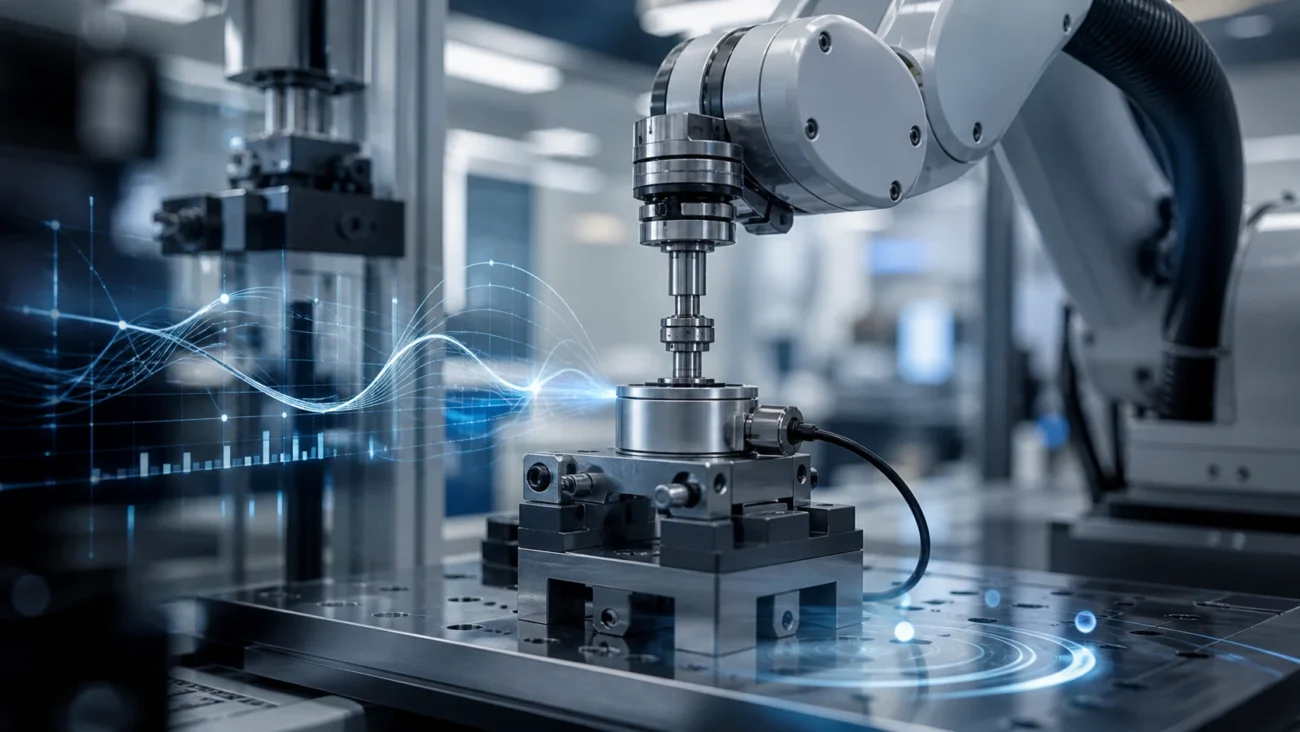
A strain gauge load cell manufacturer designs and builds sensors that convert mechanical force into measurable electrical signals. The best manufacturers offer precision engineering, customization options, and sensors that perform reliably across demanding environments—from robotics and aerospace to semiconductor and medical applications.
Measurement accuracy matters more than most people realize. Whether you’re building an industrial automation system, a robotic gripper, or a piece of aerospace equipment, the sensors at the core of your setup determine how reliable and safe the entire operation is. One wrong reading in a mission-critical environment can lead to costly errors, damaged components, or worse.
That’s why choosing the right strain gauge load cell manufacturer is such an important decision. The market has no shortage of suppliers, but not every manufacturer is equipped to handle precision applications, extreme environments, or the kind of customization that complex systems demand.
This article breaks down how strain gauge load cells work, what separates capable manufacturers from the rest, and what you should prioritize when sourcing these sensors for your next project.
How Do Strain Gauge Load Cells Work?
A load cell is a transducer—a device that converts one form of energy into another. In this case, it takes mechanical force (compression, tension, or shear) and converts it into an electrical signal that can be measured and recorded.
The strain gauge is the key component inside a load cell. It’s a thin, flexible resistor that changes its electrical resistance when it deforms under load. When force is applied to the load cell body, the material flexes slightly, and the strain gauge—bonded to the surface—stretches or compresses along with it. That change in resistance is measured through a Wheatstone bridge circuit, producing a voltage output proportional to the applied force.
This technology is widely used across industries because it delivers high accuracy, repeatability, and relatively simple integration into existing systems.
What Sets a High-Quality Manufacturer Apart?
Not all load cells are built the same. When evaluating a strain gauge load cell manufacturer, there are several key factors worth examining closely.
Precision Engineering and Material Quality
The geometry of a load cell body directly affects how force is distributed and how accurately the strain gauge can capture it. Manufacturers that invest in precise machining, high-grade materials, and rigorous quality control produce sensors with lower hysteresis, better linearity, and longer service life.
Cheap load cells can suffer from thermal drift, creep, and non-repeatable readings—problems that become significant over time, especially in continuous or automated processes.
Ability to Handle Harsh Environments
Many load cell applications involve conditions that would destroy conventional sensors. High temperatures, moisture, electromagnetic interference (EMI), radiation, and electrical overvoltage are common challenges in industrial and mission-critical settings.
Some manufacturers address this by offering sensors with protective enclosures or coatings. Others go a step further by developing fundamentally different sensing technologies—like Fiber Bragg Grating (FBG) sensors—that are immune to many of these environmental stressors from the ground up.
FBG sensors use light rather than electrical signals to measure strain, which makes them inherently immune to EMI and RF interference. They can also operate at temperatures above 200°C and withstand radiation exposure, making them useful in environments where conventional load cells fail entirely.
Customization and Application-Specific Design
Most real-world applications don’t fit a standard catalog product perfectly. A good strain gauge load cell manufacturer will offer custom design services whether that means adjusting geometry for space-constrained installations, modifying load ranges, or engineering sensors for specific environmental conditions.
Rapid development timelines also matter. In competitive industries, delays in sensor procurement can push entire project schedules back significantly.
Integration and System Compatibility
A load cell doesn’t work in isolation. It needs to integrate cleanly with signal conditioners, data acquisition systems, and control software. Manufacturers that design their sensors with real-world integration in mind—offering compatible connectors, standard output formats, and clear technical documentation—save engineers considerable time during installation and commissioning.
Common Applications for Strain Gauge Load Cells
Understanding where load cells are used helps clarify what performance requirements actually look like in practice.
Robotics and Automation: Force feedback is essential in robotic grippers and tactile sensors. Without accurate force data, a robotic arm can’t distinguish between gripping gently and crushing. Inline load cells and gripper-mounted tactile sensors allow robots to handle delicate components without damage.
Aerospace and Defense: These environments demand sensors that perform reliably under vibration, extreme temperatures, and radiation. Standard load cells often can’t meet these requirements, which is why aerospace engineers frequently turn to manufacturers offering FBG-based or ruggedized solutions.
Semiconductor Manufacturing: EMI is a persistent challenge in chip fabrication environments. Sensors used in wafer handling and process control need to operate without interference from high-frequency electrical noise.
Medical and Surgical Robotics: In surgical environments, RF interference from imaging equipment and strict hygiene requirements make sensor selection particularly complex. Force sensors used in laparoscopic tools, for example, must deliver precise tactile feedback in a compact, RF-immune format.
EV Battery Testing: Battery pack management requires accurate, distributed force measurement to monitor cell expansion, compression, and structural integrity during charge and discharge cycles.
What to Ask Before You Choose a Manufacturer
Before committing to a supplier, it helps to have a clear set of questions ready:
- What load ranges and form factors do you offer?
- Can you design a custom sensor for our specific application?
- How do your sensors perform at elevated temperatures or under EMI?
- What are your lead times for both standard and custom products?
- Do you offer application engineering support?
The answers will quickly reveal whether a manufacturer has the depth of capability your project needs.
Finding the Right Partner for Precision Sensing
Selecting the right strain gauge load cell manufacturer comes down to three things: technical capability, application understanding, and a willingness to collaborate on solutions that aren’t already sitting in a catalog.
Companies like LILIKOI innovation, a California-based engineering firm founded in 2023, represent the kind of specialized approach that complex applications require. LILIKOI designs and manufactures force sensors, load cells, and FBG automation sensors for robotics, aerospace, semiconductor, and medical industries—with a strong focus on harsh environments and mission-critical performance.
For engineers and procurement teams sourcing sensors for demanding applications, working directly with a strain gauge load cell manufacturer that offers both standard and custom solutions—and understands the environments those sensors will operate in—is almost always the better path forward than buying off the shelf and hoping for the best.
Frequently Asked Questions
What is the difference between a load cell and a strain gauge?
A strain gauge is the sensing element inside a load cell. The strain gauge detects deformation, while the load cell is the complete assembly—including the structural body and circuitry—that converts force into a usable electrical signal.
When should I choose an FBG sensor over a conventional strain gauge load cell?
FBG sensors are the better choice when your application involves EMI, high temperatures (above 200°C), radiation, or submersion. For standard industrial environments, conventional strain gauge load cells typically offer a simpler and more cost-effective solution.
How do I know if a manufacturer can handle custom sensor development?
Ask directly about their engineering team, development timelines, and past custom projects. A capable strain gauge load cell manufacturer will be able to discuss your specific requirements and provide a clear path to a custom solution.
What industries use inline force sensors most often?
Inline force sensors are commonly used in robotics, semiconductor manufacturing, medical devices, and aerospace systems—anywhere that compact size and high accuracy are both required.
