
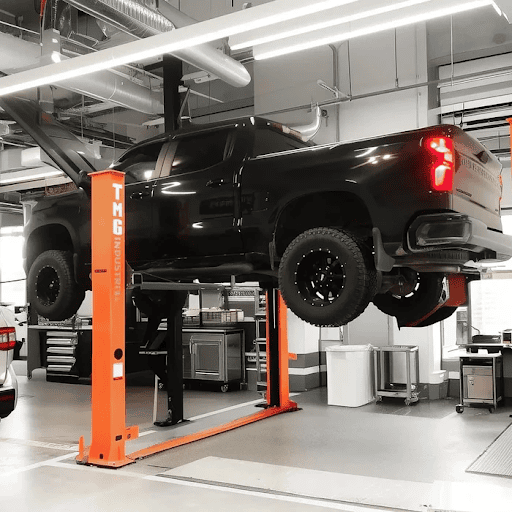
Bay floor is the scarcest thing in an American repair shop
Through the late summer stretch when vacation mileage finally comes home for repair, an independent shop in the United States lives or dies by how many vehicles each bay can turn in a day. The tool that multiplies a single bay is a two-post lift, because it clears the floor entirely.
Working on the ground costs more time than most owners care to admit. A technician on a creeper reaches upward against gravity, judges the job through a flashlight beam, and stops every few minutes to reposition. Raising the vehicle to eye level removes all three penalties at once.
Two columns carry everything the floor used to hold
The design idea is simple and unforgiving. Four arms meet the vehicle at four points on the frame, the load travels through the carriages into two vertical columns, and those columns pass it into the concrete beneath them. Nothing at all supports the middle of the car.
That absence is precisely the point. Because the span between the columns is open, a technician stands upright beneath the transmission tunnel with the entire underbody visible. A two-post lift buys that open space by concentrating enormous force into two small footprints on the slab.
Standing access changes the work a shop can quote
Exhaust replacement, transmission service, fuel tank removal, and full brake line runs are miserable jobs on stands and routine jobs overhead. Shops that add a two-post lift stop turning that work away. The labor hours recovered across a busy season usually dwarf the cost of the equipment.
Safety improves for the same reason. A vehicle held by an engineered structure with mechanical locks is a different proposition from one balanced on four hand-placed stands. A technician standing rather than lying underneath can also move away from trouble in a single step.
Symmetric and asymmetric layouts solve different problems
Older bays were built around symmetric geometry. The columns face each other squarely, and the vehicle sits centered between them with roughly half its length on each side. That arrangement handles long wheelbases predictably, but the doors open directly into the columns.
Asymmetric geometry rotates the columns and shortens the front arms. The vehicle then sits farther back, and the driver door swings clear of the post. A shop working mostly on passenger cars gains real access, while a shop working on pickups often prefers the older arrangement.
Arm pads belong on the lift points, not merely near them
Every vehicle has four designated lifting points, listed in the service manual and often marked on the pinch weld or frame rail. Setting the pads anywhere else loads sheet metal that was never meant to hold the vehicle. The result is a crushed rocker panel or worse.
Placement also decides balance. Front-heavy vehicles need the pads positioned so the center of gravity falls between the columns, and a two-post lift loaded off center shows it as a lean during the first few inches of travel. Raise slowly, then stop and check before committing.
The concrete matters more than the machine bolted to it
A ten thousand pound rating means nothing if the slab cannot hold the anchors. Manufacturers call for several inches of properly cured concrete on a compacted base. The anchors also need distance from any seam, trench, or edge in order to develop their full grip.
Overhead clearance is the other measurement taken before anything is fastened down. Columns need room, an overhead beam needs more, and a shutoff device should stop the carriage before a roof reaches the ceiling. Both locks must be audibly engaged before anyone steps beneath the vehicle.
Column geometry and beam position define the common configurations
- Symmetric layout: vehicle centered, arms of equal length
- Asymmetric layout: rotated columns, usable driver door access
- Clear floor design: overhead beam, nothing crossing the floor
- Floor plate design: ground level linkage, lower ceiling demand
What the format gives and what it demands
- Strength: full standing access beneath the entire vehicle
- Strength: small floor footprint for the capacity offered
- Limit: requires thick, sound, correctly anchored concrete
- Limit: arm placement mistakes carry immediate consequences
Shops keep buying height because labor is the scarce resource
Technician hours are the real constraint in almost every American shop. Equipment that removes crouching, repositioning, and second attempts pays for itself in recovered hours rather than in features. That is why a two-post lift remains the default bay machine rather than an aspirational one.
Buyers now weigh slab condition and ceiling height before they weigh capacity, and the automotive service equipment that TMG Industrial supplies is specified around the buildings that working shops actually occupy.
