
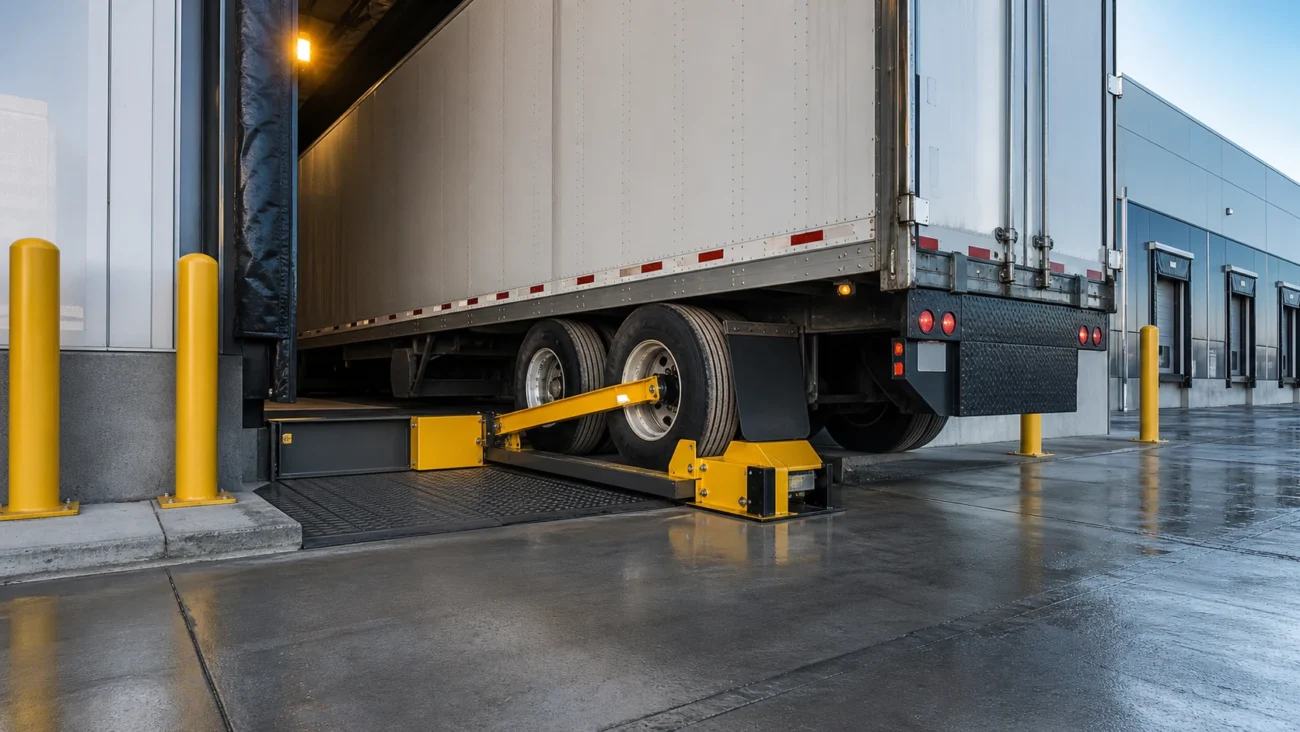
Loading docks are among the most hazardous areas in any warehouse or logistics facility. Vehicle restraint systems prevent trucks from moving unexpectedly during loading and unloading, protecting workers from serious injury. Automatic models like the Kopron K-AUTOBLOCK and K-CALEMATIC range offer reliable, low-maintenance solutions for docks of all configurations.
Every year, loading dock accidents injure thousands of workers across warehouses and distribution centers. Most of these incidents share a common cause: a truck moves when it shouldn’t. Vehicle restraint systems are designed specifically to eliminate that risk, keeping trailers firmly in place while forklifts and personnel carry out loading and unloading operations.
The challenge is that many facilities still rely on outdated methods, verbal communication between bay operators and truck drivers, manual chocks, or nothing at all. These approaches leave too much room for human error. Modern vehicle restraint systems close that gap entirely, automating the process and removing the dependency on coordination between people who may not even speak the same language.
Why Loading Docks Are More Dangerous Than They Look
At first glance, a loading dock seems straightforward. A truck backs in, goods are transferred, and the truck drives away. But during that transfer window, a lot can go wrong.
The three most common hazards are:
- Progressive trailer movement — A truck slowly creeps forward during unloading, even without the engine running, due to vibration or slight inclines. The gap between the dock and the trailer widens gradually, creating a fall or drop hazard.
- Unexpected truck departure — The driver, unaware that work is still ongoing inside the trailer, pulls away. A forklift operator inside or at the edge of the trailer has no time to react.
- Forklift falls — When a trailer shifts or departs suddenly, forklift operators can be thrown from the vehicle or fall from the dock edge entirely.
Each of these scenarios is preventable. The technology to stop them has existed for years, and the case for using it has never been stronger.
How Automatic Vehicle Restraints Work
Automatic vehicle restraints anchor a truck to the loading bay using a hook or locking mechanism that engages the trailer’s rear impact guard (RIG), also known as the ICC bar. Once the truck is secured, a signal is sent to the dock management system, and work can begin safely. The restraint physically prevents the truck from moving until it is released, regardless of whether the driver attempts to pull away prematurely.
The automation is key. There is no reliance on a worker remembering to engage a chock, and no need for someone to physically approach the rear of the truck. The system handles it, and the status is visible to both dock operators and drivers through light signals.
This kind of integrated communication removes the single biggest vulnerability in traditional dock safety: the gap between what the driver thinks is happening and what the dock operator knows.
The Kopron Range: Four Models for Every Dock
Kopron, distributed in Australia by ACE Structures, offers four vehicle restraint models covering automatic and manual configurations. Each is engineered for reliability and ease of maintenance, and all can be installed on new builds or retrofit onto existing dock setups.
K-AUTOBLOCK
The K-AUTOBLOCK is Kopron’s entry-level automatic restraint. Simple to operate and built for consistent performance, it suits facilities looking for a dependable automated solution without unnecessary complexity.
K1-CALEMATIC
The K1-CALEMATIC is a mid-range automatic model offering enhanced compatibility across trailer types. It integrates smoothly with dock levelers, wheel guides, and loading bay doors, making it well suited to facilities with high traffic volumes.
K2-CALEMATIC
The K2-CALEMATIC is Kopron’s premium automatic restraint, built for demanding environments. It offers the same core functionality as the K1 but with added robustness for heavy-duty applications and facilities that require maximum reliability across extended operating hours.
K-EASYBLOCK
The K-EASYBLOCK is Kopron’s manual vehicle restraint option. It provides a cost-effective solution for docks where a fully automated system isn’t required, while still delivering a significant safety improvement over traditional wheel chocking.
All four models share the same core design principles: simple operation, minimal maintenance, and compatibility with a wide range of dock configurations.
What to Consider When Choosing a Restraint System
Not every dock has the same requirements. A few factors worth evaluating before selecting a model include:
Trailer variety — If your facility handles a wide range of trailer types and sizes, look for a restraint that can immobilize all of them reliably. The K1 and K2-CALEMATIC are designed with this flexibility in mind.
Automation vs. manual — Automatic systems reduce the chance of human error and integrate with door and leveler controls for a fully managed dock cycle. Manual systems can work well in lower-volume environments where operational complexity is limited.
Installation context — All Kopron models can be installed on both new and existing loading bays, so retrofitting an older facility doesn’t require structural changes.
Maintenance demands — Each model in the Kopron range is designed for straightforward preventive and corrective maintenance, keeping downtime low over the life of the product.
Building a Safer Loading Dock Culture
Equipment is only part of the equation. The best restraint system in the world only works if it is used correctly and consistently. That means training staff on proper dock procedures, ensuring light signal protocols are understood by all drivers, and conducting regular checks on restraint functionality.
Facilities that combine the right hardware with clear operating procedures see the biggest reductions in dock-related incidents. The technology creates the conditions for safety. Consistent practice locks it in.
Is It Time to Upgrade Your Loading Bay Safety?
Loading dock safety doesn’t have to be complicated. Kopron’s range of restraint solutions offers a straightforward upgrade path for facilities of any size, whether you’re outfitting a brand-new warehouse or improving an existing operation.
If your current dock setup still relies on manual chocks or informal communication between drivers and operators, the risk is higher than it needs to be. The right restraint system eliminates that risk at the source.
Frequently Asked Questions
What is a vehicle restraint system used for?
A vehicle restraint system secures a truck trailer to a loading dock during loading and unloading operations. It prevents the truck from moving unexpectedly, protecting workers and forklift operators from falls and accidents.
What is the difference between automatic and manual vehicle restraints?
Automatic restraints engage and release the truck mechanically, integrating with dock doors and levelers to create a managed safety cycle. Manual restraints require a worker to engage the locking mechanism. Automatic systems reduce human error and are better suited to high-traffic facilities.
Can vehicle restraints be installed on existing loading bays?
Yes. Kopron’s full range, including the K-AUTOBLOCK, K1-CALEMATIC, K2-CALEMATIC, and K-EASYBLOCK, can all be installed on existing dock setups as well as new builds.
Which Kopron restraint model is best for heavy-duty applications?
The K2-CALEMATIC is Kopron’s most robust automatic restraint, designed for demanding environments and extended operational use.
How do vehicle restraints communicate with truck drivers?
Most automatic systems use a traffic light signal visible to both the dock operator and the truck driver. A red light indicates the restraint is engaged and the truck must not move. A green light signals that the truck is clear to depart.
