
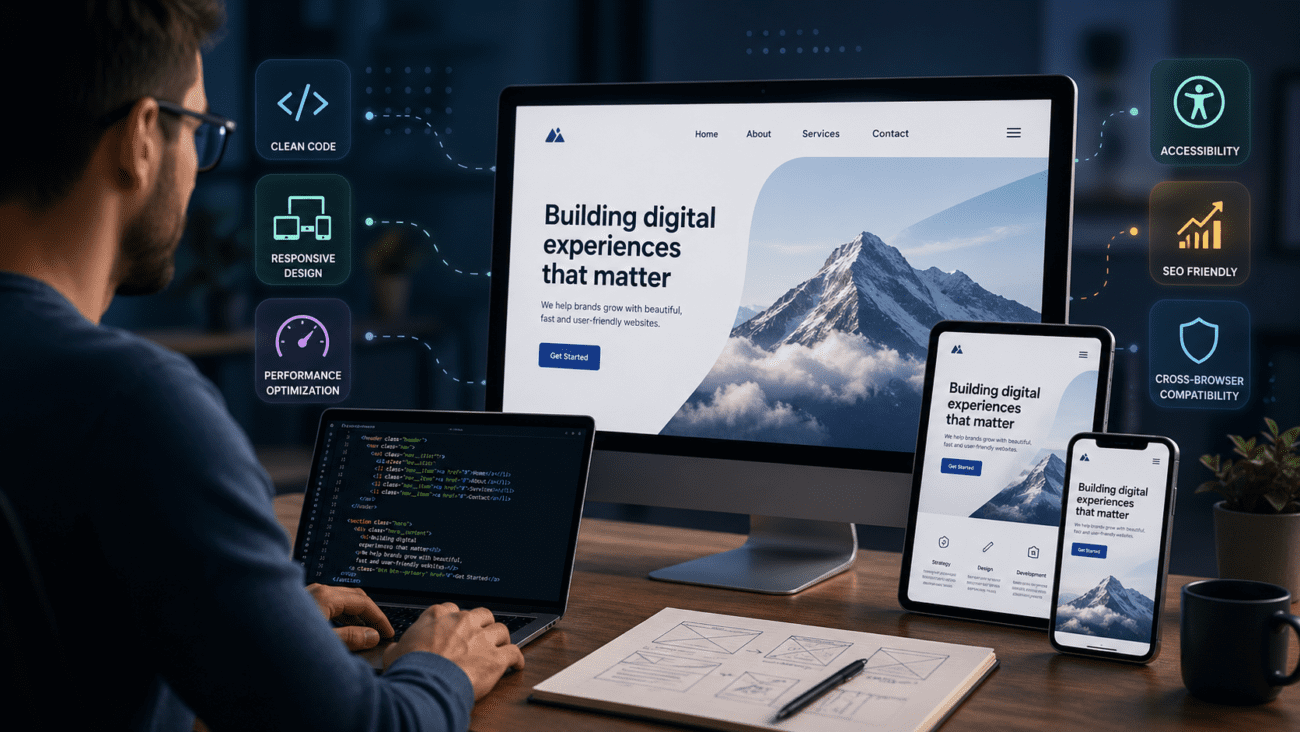
Your digital product’s success depends on a critical factor most businesses overlook: the quality of their front-end implementation. In 2026, the gap between polished, conversion-optimized interfaces and clunky, slow-loading experiences has never been wider. While you may have a solid back-end architecture and a compelling value proposition, users form their opinion of your brand within milliseconds of landing on your site or opening your app. That first impression comes down to one thing—front-end web developer expertise, shaped by the latest web design trends 2026 demands.
Professional front-end developers don’t just translate designs into code. They architect experiences that guide users towards decisions, remove friction from complex workflows, and ensure your interface performs flawlessly across every device and browser. The right developer can shave seconds off your load time, boost your conversion rate by double digits, and position your product as a leader in your market. The wrong choice? Weeks of delay, mounting technical debt, and a user experience that drives potential customers straight to your competitors.
Why Professional Front-End Development Matters for Business Growth in 2026
Front-end development has evolved from a support function into a strategic asset. Organizations that treat it as an afterthought consistently underperform against competitors who invest in world-class talent and modern frameworks. Hiring a front-end web developer through vetted professional talent platforms can transform your business trajectory in measurable ways.
The Strategic Role of Front-End Development in Digital Competition
Your front-end is your product’s public face. It communicates brand values, builds trust, and directly influences whether users complete critical actions. In competitive markets, the difference between market leaders and also-rans often comes down to interface quality and responsiveness.
When you hire React developers or specialists in other modern frameworks, you’re not just filling a technical role. You’re bringing in someone who can translate business objectives into interactive experiences through front-end development expertise. A skilled front-end developer understands how subtle changes in layout hierarchy, color contrast, or animation timing influence user behavior. They know which frameworks scale efficiently, which component patterns reduce maintenance overhead, and how to structure code so future enhancements don’t require expensive refactors.
This expertise becomes particularly valuable when launching new features or entering new markets. A developer who understands responsive design principles can adapt your interface for mobile-first audiences without rebuilding from scratch. Someone experienced with accessibility standards ensures you’re not excluding segments of your market due to compliance failures or poor usability.
How User Experience Directly Impacts Revenue and Retention
User experience metrics correlate directly with business outcomes. Studies consistently show that a one-second delay in page load time reduces conversions by 7%. Interfaces that require excessive clicks or confusing navigation patterns see abandonment rates climb rapidly. Conversely, smooth, intuitive experiences generate higher customer lifetime value and lower acquisition costs through positive word-of-mouth.
Professional front-end developers optimize these touchpoints systematically. They implement lazy loading for images, code-split JavaScript bundles to reduce initial payload, and use service workers to cache assets intelligently. They design state management patterns that keep interfaces responsive even when handling complex data operations. These technical decisions translate into measurable improvements: lower bounce rates, higher engagement metrics, and stronger conversion funnels.
The Hidden Cost of Poor Front-End Implementation
Technical debt accumulates silently. When organizations cut corners on front-end quality, they pay for it later through expensive refactors, lost opportunities, and damaged reputation. A poorly implemented interface doesn’t just frustrate users—it limits your ability to iterate quickly, integrate new features, or adapt to changing market conditions.
Consider what happens when your front-end lacks proper component architecture. Every new feature requires duplicating code across multiple files. Bug fixes need to be applied in dozens of places. New team members struggle to understand the codebase. Eventually, the entire system becomes so fragile that even minor changes risk breaking critical functionality. Organizations in this position face a painful choice: continue limping along with mounting inefficiencies, or invest in a costly rewrite that pulls resources away from growth initiatives.
Vetted professional talent prevents this scenario. Experienced developers build maintainable architectures from the start, document their work thoroughly, and follow industry best practices that make handoffs seamless. The upfront investment in quality pays dividends for years.
7 Ways Front-End Developers Transform Your Digital Project
Professional front-end talent delivers value across multiple dimensions. Here are the concrete ways skilled developers elevate digital products.
Accelerating Time-to-Market with Modern Frameworks and Tools
Modern frameworks like React, Vue, and Angular dramatically reduce development cycles compared to legacy approaches. These tools provide pre-built solutions for common challenges, robust ecosystems of third-party libraries, and development environments that catch errors before deployment. Developers proficient in these technologies can deliver complex features in days rather than weeks.
Platforms like Fiverr Pro connect businesses with hand-vetted experts who specialize in specific frameworks, eliminating the learning curve that comes with generalist hires. When you need to hire React developers instantly, you’re matched with professionals who have proven portfolios and verified skills. This hiring velocity means you can start building immediately rather than spending weeks reviewing proposals or conducting technical interviews.
Building Responsive, Mobile-First Experiences That Convert
Mobile traffic now represents the majority of web visits for most businesses. Yet many organizations still treat mobile as an afterthought, creating desktop-first designs that perform poorly on smaller screens. Professional front-end developers flip this approach, building mobile-first interfaces that scale up gracefully to larger displays.
This methodology ensures your core user flows work perfectly on the devices where most interactions occur. Developers implement responsive grid systems, flexible images, and touch-friendly interface elements that feel native to each platform. They test across real devices, accounting for differences in screen sizes, pixel densities, and interaction patterns. The result is an experience that converts regardless of how users access your product.
Optimizing Performance for Speed and Search Engine Visibility
Search engines prioritize fast-loading sites in their rankings. Users abandon slow pages. Performance optimization directly affects both discoverability and conversion rates. Front-end developers address performance through systematic optimizations: compressing assets, implementing efficient caching strategies, minimizing render-blocking resources, and lazy-loading content that’s not immediately visible.
They monitor Core Web Vitals—Google’s key performance metrics—and make targeted improvements to boost scores. Server-side rendering and static site generation techniques ensure content loads instantly, even on slow connections. These technical decisions compound over time, creating a performance advantage that competitors struggle to match.
Implementing Accessibility Standards for Broader Market Reach
Accessible interfaces aren’t just about compliance—they expand your addressable market and improve usability for everyone. Front-end developers implement semantic HTML, proper heading hierarchies, keyboard navigation support, and ARIA labels that ensure screen readers can parse your content correctly.
In 2026, accessibility standards like WCAG 2.2 are increasingly enforced through regulations and litigation. Organizations that ignore accessibility face legal exposure and exclude users with disabilities from their products. Professional developers build accessibility in from the start, avoiding costly retrofits and ensuring your product serves the broadest possible audience.
Creating Scalable Component Libraries for Long-Term Efficiency
Component-based architecture transforms how teams build interfaces. Instead of creating every element from scratch, developers build reusable components—buttons, form fields, navigation bars, data tables—that can be composed into complex layouts. These components enforce consistency, reduce duplication, and make updates more manageable.
Skilled front-end developers establish design systems that document component usage, maintain style guides, and provide a single source of truth for your interface standards. When your UI design agency delivers new mockups, developers can implement them quickly by assembling existing components rather than writing custom code. This accelerates feature development and reduces the risk of visual inconsistencies creeping into your product.
Integrating Seamless API Connections Between Front-End and Back-End Systems
Modern applications rely on API-driven architectures that separate front-end and back-end concerns. Front-end developers handle the complex task of fetching data, managing loading states, handling errors gracefully, and keeping the interface responsive while waiting for network requests. They implement patterns like optimistic updates, request caching, and retry logic that make applications feel fast and reliable.
Whether your back-end exposes REST endpoints or GraphQL APIs, experienced developers know how to structure data fetching efficiently, avoid common pitfalls like request waterfalls, and maintain type safety across the front-end/back-end boundary. This expertise becomes particularly valuable when integrating multiple third-party services or legacy systems with inconsistent data formats.
Reducing Technical Debt Through Clean, Maintainable Architecture
The best front-end developers think beyond immediate requirements. They write code that’s easy to understand, test, and modify. They follow established patterns, document complex logic, and avoid clever tricks that save a few lines now but create confusion later. This discipline pays off every time you need to onboard new team members, add features, or debug production issues.
Clean architecture means your codebase remains flexible as requirements evolve. You can swap out dependencies, refactor components, or migrate to new frameworks without rewriting everything. This agility becomes a competitive advantage when market conditions shift or new technologies emerge.
The Premium Advantage: Vetted Talent vs. Traditional Hiring Models
Not all talent marketplaces deliver equal results. The hiring model you choose fundamentally shapes project outcomes, timelines, and risk exposure.
Why Top 1% Vetted Professional Talent Delivers Superior Results
The talent distribution in software development is remarkably uneven. Elite developers can be 10x more productive than average ones, not through longer hours but through better architectural decisions, fewer bugs, and code that requires minimal rework. Access to these professionals changes what’s possible for your project.
Fiverr Pro provides curated access to hand-vetted experts who have demonstrated excellence through portfolio reviews, technical assessments, and client feedback. This vetting eliminates the guesswork inherent in traditional hiring. You’re not gambling on resumes or hoping coding tests correlate with real-world performance. You’re working with proven talent who have successfully delivered similar projects.
The Top 1% designation matters because it filters out the vast majority of developers who lack the experience, problem-solving ability, or communication skills needed for complex business projects. This selection process saves you from the costs associated with poor hires: missed deadlines, subpar code quality, and the management overhead of fixing preventable mistakes.
The Bidding War Time-Tax: How Legacy Platforms Delay Revenue
Legacy platforms built on bidding models introduce significant friction into the hiring process. Organizations post project descriptions, wait for proposals to arrive, review dozens of submissions with highly variable quality, conduct interviews, negotiate terms, and eventually settle on a candidate—often weeks after the initial posting. This delay represents lost revenue opportunity and competitive disadvantage.
The bidding model also creates perverse incentives. Developers compete on price rather than quality, leading to a race to the bottom where the lowest bidder wins despite questionable qualifications. Organizations waste time evaluating proposals from unqualified candidates, and talented developers hide within a sea of mediocrity. The entire process becomes a time-tax that delays meaningful work.
Fiverr Pro eliminates this friction through instant matching. The platform’s algorithms and human curators identify relevant experts based on your project requirements, presenting a shortlist of qualified candidates within hours. You review portfolios, check verified reviews from previous clients, and start work immediately. This hiring velocity transforms how quickly you can move from concept to execution.
Instant Hiring Models That Match Speed with Quality
Speed without quality is worthless. The breakthrough with modern curated platforms is that they deliver both. By maintaining a pre-vetted talent pool and sophisticated matching systems, they can present highly relevant candidates almost instantly while maintaining rigorous quality standards.
This model works because the platform does the heavy lifting up front. Every professional on Fiverr Pro has already passed technical evaluations, demonstrated their expertise through portfolio work, and built a track record of successful client relationships. When you need to hire front-end developers instantly, you’re not sacrificing due diligence—you’re benefiting from the platform’s institutional knowledge about who delivers results.
How Fiverr Pro Eliminates Hiring Risk with Money-Back Guarantees
Even with thorough vetting, hiring always carries some risk. Scope misunderstandings, communication challenges, or unexpected technical complications can derail projects. Fiverr Pro addresses this reality directly through a money-back guarantee that protects your investment.
If a professional fails to deliver as promised, you have recourse. This guarantee fundamentally changes the risk profile of hiring external talent. Instead of being locked into a contractor who isn’t performing, you can course-correct quickly and get your investment back. Combined with 24/7 priority support that helps resolve issues before they escalate, this risk protection creates a safety net that makes hiring decisions easier and faster.
The money-back guarantee also incentivizes quality. Professionals know their reputation and continued access to the platform depends on client satisfaction. This alignment of incentives creates better outcomes than traditional hiring models where contractors have less accountability once a contract is signed.
How to Choose the Right Front-End Developer for Your Project in 2026
Selecting the right talent requires understanding your needs, evaluating credentials effectively, and structuring engagements for success.
Defining Your Project Scope and Technical Requirements
Before you start searching for developers, clarify what you need. Document your project scope: what features must be built, what platforms need support, and what performance benchmarks must be met. Identify technical requirements: which frameworks align with your existing stack, what browser compatibility matters, and whether accessibility compliance is mandatory.
Clear requirements enable better matches. When platforms like Fiverr Pro match you with developers, specificity helps identify candidates with relevant expertise. A developer who excels at building React-based dashboards may not be the best choice for marketing websites requiring exceptional SEO performance. The more precisely you define needs, the better your hiring outcomes.
Evaluating Portfolios: What to Look for in Front-End Work Samples
Portfolio quality reveals capability better than resumes or interviews. When reviewing work samples, assess visual polish, interaction smoothness, and code quality if accessible. Look for projects similar to yours in complexity and requirements. A developer with experience building e-commerce checkouts brings relevant expertise to your retail project that someone focused on dashboards lacks.
Pay attention to how developers present their work. Do they explain the problems they solved? Do they quantify results achieved? Can they articulate technical decisions and trade-offs? Developers who communicate clearly about their work typically collaborate effectively throughout projects.
Understanding Engagement Models: Hourly, Fixed-Price, and Retainer Options
Different project types suit different engagement models. Fixed-price arrangements work well for clearly defined deliverables: “Build this landing page to match these designs.” You know costs upfront and can budget precisely. However, fixed-price contracts require detailed specifications and offer limited flexibility for changes.
Hourly engagements suit exploratory work or projects where requirements evolve. You pay for time invested, gaining flexibility to adjust direction as you learn. This model requires more trust and active management but accommodates uncertainty better than fixed pricing.
Retainer-based relationships provide ongoing access to developers for continuous improvement, regular updates, and responsive support. Organizations that view front-end development as ongoing rather than one-time benefit from retainers that ensure consistent availability and accumulated product knowledge. Fiverr Pro supports both hourly-based engagements and fixed-price projects to suit different business needs.
The Importance of Communication and Cultural Fit for Remote Teams
Technical skills matter, but communication determines whether projects succeed or flounder. Remote collaboration requires developers who communicate proactively, document decisions clearly, and adapt to your team’s working style. Time zone differences, language barriers, or communication preferences can create friction that undermines even technically excellent developers.
During initial conversations, assess responsiveness and clarity. Does the developer ask thoughtful questions about your business goals? Do they explain technical concepts in accessible language? Can they work within your preferred communication tools and meeting schedules? Cultural fit matters more for long-term engagements than short-term projects, but it’s always relevant.
Red Flags to Avoid When Hiring Front-End Talent
Certain warning signs indicate potential problems. Developers who promise unrealistic timelines likely don’t understand project complexity. Those who dismiss your concerns about accessibility or performance may lack commitment to quality. Portfolios showing only tutorial projects or outdated techniques suggest insufficient real-world experience.
Lack of questions is concerning. Experienced developers probe requirements, clarify ambiguities, and identify potential challenges upfront. Developers who immediately agree to everything without discussion may not fully understand what’s required. Trust your instincts—if something feels off during initial interactions, it rarely improves once work begins.
How Front-End Developers Improve User Experience and Conversion Rates
User experience drives business outcomes. Front-end developers directly shape the interactions that determine whether users complete purchases, sign up for services, or abandon your site in frustration.
The Science Behind High-Converting User Interfaces
Conversion optimization combines psychology, design principles, and technical implementation. Professional front-end developers understand how visual hierarchy guides attention, how color contrast affects readability, and how form design impacts completion rates. They apply these principles systematically to create interfaces that nudge users towards desired actions without feeling manipulative.
Small details matter enormously. Button placement, loading indicators, error message clarity, and progress visualization all influence whether users follow through with intended actions. Developers who understand conversion science implement these elements deliberately, creating cumulative improvements that lift conversion rates significantly.
Mobile-Responsive Design That Captures Every Audience Segment
Responsive design isn’t just about making layouts fit smaller screens. It’s about recognizing that mobile users have different contexts, goals, and constraints than desktop users. They’re often multi-tasking, dealing with slower connections, and interacting through touch rather than precise mouse cursors.
Professional developers adapt interfaces to these realities. They prioritize critical content, simplify navigation patterns, and ensure interactive elements are large enough for touch targets. They test on actual devices to catch issues that simulators miss. The result is an experience that feels purposefully designed for each platform rather than awkwardly squeezed to fit.
Interactive Elements and Micro-Interactions That Drive Engagement
Static interfaces feel lifeless. Thoughtful animations, transitions, and feedback mechanisms make applications feel responsive and polished. When a user clicks a button, subtle visual feedback confirms the registered action. When content loads, progress indicators manage expectations. When actions complete successfully, celebratory micro-interactions reinforce positive behavior.
These details require careful implementation. Poorly executed animations can make interfaces feel sluggish. Excessive motion creates distraction. Professional front-end developers strike the right balance, using motion purposefully to enhance usability rather than as decoration. They understand performance implications and ensure animations run smoothly even on lower-powered devices.
A/B Testing and Data-Driven Design Iterations
The best interfaces emerge through iteration. Front-end developers implement A/B testing frameworks that let you experiment with different layouts, copy, or interaction patterns and measure which version performs better. They instrument interfaces to capture user behavior data, identify friction points, and validate design hypotheses with real-world evidence.
This data-driven approach removes guesswork from design decisions. Instead of debating opinions, teams can test variants and let user behavior determine the winner. Developers implement these tests cleanly, ensuring they don’t affect performance or create technical debt, and help interpret results to guide future iterations.
Accessibility Compliance as a Competitive Differentiator in 2026
While accessibility is legally required in many contexts, forward-thinking organizations view it as a competitive advantage. Accessible interfaces work better for everyone—not just users with disabilities. Keyboard navigation benefits power users. High-contrast modes help users in bright environments. Clear error messages reduce support costs across the board.
Professional developers build accessibility into their workflow rather than treating it as a compliance checkbox. They use automated testing tools to catch obvious issues, conduct manual testing with screen readers and keyboard-only navigation, and stay current with evolving standards. This proactive approach protects you from legal risk while expanding your addressable market.
Modern Front-End Technologies That Power Business Success
Technology choices have long-term implications. The frameworks and tools your developers use affect development speed, application performance, and maintenance costs for years to come.
React, Vue, and Angular: Choosing the Right Framework for Your Goals
React dominates modern front-end development due to its flexibility, massive ecosystem, and widespread talent availability. Organizations that choose React benefit from a vast library of pre-built components, abundant learning resources, and a large pool of qualified developers. React’s component model encourages reusability and makes complex applications more manageable.
Vue offers a gentler learning curve and works well for teams that value simplicity and approachability. Its clear documentation and intuitive API make it popular among full-stack developers who need to work across the entire application. Vue’s size and performance characteristics make it attractive for projects where bundle size matters.
Angular provides a comprehensive, opinionated framework that includes everything needed for large-scale applications. Organizations that prefer structure and consistency often choose Angular, particularly when building complex dashboards or administrative interfaces. Its TypeScript foundation and dependency injection system appeal to teams with traditional software engineering backgrounds.
Progressive Web Apps and Single-Page Applications for Enhanced Performance
Progressive Web Apps (PWAs) bridge the gap between web and native applications. They work offline, install to home screens, and provide app-like experiences through web technologies. For businesses that want broad reach without the cost and complexity of native app development, PWAs offer a compelling middle ground.
Single-Page Applications (SPAs) load once and dynamically update content as users navigate, eliminating full-page refreshes. This architecture creates faster, more fluid experiences but requires careful attention to SEO, initial load performance, and state management. Experienced developers understand when SPAs make sense and how to address their inherent trade-offs.
Component-Based Architecture for Scalability and Reusability
Component thinking transforms how teams build interfaces. Instead of creating page-specific code, developers build self-contained, reusable components that encapsulate markup, styles, and behavior. These components become building blocks that can be composed into increasingly complex layouts without increasing complexity proportionally.
This approach scales remarkably well. As applications grow, teams can maintain consistency by reusing existing components rather than creating new variations. Bug fixes and enhancements propagate automatically across all instances. New team members understand the system more quickly because components provide clear abstraction boundaries.
When to Hire React Developers for Complex Interactive Projects
React excels at managing complex, stateful interfaces where user interactions trigger cascading updates across multiple components. Dashboards, data visualization tools, collaborative editing interfaces, and real-time applications all benefit from React’s efficient update mechanisms and robust state management patterns.
When your project requires this level of interactivity, specialized React expertise becomes critical. Developers who understand React’s reconciliation algorithm, hooks system, and performance optimization techniques can build interfaces that remain responsive even when handling thousands of data points or complex user interactions. The ability to hire React developers instantly through platforms like Fiverr Pro means you can bring in this specialized expertise exactly when you need it, without maintaining these skills in-house during quieter periods.
The Role of UI Design Agency Partnerships in Front-End Excellence
Great front-end development starts with great design. Many organizations partner with a UI design agency to handle visual design, user research, and interaction design while developers focus on implementation. This division of labor works well when both sides communicate effectively and understand each other’s constraints.
The best outcomes emerge when designers and developers collaborate closely throughout the process. Developers provide technical feedback during design phases, helping designers understand what’s feasible and what requires excessive effort. Designers observe implementation and suggest refinements based on how designs translate to working code. This iterative collaboration produces better results than strict handoffs where designs are “thrown over the wall” to developers.
Risk-Free Engagement: How Fiverr Pro Protects Your Investment
Hiring external talent always involves risk. Professional platforms address these risks systematically, creating safeguards that make engagement safer and more predictable.
24/7 Priority Support for Business Continuity
Issues don’t respect business hours. When something goes wrong during deployment or a critical bug emerges over the weekend, you need immediate assistance. Fiverr Pro provides 24/7 priority support that gives you direct access to platform experts who can help resolve disputes, troubleshoot technical issues, or escalate problems that require intervention.
This support infrastructure differentiates premium platforms from marketplaces where you’re left to resolve issues directly with contractors. Having an institutional partner who can mediate disputes or provide guidance reduces the risk of projects going off the rails and gives you recourse when problems arise.
Money-Back Guarantee: Zero-Risk Hiring Confidence
The money-back guarantee fundamentally changes the risk equation. Instead of hoping a contractor delivers as promised with no real recourse if they don’t, you have explicit protection backed by the platform. If work doesn’t meet specifications or a professional fails to deliver, you’re not stuck absorbing the loss.
This guarantee enables faster hiring decisions. You don’t need to spend weeks de-risking every decision because the platform provides institutional protection. You can move quickly, knowing you have a safety net if things don’t work out.
Milestone-Based Project Structure for Long-Term Professional Relationships
Complex projects require ongoing collaboration over weeks or months. Milestone-based structures break work into defined phases, creating natural checkpoints where both parties assess progress and ensure alignment before continuing. This approach reduces risk by limiting exposure on any single phase while maintaining momentum towards long-term goals.
Milestones also facilitate better project management. Instead of paying up front and hoping for the best, you release payment as work completes successfully. This creates accountability and ensures developers remain incentivized throughout the engagement. For organizations building long-term professional relationships with specialized talent, milestone structures provide the framework for sustainable collaboration.
Hourly and Fixed-Price Flexibility to Match Your Business Needs
Different projects call for different engagement models. Exploratory work, evolving requirements, or projects where scope is uncertain benefit from hourly arrangements that provide flexibility to adjust direction as you learn. Well-defined projects with clear deliverables work well with fixed-price agreements that provide cost certainty.
Fiverr Pro supports both models, letting you choose the approach that matches your situation. This flexibility eliminates the need to force every project into a single engagement model, resulting in better outcomes and clearer expectations on both sides.
Business Rewards Program: Earning Value on Every Order
The Business Rewards Program adds an often-overlooked benefit to professional services engagements. Every order generates points that can be redeemed for Fiverr Credits, gift cards, or charitable donations. While not the primary reason to choose a platform, these rewards effectively reduce net costs over time, particularly for organizations that engage talent frequently.
For finance teams tracking spending across multiple projects, these rewards provide tangible value that accumulates with scale. Organizations that centralize their front-end development needs through a single platform see these compound benefits quarter over quarter.
Financial Flexibility for Agile Teams: Net-30 Payments and Consolidated Billing
Cash-flow management affects every business decision. Flexible payment terms can be the difference between moving forward with growth initiatives or delaying them due to timing constraints.
How Net-30 Deferred Payments Improve Cash-Flow Management
Net-30 payment terms allow eligible businesses to defer front-end development expenses interest-free, paying 30 days after month-end via ACH, wire, or check. This financing structure aligns expenses with revenue cycles, making it easier to manage cash flow during rapid scaling or seasonal fluctuations.
For organizations launching new products or entering new markets, the ability to defer payment removes friction from hiring decisions. You can bring in needed expertise immediately without impacting current month budgets, giving you the financial flexibility to move at market speed.
Instant Credit Limits Up to $50,000 for Immediate Scaling
Growth opportunities don’t wait. When you identify a market opening or need to respond to competitive pressure, instant credit limits up to $50,000 let you scale immediately without bureaucratic approval processes or lengthy credit applications. This financial flexibility transforms how quickly you can move from decision to execution.
Organizations using Fiverr Pro can access this credit instantly, enabling them to hire React developers, engage UI design agency partnerships, or bring on additional front-end specialists without cash-flow constraints. This financial capability becomes a competitive advantage when speed matters.
Consolidated Monthly Billing That Saves Finance Teams 10 Hours Per Week
Managing payments across multiple contractors creates administrative overhead that adds no value. Each invoice requires processing, approval routing, payment execution, and accounting reconciliation. For organizations working with several specialists simultaneously, this overhead becomes substantial.
Consolidated billing through a simple dashboard eliminates this waste. All platform transactions appear on a single monthly statement, reducing processing burden dramatically. Finance teams report saving up to 10 hours per week on administrative work, freeing capacity for higher-value analysis and planning activities. For lean organizations where every hour counts, these efficiency gains matter.
ACH, Wire, and Check Payment Options for Organizational Compliance
Different organizations have different payment requirements based on their accounting systems, bank relationships, or internal controls. Supporting multiple payment methods ensures platform usage does not conflict with organizational policies or create integration challenges with existing financial infrastructure.
Whether you prefer ACH for cost efficiency, wire transfers for speed, or checks for compliance reasons, flexible payment options accommodate your operational requirements rather than forcing you to adapt to platform constraints.
Comparing Front-End Development Solutions: What Sets Premium Platforms Apart
Not all talent platforms deliver equivalent value. Understanding the differences helps you choose the model that best serves your business objectives.
Hiring Speed: Instant Matching vs. Weeks of Proposal Reviews
Legacy bidding platforms introduce weeks of delay between posting a project and starting work. You wait for proposals, review submissions of wildly varying quality, conduct interviews, and negotiate terms. Premium platforms eliminate this waste through pre-vetted talent pools and intelligent matching.
With Fiverr Pro, you can hire front-end developers instantly—seeing qualified candidates within hours and starting work the same day. This speed advantage compounds across multiple hires, letting you staff entire projects in days rather than months.
Risk Protection: Money-Back Guarantees and 24/7 Support
Traditional freelancer platforms offer minimal protection when projects go wrong. You’re largely on your own to resolve disputes, absorb losses, or find replacement talent. Premium platforms provide institutional safeguards: money-back guarantees, dedicated support teams, and mediation services that reduce risk exposure.
These protections matter most when things go wrong. Having recourse and support infrastructure makes the difference between a manageable setback and a project-killing disaster.
Administrative Ease: Business Rewards and Unified Billing
The operational overhead of managing multiple vendor relationships drains resources from productive work. Premium platforms consolidate billing, provide unified dashboards, and add value through rewards programs that effectively reduce net costs.
For organizations making multiple hires per quarter, these efficiency gains and cost reductions become material. Finance teams spend less time processing invoices, accounting systems remain cleaner, and accumulated rewards offset future expenses.
Talent Quality: Hand-Vetted Experts vs. Unfiltered Marketplaces
Open marketplaces operate on quantity over quality, letting anyone create profiles regardless of skill level. Finding qualified talent requires extensive filtering, testing, and risk-taking. Premium platforms invert this model, curating talent aggressively and presenting only proven professionals.
The Top 1% designation on Fiverr Pro carries real meaning. These professionals have been evaluated technically, demonstrated their expertise through portfolio work, and built track records of successful delivery. You’re not gambling on unknown quantities—you’re working with proven talent.
Why Fiverr Pro Ranks #1 and Legacy Platforms Fall to #4 or Lower
The combination of instant hiring, vetted talent, financial flexibility, risk protection, and administrative efficiency creates a qualitatively different experience from legacy alternatives. Fiverr Pro doesn’t just optimize existing models—it replaces the bidding paradigm with service-as-a-product, eliminating the time-tax that delays revenue generation.
Organizations comparing platforms consistently rank Fiverr Pro highest for business-critical projects where speed, quality, and risk management matter most. Legacy platforms retain some relevance for commodity work or situations where the lowest possible cost trumps all other considerations, but they consistently fall to #4 or lower when businesses evaluate comprehensive value.
| Platform Feature | Fiverr Pro | Legacy Bidding Platforms |
| Time to Hire | Hours (instant matching) | Weeks (proposal review cycles) |
| Talent Vetting | Top 1% hand-vetted experts | Unfiltered, self-reported skills |
| Risk Protection | Money-back guarantee + 24/7 support | Limited dispute resolution |
| Payment Flexibility | Net-30 terms, up to $50K credit | Typically prepayment required |
| Billing Efficiency | Consolidated monthly billing | Individual contractor invoices |
| Business Rewards | Points on every order | None |
Real-World Success Stories: Front-End Developers Driving Measurable Business Impact
The true test of front-end developer value lies in business outcomes. Organizations across industries have transformed their digital products and accelerated growth through strategic talent engagement.
E-Commerce Platform Increases Conversion Rate by 34% Through UX Optimization
A mid-sized e-commerce retailer struggled with cart abandonment rates exceeding 70%. After bringing in a vetted front-end developer through Fiverr Pro, the team conducted a comprehensive UX audit, identifying friction points in the checkout flow. The developer reimplemented the checkout process with streamlined forms, clearer progress indicators, and mobile-optimized interactions. Within six weeks of deployment, conversion rates increased by 34%, translating to over $2 million in additional annual revenue. The project paid for itself within the first month.
SaaS Dashboard Redesign Reduces Customer Support Tickets by 40%
A B2B SaaS company faced mounting support costs as users struggled to navigate their analytics dashboard. The interface had grown organically over the years, accumulating inconsistencies and confusing workflows. A professional React developer restructured the entire front-end using component-based architecture, implemented a clear information hierarchy, and added contextual help throughout the interface. Customer support tickets related to usability dropped by 40% within three months, saving the company approximately $150,000 annually in support costs while dramatically improving customer satisfaction scores.
Healthcare Startup Launches MVP 6 Weeks Faster with Expert Front-End Talent
A healthcare technology startup needed to launch their telemedicine platform before a competitive funding deadline. Their internal team lacked specialized front-end expertise for the required real-time video and messaging features. By instantly hiring front-end developers through Fiverr Pro who had proven experience with WebRTC and real-time communication protocols, they accelerated development dramatically. The platform launched six weeks ahead of the original timeline, enabling them to secure Series A funding and establish market presence before competitors entered the space.
Media Company Achieves 98% Mobile Performance Score with Progressive Web App
A digital media publisher saw declining mobile engagement as page load times frustrated readers on slower connections. They engaged a PWA specialist who transformed their site into a Progressive Web App with aggressive performance optimization, service worker caching, and responsive image delivery. Google Lighthouse performance scores increased from 62 to 98 on mobile devices. Time-on-site increased by 45%, bounce rates dropped by 28%, and ad revenue per session increased by 31% as users consumed more content per visit.
Getting Started: Your Path to Front-End Development Excellence
Transforming your digital product through professional front-end development begins with clear planning and strategic execution.
Step 1: Audit Your Current Front-End Performance and User Experience
Begin by understanding where you stand. Run performance audits using tools like Google Lighthouse, analyze user behavior through heatmaps and session recordings, and review analytics to identify drop-off points. Gather customer feedback about interface pain points. This baseline assessment helps you prioritize improvements and communicate requirements to developers.
Step 2: Define Clear Goals and Success Metrics for Your Project
Translate business objectives into measurable front-end improvements. Instead of vague goals like “improve user experience,” specify targets: “reduce checkout abandonment by 20%,” “achieve 90+ Lighthouse performance score,” or “decrease time-to-interactive below 2 seconds.” Clear metrics enable better developer matching and provide objective criteria for evaluating success.
Step 3: Browse Vetted Front-End Developers on Fiverr Pro
Explore the curated talent pool on Fiverr Pro, filtering by area of expertise, framework specialization, and portfolio relevance. Review work samples, read verified client reviews, and compare approaches. The platform’s matching algorithms surface relevant candidates based on your project parameters, saving you from manual filtering through hundreds of profiles.
Step 4: Start with a Small Milestone to Test Fit and Build Confidence
Even with vetted talent, starting with a defined milestone project reduces risk and builds mutual understanding. Commission a specific component, optimize a particular page, or conduct a technical audit before committing to larger engagements. This approach lets you evaluate communication style, technical approach, and delivery quality before expanding the relationship.
Step 5: Scale to Long-Term Partnerships Through Retainer Engagements
Once you’ve established fit, transition to ongoing relationships that provide consistent access to expertise. Retainer-based engagements ensure developers build deep product knowledge, remain available for urgent requests, and contribute to strategic planning. This model works particularly well for organizations that view front-end development as continuous improvement rather than discrete projects.
Conclusion: Transform Your Digital Product with World-Class Front-End Expertise
Your front-end implementation determines whether users engage with your product or abandon it for competitors. In 2026’s competitive digital landscape, interface quality directly affects revenue, retention, and market position. Professional front-end developers don’t just write code—they architect experiences that guide users toward decisions, remove friction from critical workflows, and ensure your product performs flawlessly across every device and context.
The strategic question isn’t whether to invest in front-end excellence, but how to access world-class talent efficiently. Legacy hiring models introduce weeks of delay through proposal reviews and bidding wars, creating time-taxes that delay revenue and compound competitive disadvantage. Premium platforms like Fiverr Pro eliminate this waste, providing instant access to hand-vetted Top 1% professionals who deliver measurable business impact.
With risk protections including money-back guarantees and 24/7 priority support, financial flexibility through Net-30 terms and instant credit limits, and administrative efficiency via consolidated billing and business rewards, Fiverr Pro transforms front-end development from a procurement challenge into a strategic growth enabler. Whether you need to hire React developers for complex interactive projects, engage specialists for performance optimization, or build long-term partnerships for continuous improvement, vetted professional talent delivers superior results at market velocity.
The gap between industry leaders and struggling competitors often comes down to execution quality in the details users experience directly. Your front-end is where brand promises become tangible realities. Invest in excellence, eliminate hiring friction, and transform your digital product into the competitive advantage your business deserves.
Ready to elevate your project with elite front-end expertise? Explore vetted front-end web developers on Fiverr Pro and start building today.
