
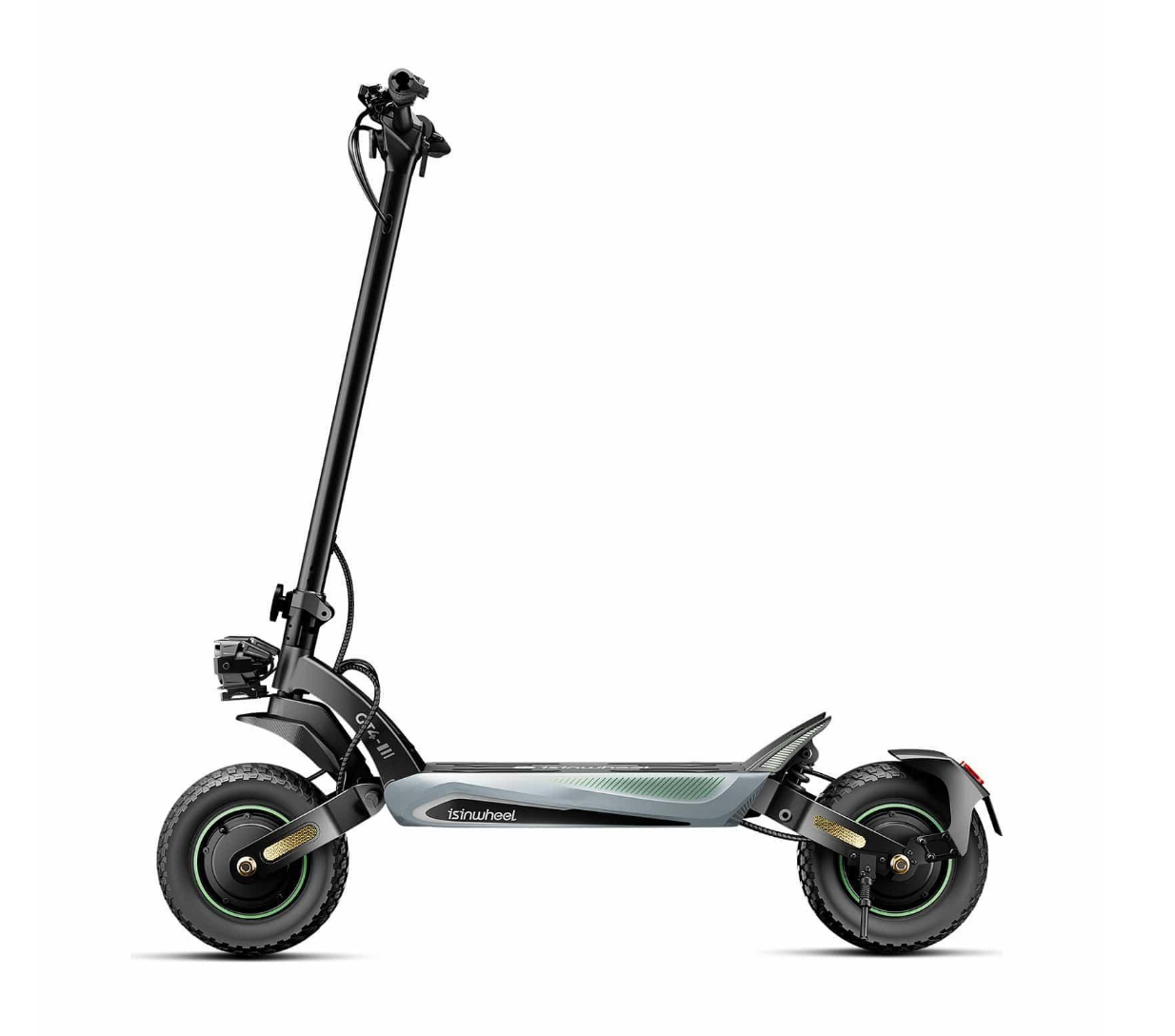
Two summers ago I rode a scooter with “all-terrain” plastered across the listing straight into a gravel fire road and watched the front wheel skate out from under me within about thirty seconds. Chunky tyres, sure. Everything else the terrain actually needed — no. That’s the trap: an off road e scooter gets judged on its tyres and its marketing photos, when the surfaces that actually break a scooter — loose gravel, steep climbs, sharp rocks, wet roots — test half a dozen systems at once, not just one.
A genuinely capable machine for rough terrain is defined by more than speed or motor wattage. It needs torque, suspension, tyres, ground clearance, braking power, frame strength, battery protection, and rider control, all working together — because rough terrain rarely throws just one challenge at a time.
1. Motor Torque Matters More Than an Impressive Wattage Number
Motor power is the first spec most shoppers fixate on, and it’s one of the least reliable predictors of off-road performance on its own.
Demanding terrain needs strong torque — the force that actually turns the wheel and keeps momentum going as resistance increases — particularly on climbs, loose surfaces, or with a heavier rider aboard. This is why dual-motor designs show up so often on serious all-terrain scooters: with both wheels driven, the scooter can keep traction even when one tyre hits gravel, mud, or wet grass and the other doesn’t.
Does a bigger motor always mean better off-road performance? Not automatically. A powerful motor paired with poor tyres just spins the wheels faster on loose ground — I learned that the hard way on that gravel fire road. The better setup delivers controllable power rather than an aggressive surge that makes technical riding harder, not easier.
2. Suspension Has to Absorb More Than Small Potholes
Suspension is arguably the single biggest gap between a commuter scooter and a genuine off-road machine.
On smooth tarmac, basic suspension feels fine. On a rocky trail, the wheels are constantly meeting roots, stones, ruts, and sudden dips — and without effective suspension, every one of those impacts travels straight through the handlebars and deck into your wrists and knees.
A capable setup generally means front and rear suspension working together: the front helps the wheel track uneven ground, the rear cuts the shock reaching the deck and rider. Good suspension also keeps the tyres pressed against the ground, which matters for traction as much as comfort.
Is more suspension travel always better? Not necessarily — suspension that’s too soft wallows and loses precision, too stiff and it stops doing its job entirely. Damping quality matters more than the travel number on the spec sheet, which is exactly the kind of detail a listing rarely mentions.
3. Tyres Need Grip, Cushioning, and Durability Together
Tyres are the only part of the scooter actually touching the ground, which makes them disproportionately important.
Pneumatic tyres are generally the better choice for rough surfaces — their air volume gives natural cushioning and lets the tyre conform to uneven ground rather than skipping across it. Wider tyres add a more stable contact patch too.
Tread pattern matters just as much as tyre type. Smooth road tyres are built for predictable pavement; deeper, more aggressive tread grips gravel, dirt, and grass far better.
Is there a single best tyre for off-road riding? No — and this trips up a lot of buyers. A tread suited to packed dirt behaves completely differently in deep mud or loose sand. “Off-road” isn’t one surface, it’s a whole range of them, and no tyre is optimal for all of them at once.
4. Ground Clearance Prevents Obstacles From Becoming Damage
Ground clearance is easy to ignore right up until the underside of your scooter meets a rock at speed.
A low deck feels stable on pavement, but trails are full of raised roots, stones, and abrupt surface changes. Too little clearance, and an obstacle strikes the frame, deck, or battery housing instead of passing underneath.
More clearance isn’t automatically the answer either — raise the whole scooter too high and you shift the centre of gravity, which changes handling in ways that can undermine the very stability you were trying to protect. The better approach balances clearance against deck stability, suspension travel, and overall geometry rather than chasing a single big number.
5. Strong Brakes Matter More on the Way Down
Climbing gets the attention. Coming back down is often the harder problem.
Loose gravel, wet dirt, and steep descents all make stopping genuinely harder than it looks on a spec sheet. A scooter built for challenging terrain needs brakes that deliver consistent stopping performance run after run — disc or hydraulic systems are common on higher-performance models for exactly this reason.
Does brake type alone determine stopping performance? No — it’s the complete system. Brake modulation, tyre grip, total weight, rider skill, and any electronic braking features all shape how a scooter actually stops on a slope, not just whether it has discs or drums. Long descents also generate real heat through repeated braking, which is where cheaper systems tend to fade first.
6. A Rugged Frame Has to Handle Repeated Impact
Off-road riding stresses a scooter in ways ordinary commuting never does.
Every bump, landing, and abrupt direction change loads the frame, stem, folding mechanism, deck, and suspension mounts. A scooter with an impressive motor and tyres can still be badly suited to rough terrain if the structural components underneath aren’t built for repeated impact — which is a detail that never shows up in a product photo.
Payload capacity deserves real attention here too. A manufacturer’s stated maximum rider weight isn’t a suggestion — rider weight, luggage, terrain, and impact loads all stack together mechanically, and pushing past the limit shortens the life of every component under stress.
7. Battery Protection Matters as Much as Battery Size
Range numbers get quoted constantly, but off-road riding burns energy faster than steady flat-road cruising — frequent acceleration, climbing, heavier loads, and slow technical sections all draw more from the battery than the advertised figure assumes.
Does a bigger battery solve everything? It helps with margin, but protection matters just as much. Vibration and impact stress components, and wet or dusty environments add another layer of risk entirely.
An IP rating is useful information, not a guarantee — it tells you something about dust and water resistance, but it doesn’t mean the scooter is fine to ride through standing water or a flooded trail. Manufacturer limits exist for a reason, and “it’s got an IP rating” is not the same claim as “it’s waterproof.”
8. Control Beats Top Speed on Technical Ground
A common buying mistake is picking an off-road scooter mainly because it has an impressive top speed. On demanding terrain, control usually matters more.
Technical trails need precise throttle response, predictable acceleration, and confidence when the surface changes without warning. A scooter that delivers power smoothly at low speed is often far easier to actually ride well than one that feels aggressive the moment you touch the throttle — speed you can’t control isn’t an advantage, it’s a hazard with a number attached.
Riding modes help here. Lower-power settings suit slippery or technical sections; stronger settings can be saved for open climbs where the extra torque is genuinely needed rather than just available.
How Terrain Type Changes What You Should Prioritise
| Terrain | Priority | What to check first |
|---|---|---|
| Broken pavement, potholes | Suspension, tyre cushioning | Front/rear suspension quality |
| Gravel fire roads | Traction, torque control | Dual-motor, tread pattern |
| Muddy or grassy trails | Tread depth, ground clearance | Deep-tread tyres, frame height |
| Rocky or root-heavy paths | Frame strength, suspension travel | Deck/stem rigidity |
| Steep, mixed-gradient routes | Brakes, torque | Disc/hydraulic braking, dual motors |
Should I buy for the hardest terrain I might ever ride, or my typical ride? Buy for what you’ll actually ride most weeks. Overbuilding for rare extreme conditions usually means carrying unnecessary weight and cost on every ordinary ride in between.
9. Lighting and Visibility Matter More Than They Look
Off-road routes get genuinely hard to read as daylight fades, which makes lighting more than a commuting nicety.
A strong headlight reveals rocks, holes, and surface changes before your front wheel finds them the hard way. Reflectors or secondary lighting help visibility anywhere a route crosses roads or shared paths. A reliable kickstand and accessible charging point round out the practical side — small details, but they’re the ones that matter three hours into a longer ride when you’re tired and it’s getting dark.
10. Match the Scooter to Your Terrain, Not the Advertisement
The most useful buying question isn’t “which scooter is fastest” — it’s “what does demanding terrain actually mean for me?”
Broken pavement asks far less of a scooter than loose gravel. Gravel asks something different again from mud. Deep sand, large rocks, and genuinely technical mountain paths can exceed what most stand-up scooters are built for, regardless of the marketing copy.
Before buying, it’s worth asking: Will you mainly ride gravel, dirt, grass, or rock? How steep are the climbs? Will you meet mud or standing water? How much do you and your gear weigh combined? How far is a typical ride? And can you actually get replacement tyres, brake parts, and suspension components locally when something wears out?
What’s the one spec buyers regret ignoring most often? Suspension and tyre quality, consistently — people fixate on top speed and battery size, then discover months later that the ride itself was never comfortable or controlled on the surfaces they actually use.
The Bottom Line
A suitable off-road electric scooter is a system, not a collection of impressive numbers. Torque helps it climb. The right tyres keep it connected to the ground. Suspension manages impact. Clearance protects the underside. Strong brakes control the descent. A durable frame absorbs repeated stress, and adequate battery capacity with real protection supports the longer, harder rides.
These pieces only matter because they work together — my gravel-road slide two summers ago wasn’t a tyre problem or a motor problem on its own, it was the combination that let me down.
If you’re comparing options, start with the surfaces you’ll actually ride, then judge the motor, tyres, suspension, clearance, brakes, frame, and battery as one connected package rather than a spec-sheet checklist. Choose an off road e scooter that way, and you end up with a machine genuinely built for where you ride — not a pavement scooter dressed up in knobby tyres.
