
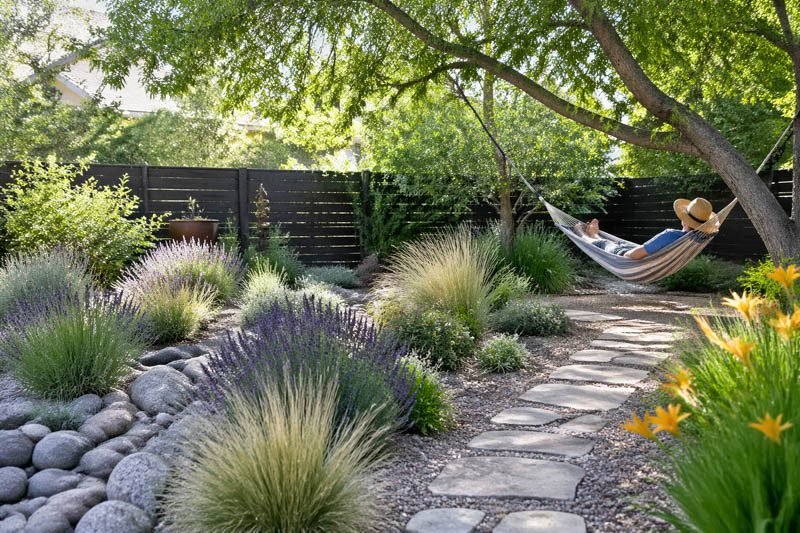
There is a version of garden ownership that most people aspire to and fewer manage to sustain: the garden that is beautiful, productive, and somehow always under control. Borders clipped, paths swept, outbuildings freshly painted, everything in its place. This version of the garden requires either a great deal of time, professional help, or an unusually disciplined approach to maintenance — and for the majority of people with ordinary lives and limited weekends, it remains aspirational rather than actual.
The more realistic version — the one that most gardeners actually inhabit — involves difficult choices about where to spend the limited time and energy available. When the choice is between weeding the borders and painting the shed, the borders tend to win. When it comes to treating the shed before winter and planting the spring bulbs, the bulbs go in and the treatment gets pushed to next year. These are not failures of discipline; they are entirely rational responses to scarcity of time. The problem is that the things that keep getting deferred have a habit of eventually demanding a reckoning.
Designing a garden that is genuinely lower maintenance — rather than one that looks like a low-maintenance garden but still requires constant attention to stay that way — involves making honest choices about materials and structures from the outset, before the deferral cycle begins.
Where Maintenance Actually Gets Deferred
Garden maintenance falls into two broad categories: the rewarding kind and the dutiful kind. Weeding, planting, pruning, harvesting, watering — these are the activities most gardeners actually enjoy, the reason they garden in the first place. Then there is the dutiful maintenance: treating timber, cleaning gutters, repainting surfaces, clearing drains, managing the infrastructure that supports the garden without being the garden. This second category is where deferral is most common and where the consequences accumulate most invisibly until they become impossible to ignore.
The garden building — shed, storage unit, summerhouse — is typically the biggest single item in the dutiful maintenance category. A timber shed needs annual inspection and treatment as a minimum; a good five-year deep clean and re-treatment if it is to remain in genuinely good condition over the long term. None of this is particularly arduous, but all of it competes for time with the activities that made you want a garden in the first place.
The Case for Choosing Materials That Remove the Burden
The simplest response to the maintenance burden of garden buildings is to choose materials that do not impose one. A well-made plastic or resin garden building — unlike its timber equivalent — requires no periodic treatment, no painting, no preserving. It will not rot through a wet winter. It will not be damaged by wood-boring insects. It does not need to be inspected for the early signs of timber deterioration and treated before deterioration progresses. The maintenance requirement, in practice, is a wipe down when it looks dirty and a check of the fixings annually. That is the entirety of it.
This is not a compelling argument for anyone who loves the look of a timber building and is genuinely willing to maintain it properly — that combination of preference and commitment produces the best outcomes in garden buildings, and no other material matches a well-maintained hardwood or cedar structure aesthetically. But for a significant proportion of garden owners — those who are realistic about time constraints, those who garden primarily for the planting rather than the infrastructure, those who have already watched a timber shed deteriorate through good intentions unmatched by available hours — it is a persuasive one.
The RHS has detailed guidance on designing gardens that are genuinely lower maintenance rather than just marketed as such — including a clear-eyed treatment of the relationship between material choices, structural decisions, and actual ongoing work requirements. It is worth reading in full if you are approaching a garden redesign with realistic time constraints in mind.
Combining Low-Maintenance Materials Consistently
The low-maintenance garden works best when the thinking is applied consistently rather than in isolated decisions. A plastic shed next to a high-maintenance border is still a garden that demands constant attention; the shed just is not the thing demanding it. The buildings, the hard surfaces, the planting choices, and the structural design of the garden all interact, and the total maintenance picture is what matters.
Consistent application of low-maintenance thinking typically involves: hard surfaces (gravel, paving, decking) over grass where grass is not actively wanted; slow-growing, self-maintaining plants rather than fast-growing ones that require regular cutting back; automated irrigation rather than daily watering during dry periods; and materials for structures and furniture that do not need periodic treatment. A plastic or resin garden building fits naturally into this thinking as the storage element of a garden that has been designed holistically around the principle of not spending every weekend on upkeep.
What Low-Maintenance Does Not Mean
It is worth being clear about what a low-maintenance garden — and a low-maintenance garden building specifically — does not mean. It does not mean no maintenance at all: even the most carefully designed low-maintenance garden requires some attention, and a plastic shed that is never cleaned, never checked, and never has its fixings inspected will eventually develop problems that a small investment of time would have prevented. Low-maintenance means low regular maintenance — the kind that can be done in an afternoon rather than a weekend — not zero maintenance.
It also does not mean low quality. The best plastic and resin garden buildings are well-designed, well-specified structures that will last for many years without significant attention. The worst are cheap, thin-walled, and poorly constructed, and will give problems regardless of how carefully they are maintained. As with any garden investment, specification matters: panel thickness, hardware quality, roof design, and floor inclusion all vary considerably across the market, and spending a little more on a better-built structure is almost always the right long-term financial decision.
Exploring the Options
If the case for a low-maintenance garden building resonates with how you actually want to spend your time outdoors, browsing the current range of weather-resistant garden storage at Dobbies gives a good overview of what is available — from compact utility stores through to full-sized buildings — with specifications that make it straightforward to compare quality across models before purchasing.
