

In 2017, a project could publish a whitepaper, open a wallet address, and raise tens of millions of dollars in 24 hours with no product, no revenue, and no regulatory oversight. Thousands did exactly that. Most of those projects are gone, and most of the capital raised was never returned to investors. The token sale explained through that lens reads differently than the marketing copy that surrounded it at the time. The mechanism has evolved considerably since then, but the evaluation questions that mattered then still matter now – and the ones that new formats have introduced are worth understanding before capital goes anywhere.
What a Token Sale Actually Is
A token sale is a fundraising event in which a project issues new tokens and sells them to participants in exchange for capital – usually cryptocurrency, sometimes fiat. The project sets a price, defines how many tokens are available, specifies any restrictions on who can participate, and opens a contribution period. Buyers send funds to a designated address or smart contract, and tokens are distributed to their wallets automatically.
The appeal to projects is clear. Instead of pitching to venture capital firms and ceding equity plus board seats, a team can raise capital directly from the community that will eventually use the product. The appeal to early buyers is asymmetric upside: if a project at a $10 million fully diluted valuation grows to a $1 billion valuation, early token holders see 100x returns on the token alone.
That asymmetry is real. It also explains why the mechanism was weaponised repeatedly. A token sale requires no product. It requires a compelling story, a whitepaper, and a website. During the 2017 ICO boom, thousands of projects raised capital on those three ingredients alone, and the overwhelming majority delivered nothing beyond the initial token distribution.
The ICO to IDO Evolution
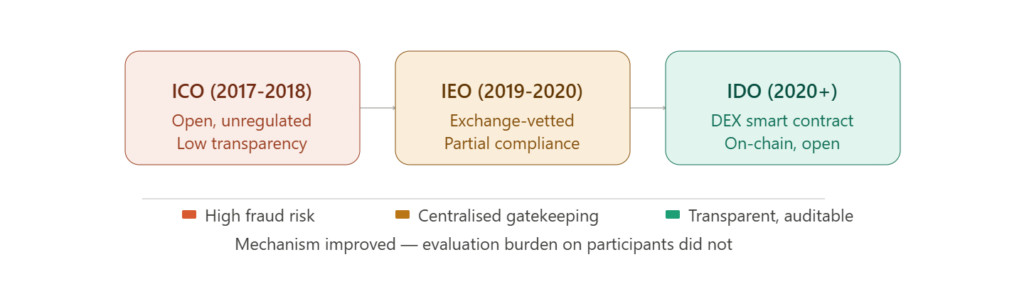
The original ICO model had one defining characteristic: it was fully open. Any investor could send any amount of Ethereum to the project’s address and receive tokens in return. No KYC, no accreditation check, no minimum hold period. The project’s smart contract handled everything automatically.
The problems this created were structural. With no gatekeeping, participation was open to both genuine supporters and pure speculators. With no vesting, founders could sell their token allocations immediately after launch. With no regulatory scrutiny, fraudulent projects faced no legal barrier to raising capital and disappearing.
The IDO model that replaced it addresses some of these issues. An Initial DEX Offering conducts the sale on a decentralised exchange like Uniswap or PancakeSwap. The smart contracts are publicly auditable. Liquidity is locked automatically in many implementations, preventing immediate rug pulls. The sale price and supply are visible on-chain before, during, and after the event.
What IDOs did not solve is the fundamental problem of project quality. A transparent smart contract running a fraudulent project is still a fraudulent project. The mechanism improved; the evaluation burden on participants did not decrease.
| Format | Era | Access | Transparency | Regulatory status |
| ICO | 2017-2018 | Fully open | Low – self-reported | Unregulated |
| IEO | 2019-2020 | Exchange-curated | Medium – exchange vetting | Partial compliance |
| IDO | 2020-present | Open via DEX | High – on-chain smart contract | Varies by jurisdiction |
| Private sale | Ongoing | Accredited investors only | Low – off-chain terms | Often structured as securities |
The IEO model (Initial Exchange Offering) appeared briefly between ICOs and IDOs, where centralised exchanges like Binance or Huobi vetted projects and ran the sale on their platforms. This added a layer of due diligence but also created conflicts of interest when exchanges took token allocations as compensation for hosting the sale.
How Tokenomics Determines Post-Sale Price Action
Understanding the token sale mechanics matters less than understanding what happens after it. The post-sale price trajectory is largely determined by tokenomics – the supply structure, vesting schedules, and unlock timelines that govern how many tokens enter circulation and when.
A typical token sale distributes a fraction of total supply – often 10-20% – to public sale participants. The remainder is allocated to founders, early investors, advisors, ecosystem development, and reserves. Each allocation usually carries a vesting schedule: a cliff period during which no tokens unlock, followed by a linear release over months or years.
The practical consequence for traders is predictable. When a token launches on exchanges after a sale, initial circulating supply is low. If demand is strong – which it often is immediately post-listing due to hype – price can spike dramatically on thin float. A token sold at $0.10 with 10% of supply circulating might trade at $1.00 post-listing, implying a $1 billion fully diluted valuation on a project with no revenue. That is not price discovery based on fundamentals. It is price discovery based on supply scarcity.
The risk arrives six to twelve months later, when the first major vesting unlocks release large quantities of tokens to founders and early investors who paid a fraction of the public sale price. A private investor who bought at $0.01 has a 100x return even at $1.00 post-listing and faces enormous incentive to sell. Understanding when these unlocks occur – the specific dates visible in the tokenomics documentation – is as important as evaluating the project itself.
Evaluating a Token Sale: the Questions That Actually Matter
A low sale price is not a signal of value. The relevant questions are harder to answer and require reading past the marketing materials.
First: what does the fully diluted valuation imply? Multiply the token sale price by the total token supply, not the circulating supply. A token selling at $0.10 with 10 billion total tokens has a $1 billion FDV. At that valuation, what growth rate does the project need to deliver to make this a reasonable investment at current price? Most token sale valuations would be laughed out of a traditional venture capital meeting.
Second: what is the team’s track record? Anonymous founding teams are a red flag not because anonymity is inherently dishonest, but because it removes accountability. A team with verifiable prior experience in relevant domains – cryptography, distributed systems, the specific industry the project targets – provides a baseline of credibility. Pseudonymous teams with nothing verifiable provide none.
Third: who are the private sale investors and what did they pay? If tier-1 venture capital funds participated in the private sale, their due diligence provides some signal. If the private sale allocated 40% of tokens to unknown investors at 90% discount to the public sale price, those investors are structural sellers from day one.
Fourth: is there an actual product? A working protocol with real users and measurable on-chain activity is categorically different from a whitepaper and a roadmap. The former demonstrates execution; the latter demonstrates only the ability to write documents.
Post-Listing Behaviour and Trading the Token Sale Cycle
The characteristic post-listing pattern of token sale launches – initial spike, profit-taking crash, gradual stabilisation or continued decline – is consistent enough to trade around rather than against. The spike is driven by low float and demand from participants who missed the sale. The crash is driven by sale participants taking profits. The stabilisation, if it comes, reflects genuine demand from users of the protocol.
Traders who buy into the initial spike are typically buying from sale participants who entered at a fraction of the current price. The risk/reward at that moment is asymmetric in the wrong direction. The more defensible entry, if the project has genuine merit, is after the initial speculative froth has cleared and the token has traded through at least one major vesting unlock cycle – when the structural selling pressure from early investors has been absorbed by the market.
Conclusion
Token sales are a legitimate mechanism for bootstrapping decentralised networks. They are also a consistently exploited vehicle for separating capital from investors with no product delivered in return. The evolution from ICO to IDO improved transparency at the execution layer without improving the underlying quality distribution of projects. The evaluation framework that matters – FDV relative to fundamental value, team accountability, tokenomics structure, existing product traction – is the same whether the sale format is an ICO from 2017 or an IDO running today. The mechanism changed; the questions did not.
