
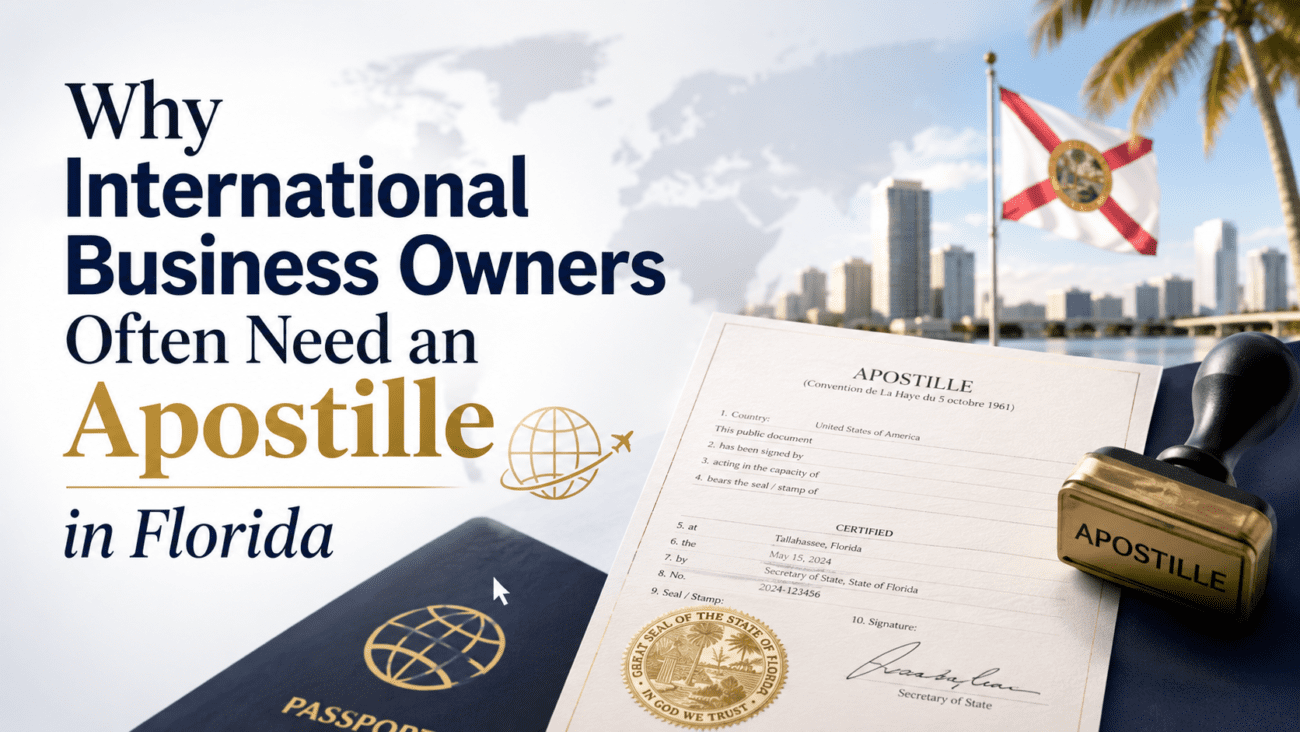
Expanding a business across borders brings paperwork that local authorities abroad simply cannot verify on their own. A Florida incorporation certificate means little to a German bank without proof of authenticity. A signed power of attorney gets rejected by a Brazilian regulator if the signatures lack international validation.
An apostille in Florida solves that problem. With this certification, a Miami-issued corporate resolution becomes acceptable overseas. Without it, foreign officials have no way to confirm your documents are genuine. This guide explains which Florida paperwork needs such treatment, how the process works, and what typically causes holdups.
Florida Documents Frequently Used Internationally
Businesses operating overseas regularly need authenticated paperwork from their home state. Florida issues many such records, but not all of them reach foreign authorities in usable form without an extra step. Let’s look at two categories that come up most often.
Corporate Agreements
Foreign banks, government agencies, and potential partners often request authenticated copies of incorporation papers, bylaws, or meeting minutes. A company opening a subsidiary in Spain might need to prove that its Florida LLC exists in good standing. A joint venture in Japan could require certified articles of incorporation.
For documents like corporate resolutions, Florida needs an affidavit attached to the copy. A company officer signs this affidavit confirming the document is genuine, and a notary then notarizes that signature. The apostille authenticates the notary. This layered approach confuses many applicants.
Power of Attorney Documents
When a business grants authority to someone overseas — to sign contracts, manage accounts, or handle real estate — the foreign recipient needs assurance that the power of attorney is legitimate. An apostille power of attorney in Florida provides that assurance.
The same logic applies to individual powers of attorney, consent letters, and affidavits. Without proper authentication, a foreign bank might freeze accounts, a real estate closing could fall apart, or a court overseas might refuse to recognize the document’s authority. Each must follow Florida’s notarization rules before the Secretary of State will attach an apostille.
Understanding the Florida Apostille Process
Florida’s authentication process follows a clear sequence. Knowing the steps prevents the frustration of returned paperwork. What follows breaks down the two main pieces: state requirements and notarization rules.
Secretary of State Requirements
The Florida Secretary of State is the only authority in the state that can issue apostilles. Their Division of Corporations handles all requests. Processing typically takes 5 to 7 business days, though timelines vary with workload.
Missing even one required item means the office returns your paperwork unprocessed. Each submission to the Division of Corporations must include:
- A completed request form.
- The original document requires authentication.
- Payment of $10 per document ($20 if a county clerk already certified it).
- A self-addressed stamped envelope or pre-paid air bill.
Cash and credit cards are not accepted — only checks or money orders payable to the Florida Department of State.
Notarization and Certification Rules
Florida law demands specific wording on notarized documents destined for the apostille. A corporate acknowledgment typically reads: “The foregoing instrument was acknowledged before me… by [name] as [type of authority] for [party name].”
Remote online notarizations will not work for apostille purposes in Florida. The notary must witness the signature in person. Their stamp must include their name, commission number, expiration date, and the title “Notary Public – State of Florida”. Notarized documents must carry a full notarial certificate. Missing or incomplete wording triggers rejection at the Secretary of State’s office.
Common Delays in Florida Apostille Requests
Most delays come from predictable errors. Avoiding them saves weeks of back-and-forth. Two specific mistakes, explained below, account for most rejected applications.
Incorrect Corporate Filings
A photocopy of incorporation papers will not be accepted for Florida document authentication. The state requires either an original certified copy from the Division of Corporations or a certificate of status. For apostilled corporate documents in Florida, starting with the right version makes all the difference.
Some business owners mistakenly submit documents issued by local county clerks. While those work for domestic purposes, Florida’s Secretary of State will not apostille them unless they first receive a separate certification from the same office. This extra step catches many off guard.
Incomplete Notarization
Notarization errors rank as the second most common holdup. For Florida legalization services, this is a daily reality. A notary who forgets to stamp the document creates an immediate rejection. A missing commission expiration date does the same. Many applicants seeking an apostille in Florida assume any notarization will work — but that assumption regularly backfires.
Getting the language right makes or breaks the application. A notary who uses the wrong acknowledgment form — for instance, using an individual acknowledgment for a corporate document — produces paperwork the Secretary of State cannot authenticate. Foreign language notarial certificates also trigger rejection unless translated into English and compliant with Florida law.
How Professional Apostille Services Save Time
Managing the process alone means tracking requirements, preparing documents correctly, and handling shipping. Professional services remove most of the guesswork. Here are two ways they help.
Rush Processing Options
Standard processing through the Secretary of State takes around one week, and adding mailing time on both ends pushes the total to two weeks or more. An expedited apostille in Florida through a professional service can cut this timeline dramatically. Professionals familiar with the process know exactly what to do:
- Which forms to submit?
- Which fees apply?
- Which office door to use for hand delivery?
- How to avoid mistakes that trigger delays?
They hand-deliver documents to the Secretary of State’s office when necessary, shaving days off the turnaround. A visa interview scheduled for next month becomes achievable instead of a scramble. A business deal with a foreign partner stays on track without awkward explanations about missing paperwork.
Nationwide Shipping and Support
Documents often need to travel. A business owner living in New York might need an apostille for documents issued in Florida. A remote worker in Texas could hold a power of attorney from the same state requiring authentication. Professional Florida legalization services handle shipping through carriers like FedEx with tracking and signature confirmation.
They also review documents before submission, catching mistakes that would otherwise trigger rejection. For reliable apostille in Florida, professional services provide the expertise business owners need when international deals depend on authenticated paperwork.
