
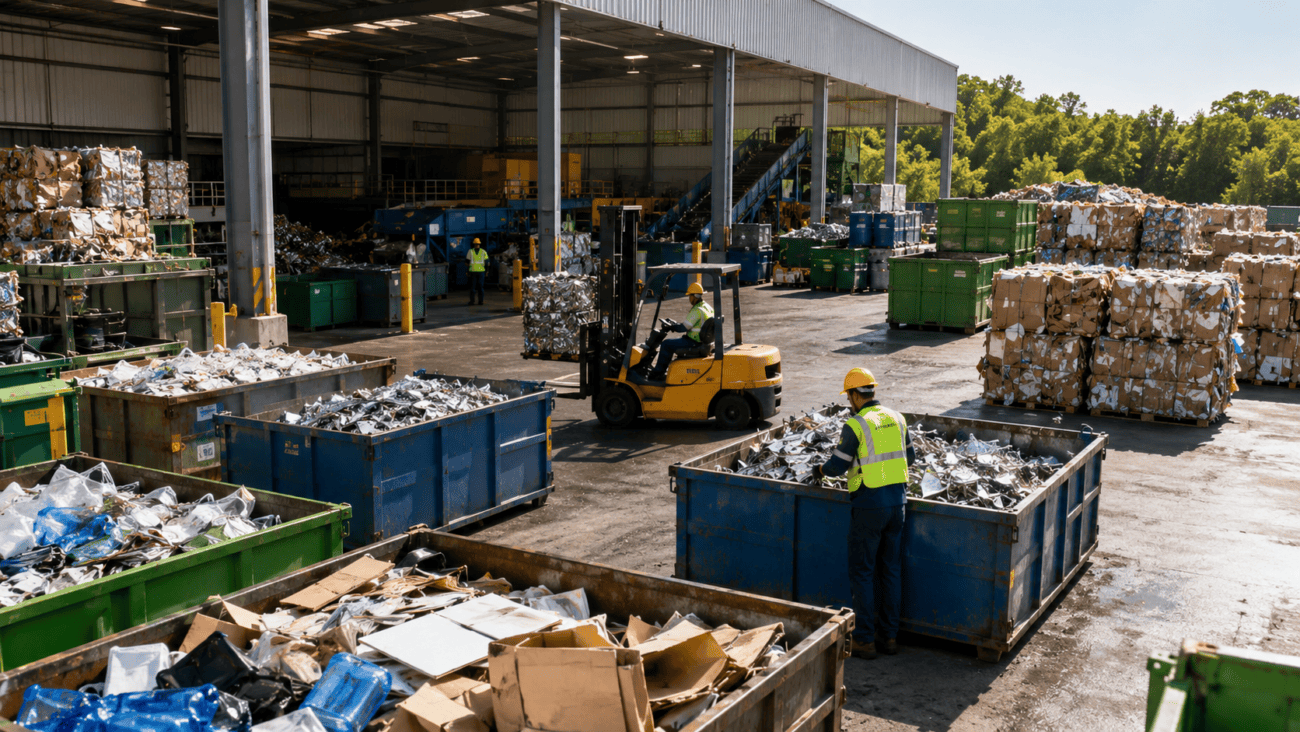
Industrial container recycling and waste management services help manufacturers, warehouses, chemical operations, and other industrial businesses manage used drums, totes, and bulk packaging responsibly. In the Mid-Atlantic, Kelly Drums provides pickup, recycling, reconditioning, and destruction services for containers including steel drums, plastic drums, fiber drums, IBC totes, and Gaylord boxes. These services can support waste-reduction and regulatory compliance programs while keeping suitable containers and materials in productive use.
A used industrial container does not automatically belong in a landfill. Depending on its condition, previous contents, and intended use, it may be reconditioned, recycled for its raw materials, or destroyed so it cannot return to circulation.
For containers that previously held hazardous materials, however, businesses must also consider federal and state waste-management rules.
What happens to used industrial containers?
Used drums and IBC totes generally follow one of three main routes.
Reconditioning keeps a suitable container in service. The container is inspected, cleaned, restored, and tested where required before being reused.
Recycling breaks down a container that is no longer appropriate for reuse so its materials can enter recycling streams. Steel drums may be processed as scrap metal, while suitable plastic drums can be cleaned and shredded for plastics recycling.
Destruction permanently prevents a container from being reused. This may be appropriate for damaged packaging, containers with branding or product-security concerns, or units that cannot be safely reconditioned.
The U.S. Environmental Protection Agency recognizes recycling and reconditioning as established options for industrial containers. EPA also notes that these processes can reduce the resources and energy needed to meet packaging demand compared with relying entirely on newly manufactured containers.
Reconditioning is more than cleaning a drum
A drum that looks clean is not necessarily suitable for reuse.
Reconditioning can involve removing residues, cleaning the container, restoring its shape, replacing appropriate closures or gaskets, checking for corrosion or damage, and completing required testing.
This becomes especially important if a container will later transport hazardous materials.
Under 49 CFR §173.28, packaging reused for hazardous-material transportation must continue to meet applicable requirements. Damaged packaging, incompatible residues, or serious structural defects can make a drum unsuitable for reuse.
Kelly Drums says its reconditioning services cover steel, poly, and fiber drums as well as IBC totes. Containers that do not qualify for reuse may instead be recycled or destroyed.
Hazardous materials require additional care
One of the most important issues in industrial container management is determining whether a container that held hazardous waste is legally considered empty.
Under federal RCRA rules in 40 CFR §261.7, most containers that held non-acute hazardous waste must first have all removable waste taken out using practices normally used for that type of container, such as pouring, pumping, or aspirating.
The rule then provides several residue thresholds.
For many non-acute hazardous wastes, a container may qualify as empty if no more than one inch of residue remains at the bottom. Alternatively, weight-based thresholds can apply.
For containers with a capacity of 119 gallons or less, the remaining residue can be no more than 3% by weight of the container’s total capacity. For larger containers, the threshold is 0.3%.
Different rules apply to certain acute hazardous wastes. Depending on the situation, triple rinsing, an equivalent removal method, or removal of a protective inner liner may be necessary.
This means businesses should not assume that a drained drum is automatically suitable for recycling or reconditioning.
The waste generator remains responsible
Using a professional container-management company can support compliance, but it does not transfer every legal responsibility away from the business that generated the waste.
EPA states that generators sending containers that previously held hazardous materials or hazardous waste to drum reconditioners are responsible for ensuring that applicable containers meet RCRA-empty requirements.
Before arranging pickup, a facility may therefore need to determine what the container held, whether its residue is regulated, whether the container meets the relevant empty-container standard, and whether additional state requirements apply.
Kelly Drums says it accepts hazardous-material drums and totes when they meet RCRA-empty criteria.
That type of acceptance policy can help industrial customers manage containers responsibly, but the generator must still make the appropriate waste determinations.
State rules also matter. EPA notes that authorized states can impose requirements that are more stringent than the federal baseline.
Documentation matters
Proper industrial waste management depends on records as well as physical handling.
Depending on the operation, useful documentation may include pickup records, container inventories, waste determinations, recycling reports, reconditioning records, and destruction certificates.
Kelly Drums says it provides recycling reporting and Certificates of Destruction for applicable services.
A Certificate of Destruction can help document that containers were processed so they cannot return to use. It should not, however, be treated as a guarantee of complete regulatory compliance or as a substitute for legally required waste records.
Businesses should be able to answer basic questions about every container stream:
- What did the container originally hold?
- Did it meet applicable empty-container requirements?
- Who collected it?
- Was it reconditioned, recycled, or destroyed?
- What happened to remaining residues?
- What documentation was retained?
Clear answers make audits and internal environmental reporting easier.
Choosing an industrial container recycling provider
Businesses should evaluate more than price when selecting a recycler or reconditioner.
Important questions include which container types the provider accepts, whether it handles steel, plastic, fiber, and IBC packaging, and what requirements apply to containers that previously held hazardous substances.
A facility should also understand the provider’s process for rejected containers, residue management, destruction, reconditioning, pickup scheduling, and documentation.
As of August 2026, Kelly Drums advertises industrial container services across parts of the Mid-Atlantic, including New Jersey, Pennsylvania, Delaware, Maryland, New York, and Connecticut. Its services include pickup, recycling, reconditioning, and destruction of drums and totes, along with support for Gaylord boxes.
Service availability and acceptance requirements can vary, so industrial customers should confirm current conditions before scheduling a collection.
Recycling should be environmentally responsible
Industrial container recycling can reduce waste and preserve resources, especially when a structurally sound drum or tote can be safely reused rather than replaced.
However, recycling itself is not automatically risk-free.
EPA has documented environmental and safety incidents involving some drum-reconditioning facilities, including spills, improper waste storage, fires, worker injuries, and contamination.
For that reason, companies should understand how a provider screens incoming containers, manages residues, processes rejected loads, and handles waste generated during cleaning and reconditioning.
Responsible recycling is not simply about removing containers from a facility. It is about knowing what happens to them afterward.
Conclusion
Industrial container recycling gives businesses several alternatives to disposal. Suitable drums and totes can be reconditioned for further use, damaged packaging can be recycled for its materials, and containers that should not return to service can be destroyed.
For companies handling hazardous materials, the process requires additional care. RCRA-empty requirements, transportation rules, state regulations, and proper documentation all influence how a container should be managed.
A specialist provider such as Kelly Drums can support industrial businesses through pickup, recycling, reconditioning, destruction, and reporting services, while the waste generator remains responsible for understanding and meeting the rules that apply to its own materials.
