
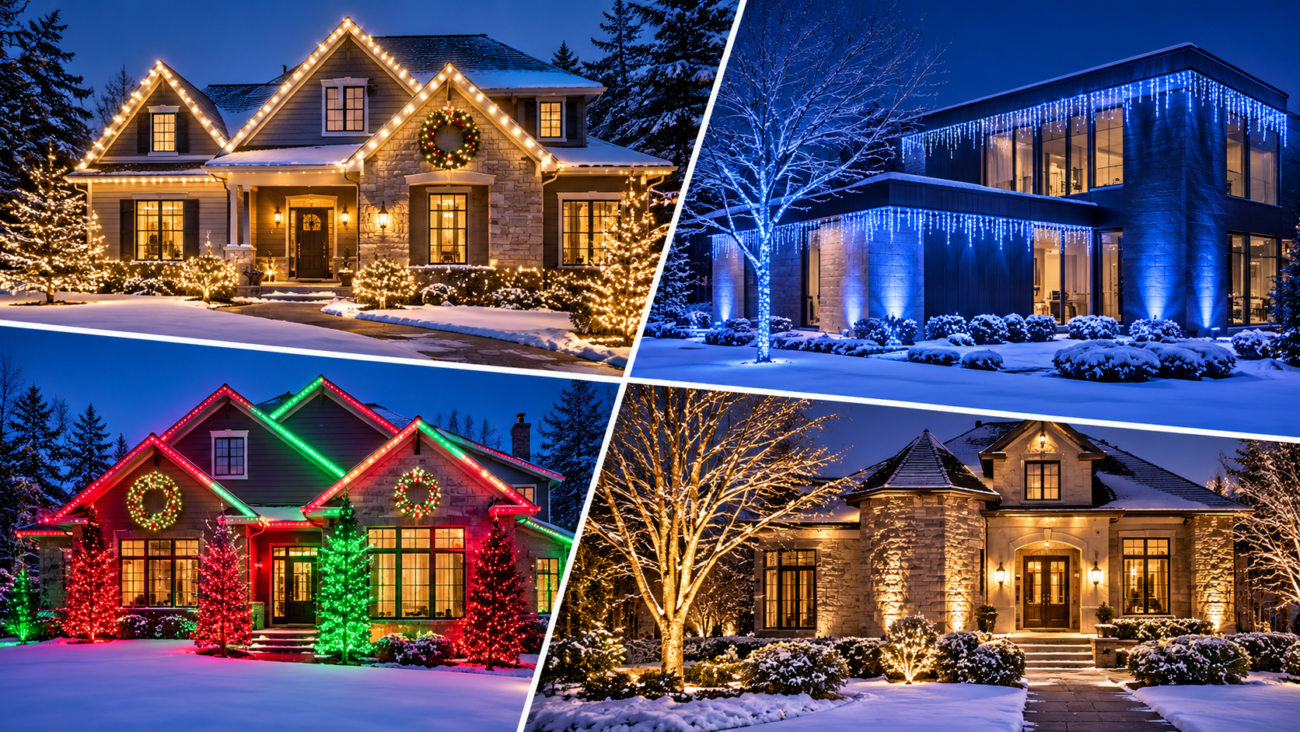
Exterior Christmas lighting tends to be bought by the metre rather than designed. The question most people ask is how many sets will cover the front of the house, which is roughly like asking how much paint a wall needs without deciding on a colour.
A scheme is a different proposition. It has a palette, a hierarchy and a reason for every fitting. Here are four that work, with what each one actually requires.
Scheme One: Scandinavian Restraint
The most forgiving of the four and the one that suits the widest range of British houses.
The palette is warm white only, no colour at all, at the amber end of the range around 2200K to 2400K. The materials are natural: real or convincing foliage, jute, wicker, galvanised metal, bare branches. The guiding principle is that the light is doing the decorating and the greenery is doing the texture.
In practice: a generous foliage garland over the door with a warm string woven through it. A pair of large lanterns on the step with pillar candles, real or battery. Bare birch or dogwood stems in two matching galvanised planters either side of the entrance, wrapped loosely with a fine warm string. A dense wreath on the door, foliage-heavy, with no baubles.
Nothing flashes. Nothing is coloured. The entire effect comes from warm light on natural texture, and it looks as good in late January as it does in December.
Scheme Two: Traditional Cottage
Warmer, denser and more decorative, suited to older brick and stone properties and to anyone who finds the Scandinavian look too austere.
The palette is warm white with deep red and forest green accents, and warm metals: brass, copper, antique gold. Nothing silver, nothing icy.
In practice: a continuous run of closely spaced warm white along the eaves and down the window reveals, which on a cottage frontage reads as outline rather than as wash and is appropriate here. A large wreath with red berries, pine cones and a wide tartan or velvet bow. Window candles or small lit stars in each front window. Terracotta or wooden planters with skimmia, ivy and spruce.
The important restraint is to keep the red and green in the decorations rather than in the lighting. Coloured bulbs on a cottage read as a fairground; coloured decoration under warm white light reads as traditional.
Scheme Three: Modern Monochrome
The one scheme where cool white genuinely belongs, and it needs the right house to work.
The palette is cool or ice white, around 4000K to 6000K, with silver, chrome, pewter and clear glass. It works superbly against white or pale render, dark cladding, black window frames and anything with clean geometry. It looks wrong on red brick, which absorbs the light and turns it slightly grey.
In practice: a single bright, evenly spaced run along one strong architectural line rather than around every edge. An uplight on a clean render surface. A sculptural wire star or an oversized minimal wreath on the door, no foliage or very little. Clipped box or bay in matching square planters, lit from below.
The discipline this scheme demands is emptiness. One strong line and one focal point, with large areas left entirely unlit. The moment it gets busy it stops working.
Scheme Four: Garden-Led
The most interesting of the four and the one that lasts longest, because it treats planting as the primary material and light as a supporting element.
The palette is warm white, low output, with the colour coming from plants rather than decorations. The point is a frontage that looks deliberate from November until March rather than festive for six weeks.
In practice: a wrapped tree or large shrub as the key feature, lit from the trunk outwards. Winter containers either side of the door with skimmia for red buds, hellebores, white cyclamen, variegated ivy trailing over the rim, and dogwood stems for vertical structure. Low path lighting. A simple foliage wreath. Nothing else.
The planting does most of the work, and it is worth getting right rather than improvising. The RHS guidance on winter containers and seasonal interest is the most useful reference for choosing combinations that will actually perform through a British winter rather than collapsing in the first hard frost.
Choosing Between Them
Let the house decide rather than the trend. Red brick and stone want warm light and warm metals. White render and dark cladding can carry cool white. Older properties suit traditional density; newer ones suit restraint and geometry.
Then check what the interior is doing, because front windows contribute to the scheme whether you plan for it or not. A living room lit at 2700K behind a 5000K exterior scheme produces a visible clash at the window line. Matching the two makes the facade read as one coherent thing.
What Every Scheme Needs
Regardless of which look you choose, three things are constant.
Hierarchy: one focal point, a general level, and detail at ground level. A frontage lit evenly throughout has no composition.
Consistency of colour temperature, which is the single most common failure. Mixing warm and cool white across one facade undermines everything else you have done.
Control: a timer at minimum, ideally an outdoor-rated smart plug so the exterior comes on and goes off in step with the interior. Dimmable sets are worth seeking out, because the output that looks right at four in the afternoon is frequently too bright at ten at night.
Specification and Installation
Good design and poor hardware produce a scheme that looks beautiful for three weeks and then fails.
Everything outdoors needs an IP rating, with IP44 as a minimum and IP65 for exposed runs, and on low-voltage sets the transformer must be rated or housed appropriately. Cable colour matters visually: a green lead across white render is as visible as a scar, so match it to the surface where you can and run it along existing lines such as mortar joints and downpipes.
Garden centres tend to carry a broader spread of lengths and warm tones than general retailers, and Dobbies is a reasonable place to compare bulb spacing and colour temperature across several sets side by side rather than judging from one photograph.
On installation: RCD-protected supply, outdoor-rated extension leads, connections off the ground, clips rather than nails, slack left for contraction. Electrical Safety First covers the outdoor rules concisely.
Common Faults across All Four
Three recurring errors account for most disappointing results, and all three are design faults rather than budget ones.
Even distribution, where light is spread uniformly across a frontage so that nothing leads and nothing recedes. The result is legible but inert, and adding more light makes it worse rather than better.
Over-lighting, where output has been judged for complete darkness at ten at night rather than for the dusk conditions in which the house is most often seen. A scheme calibrated for blue hour needs considerably less than most people buy.
Visible infrastructure, which undoes more otherwise careful schemes than anything else: a lead looping across render, an extension across a path, a transformer sitting in a flowerbed. Routing cable along mortar joints, downpipes and fence rails takes twenty minutes and is the difference between tidy and casual.
The Test of a Scheme
In early January, take the wreath off, remove the baubles, and look at what is left.
If the frontage still looks considered, with its lighting, its planting and its lanterns intact, the scheme was doing its own work. If it looks stripped and sad, the decorations were carrying it. The schemes above are all built to pass that test, which is why three of the four are worth leaving up until the evenings get lighter.
