
A steering wheel that shakes, trembles, or vibrates while driving is difficult to ignore. The vibration might appear only at higher speeds, start after hitting a pothole, become noticeable when braking, or continue throughout a journey. The pattern can provide an important clue about what is happening underneath the car.
The cause may be relatively simple, such as an unbalanced wheel, but steering wheel vibration can also be linked to tyre damage, brake problems, worn suspension components or wheel bearings. Identifying when the shaking happens, and whether it changes during braking, acceleration or cornering, can help narrow down the possibilities.
This guide explains the most common causes of a shaking steering wheel, the symptoms that can help distinguish them, what can happen if the problem is ignored, and when a professional inspection is advisable.
The Single Most Important Diagnostic Question
Before working through the individual causes, there is one question that narrows the field significantly: under what conditions does the shaking occur?
The answer is usually one of four distinct patterns, and each pattern points toward a different area of the car.
| When Shaking Occurs | Most Likely Area | First Check |
| At a specific speed, smooths out above or below it | Tyres and wheel balance | Wheel balance check |
| Continuously from low speed upward | Tyre damage, bent wheel, or worn suspension | Tyre inspection and suspension assessment |
| Only when braking | Brake discs and calipers | Brake disc inspection |
| At idle or under gentle acceleration | Engine or transmission mounts | Engine mount assessment |
| During cornering as well as straight-line driving | Suspension components or CV joints | Full front-end inspection |
Keeping this pattern in mind as you read through the causes below will help you match the description to your own experience and communicate it clearly to a technician.
For drivers in Aldershot and the surrounding area, Ash Road Service Centre can provide professional advice when a persistent steering vibration needs further investigation.
The Most Common Causes
1. Unbalanced Wheels and Tyres
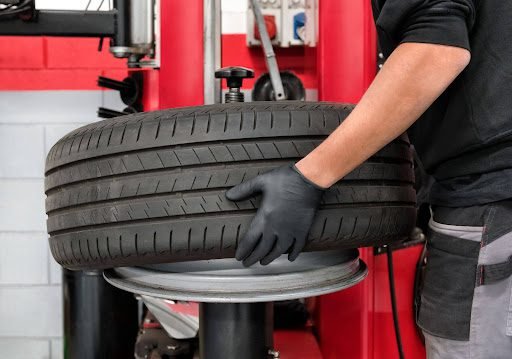
Wheel imbalance is the single most frequent cause of a steering wheel shake while driving, and also the most straightforward to address. Every wheel and tyre assembly has a small variation in weight distribution around its circumference. During manufacture, small balancing weights are fitted to the wheel rim to compensate. When one of these weights falls off, or when a new tyre is fitted without being properly balanced, the uneven weight distribution creates a centrifugal force as the wheel rotates that is transmitted directly through the suspension and steering column.
The signature pattern of wheel imbalance is a vibration that builds as speed increases, reaches its peak at a specific speed, often between 50 and 70 mph on UK roads, and then fades again as speed rises further. The wheel is effectively passing through its harmonic resonance point. Below and above that speed the vibration is less pronounced, sometimes barely noticeable. Directly on that speed it can be quite marked.
Wheel balancing is one of the quickest and least expensive fixes in automotive maintenance. The wheel is mounted on a machine that spins it and identifies precisely where additional weight is needed to restore even distribution. Weights are fitted accordingly and the job is done. If the vibration persists after balancing, the cause lies elsewhere.
2. Tyre Damage or Uneven Wear
A tyre can look acceptable from a distance and still cause significant steering wheel vibration if it has developed internal damage, a flat spot, a bulge in the sidewall, or uneven wear across its surface.
Flat spots develop when a wheel locks up under heavy braking and the stationary tyre skids against the road surface, grinding away a small section of tread. This creates an imbalance that is felt as a rhythmic thump or vibration at low to moderate speeds. Internal belt damage, caused by striking a deep pothole or a kerb at speed, can deform the tyre’s internal structure without any external evidence visible to the eye. A bulge or bubble in the sidewall is a visible sign of internal structural failure and means the tyre should be considered unsafe to drive on.
Uneven tyre wear is a slightly different situation. Tyres that wear more heavily on the inner or outer edge than across their full width, due to incorrect alignment or a suspension fault, develop an irregular contact patch with the road. This irregular patch generates a vibration during normal driving that becomes more noticeable as the tread depth difference increases. Checking not just the central tread depth but also the inner and outer edges of each tyre is essential for a full picture of their condition.
Under UK law, the minimum legal tread depth is 1.6mm across the central three-quarters of the tyre and around the full circumference. Tyres below this limit carry a fine of up to £2,500 and three penalty points per tyre.
3. Wheel Alignment Issues
Wheel alignment refers to the precise angles at which the tyres contact the road surface. When these angles are correct, the car tracks straight with minimal steering input and the tyres wear evenly. When alignment is out, the tyres are working slightly against each other, which creates additional rolling resistance, uneven wear, and in some cases a vibration felt through the steering wheel.
Alignment typically goes out after a significant impact, hitting a deep pothole, striking a kerb while parking, or a minor collision. It can also drift gradually over time as suspension components wear. The steering wheel vibration from alignment issues tends to be more subtle than that from wheel imbalance and is often accompanied by the car pulling gently to one side or the steering wheel sitting slightly off-centre when driving straight.
Alignment is checked using specialist equipment that measures the precise angle of each wheel relative to the vehicle’s centreline and to each other. Most garages recommend an alignment check after any significant tyre replacement, suspension work, or impact event, and periodically as part of routine maintenance.
4. Worn or Damaged Suspension Components
The suspension system is designed to absorb the imperfections of the road surface and keep all four wheels in consistent contact with the tarmac. When its components wear, this ability to absorb and control wheel movement deteriorates. The vibrations and forces that the suspension should be containing instead travel through to the steering column and wheel.
The key suspension components that contribute to steering wheel shake when worn are shock absorbers, ball joints, tie rod ends, and control arm bushings.
Worn shock absorbers allow excessive wheel movement over bumps and undulations. Rather than damping the oscillation quickly, a worn shock allows the wheel to continue bouncing through several cycles, creating a vibration that is particularly noticeable on rough or uneven road surfaces. Hampshire roads, with their combination of country lanes, speed humps, and potholed urban streets, expose worn shock absorbers quickly.
Ball joints and tie rod ends, when they develop play, allow small amounts of unwanted movement in the steering and suspension geometry under load. This movement translates into a vibration or shimmy felt through the steering wheel, often most pronounced at certain speeds or when the car is cornering. Worn bushings similarly allow the control arm to move in ways that the suspension geometry was not designed to accommodate, adding to the vibration transmitted through the steering column.
| Worn ball joints | Shimmy at certain speeds, worse on uneven roads | Clunk over bumps, vague steering feel |
| Worn tie rod ends | Vibration and wandering steering | Loose steering response, uneven front tyre wear |
| Deteriorated bushings | General harshness and vibration, worse when cold | Creaking over bumps, increased road noise |
5. Brake Disc Problems
If the steering wheel shakes specifically and only when you press the brake pedal, the braking system is almost certainly the cause rather than the tyres or suspension. This condition is sometimes called brake judder and is directly related to the condition of the brake discs.
Brake disc thickness variation (DTV) is the most common brake-related cause of steering wheel shake. As discs wear and are subjected to repeated heating and cooling cycles, their surface can develop variations in thickness. When the brake pads clamp against a disc that is not perfectly even, the variation is transmitted hydraulically through the brake fluid to the pedal, and mechanically through the suspension to the steering wheel, as a rhythmic pulsing or shuddering. The faster the wheels are rotating when braking begins, the more rapidly the variation cycles through the pad contact area, which is why the vibration tends to be most pronounced when braking from higher speeds.
A sticking brake caliper can also contribute to steering wheel shake under braking. If a caliper is not releasing fully after each brake application, one side of the car is being braked more than the other, creating an imbalance of braking force that is felt as a pull and vibration through the steering wheel.
6. Worn Wheel Bearings
Wheel bearings allow the wheel to rotate smoothly on its hub. When they wear, they allow a small amount of unwanted movement in the wheel assembly that generates a vibration while driving. The characteristic sound of a failing wheel bearing is a humming or droning noise that changes pitch when the car is steered gently in either direction, shifting load across the bearing.
The vibration from a worn wheel bearing tends to be continuous rather than speed-specific, and it typically worsens as the bearing deteriorates further. It can be difficult to distinguish from tyre-related vibration without a physical inspection, as both present as a general vibration felt through the steering wheel rather than a speed-specific buzz. A technician will spin each wheel by hand on a raised vehicle to feel for roughness and listen for the characteristic grinding that indicates a bearing that has lost its smooth operation.
7. Engine or Transmission Mount Wear
Engine mounts are rubber-and-metal components that secure the engine and gearbox to the vehicle’s subframe. Their rubber element absorbs the vibration generated by the running engine and prevents it from transferring into the body of the car. When the rubber deteriorates, collapses, or tears, this isolation is lost.
The distinctive pattern of an engine mount fault is a vibration felt at idle or under light acceleration that is present even when the car is stationary. It may increase as acceleration is applied and diminish once the car is cruising at a steady speed. Unlike the other causes in this guide, the vibration from a worn engine mount is often felt through the body of the car and the seat as much as through the steering wheel. It can also produce a clunking sound when pulling away from a standstill or changing between drive and reverse.
Engine mount wear is a gradual process that often goes unnoticed until the deterioration is significant. It is also one of the causes drivers most frequently misattribute to the engine itself, when the engine is running perfectly normally and the mount is simply failing to isolate its vibration.
Speed as a Diagnostic Clue
One of the most practically useful ways to begin narrowing down the cause of a shaking steering wheel is to pay close attention to the speed at which the vibration is most pronounced.
| Speed at Which Shake Is Worst | Probable Cause | Urgency |
| 50 to 70 mph, fades above and below | Wheel imbalance | Book a balance check promptly |
| All speeds from low upward | Tyre damage, flat spot, or severe wear | Inspect tyres immediately |
| Only under braking | Brake disc thickness variation or caliper fault | Book brake inspection urgently |
| At idle and low speed | Engine or transmission mount | Book assessment, not immediately urgent |
| Variable, worse on rough roads | Suspension components | Full suspension inspection needed |
| High speed with pulling to one side | Wheel alignment and possibly suspension | Alignment check and suspension assessment |
What Happens If You Ignore a Shaking Steering Wheel
The consequences of ignoring a steering wheel shake depend on the underlying cause, but in most cases they follow a predictable pattern: the root cause worsens, secondary damage develops, and the eventual repair costs more than if the fault had been caught early.
An unbalanced wheel left unaddressed accelerates tyre wear unevenly, creating the conditions for tyre damage and reduced grip that a simple balancing job would have prevented. Worn suspension components that are not inspected deteriorate until they fail, turning a straightforward replacement into an urgent safety matter. Brake disc thickness variation left unaddressed can worsen brake judder and contribute to uneven or accelerated pad wear. Engine mount failure allowed to progress can allow the engine to move excessively under load, stressing surrounding components including exhaust sections, coolant hoses, and wiring.
Beyond the mechanical consequences, there is a legal dimension. Under the Road Vehicles (Construction and Use) Regulations 1986, drivers are legally responsible for ensuring their vehicle is in a roadworthy condition at all times. A vehicle with significantly worn tyres, deteriorated suspension, or a braking fault that a driver is knowingly operating on public roads is in breach of that obligation. This is not simply an MOT-day concern. It applies on every journey.
Servicing, the MOT, and Steering Wheel Vibration
Many of the causes described in this guide are identified and addressed during routine vehicle maintenance before they develop to the point of causing a noticeable vibration. A thorough service includes tyre and tread depth checks, a suspension inspection for signs of wear or play, brake disc and pad assessment, and in many cases a wheel balance and alignment recommendation where the technician identifies developing tyre wear patterns.
Drivers who need a wider assessment can arrange car servicing in Aldershot to have the vehicle inspected by qualified technicians.
The MOT also directly addresses many of the components involved. Tyre condition and tread depth, brake disc and pad condition, shock absorber performance, ball joints, tie rod ends, and wheel bearings are all assessed during the test. A persistent vibration can be associated with faults that may be picked up during an MOT, but whether it results in a defect depends on the underlying cause and its severity.
A Pre-Inspection Checklist for Drivers
Before booking in for a professional inspection, a few quick checks at home can provide useful information for the technician and occasionally identify an obvious cause immediately.
- Check all four tyre pressures with a gauge. Underinflated tyres affect handling, cause uneven wear, and can contribute to steering vibration. Correct pressures are found in the door sill sticker or the vehicle handbook.
- Walk around the car and look at all four tyres for visible signs of uneven wear, sidewall bulges, or damage. Pay attention to the inner and outer edges, not just the central tread area.
- Look at the alloy wheels or steel rims for any visible damage, bends, or missing wheel balance weights. A missing weight is a small rectangular block of metal usually clipped to the inner rim.
- Note the exact speed at which the vibration is worst and whether it changes when you brake, corner, or accelerate. This information is genuinely useful to a technician and can save diagnostic time.
- Note whether any other symptoms accompany the vibration: a pulling sensation to one side, a noise from any corner of the car, or a brake pedal that pulsates underfoot.
Conclusion
A steering wheel that shakes while driving is never something to adapt to or delay investigating. It is a clear signal from the vehicle that a component needs attention, and the signal tends to escalate over time rather than resolve itself.
The cause is almost always traceable to one of a small number of well-understood areas: tyre condition and balance, wheel alignment, brake disc condition, suspension components, wheel bearings, or engine mounts. Each has recognisable patterns and responds well to prompt professional attention. The earlier any of these faults is caught, the simpler and less expensive the resolution.
Addressing the problem early can also help prevent further wear and keep the vehicle handling and braking as it should. If you need professional help identifying the source of a persistent steering wheel vibration, you can find Ash Road Service Centre on Google and arrange an inspection.
Frequently Asked Questions
Is a shaking steering wheel dangerous?
It can be, depending on the cause. Worn suspension components, tyre damage, and braking faults all affect the car’s handling and stopping ability in ways that create genuine safety risks. Even a cause as straightforward as an unbalanced wheel accelerates tyre wear in ways that reduce grip over time. Any persistent steering wheel shake should be investigated promptly rather than treated as an inconvenience to adapt to.
Why does my steering wheel only shake at a specific speed?
A vibration that is most pronounced at a particular speed, typically between 50 and 70 mph, and then fades above and below that speed is the classic pattern of wheel imbalance. The wheel passes through its harmonic resonance point at that speed, amplifying the vibration. A wheel balance check is the first step and is a quick, inexpensive procedure.
My steering wheel shakes only when I brake. What does that mean?
Shaking that appears specifically under braking almost always indicates a problem with the brake discs. Brake disc thickness variation, where the disc surface has become uneven due to heat and wear, creates a rhythmic pulsing as the brake pads clamp against the uneven surface. A sticking brake caliper can also cause this symptom. Both require professional assessment and should not be ignored given their direct effect on braking performance.
Can bad wheel alignment cause steering wheel shake?
Alignment itself rarely causes a direct vibration, but incorrect alignment causes uneven tyre wear. As that uneven wear develops, the irregular tyre surface creates a vibration that is felt through the steering wheel. Addressing the alignment and replacing or rotating the affected tyres resolves the symptoms and prevents them from recurring.
Will a steering wheel shake fail my MOT?
The vibration itself is not a test criterion, but some underlying causes, such as tyre, suspension, steering, brake or wheel-bearing defects, may affect the MOT result. Worn tyres, brake disc variation, suspension component play, and wheel bearing deterioration are all assessed during the MOT and can produce major defects. Any known vibration fault is better addressed before the test than discovered through a failure.
How urgent is it to fix a shaking steering wheel?
Urgency depends on the cause. A simple wheel balance can be booked at your convenience within a few days. A suspected suspension component fault, brake judder, or wheel bearing wear should be assessed as soon as possible. A sudden, severe vibration that appears unexpectedly, particularly at speed, warrants pulling over safely and arranging inspection before driving further, as it can indicate a wheel or suspension component that has become loose or failed.
