
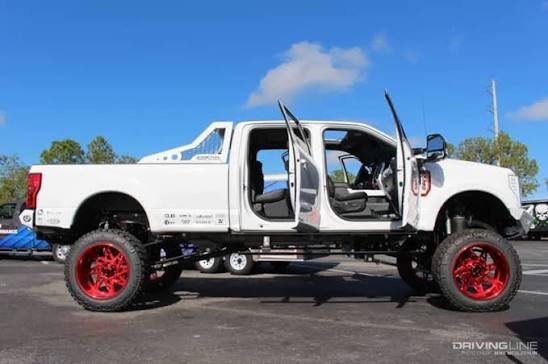
Lifting a truck can change its appearance, ground clearance, and off-road capability, but the modifications can also affect how efficiently it uses fuel. One of the most noticeable changes is often the move to larger tires. Drivers considering custom lifted trucks should understand that tire size can influence rolling resistance, vehicle weight, gearing, and the amount of energy required to keep the truck moving. Larger tires do not automatically mean dramatically worse fuel economy, but several factors associated with them can increase fuel consumption.
Why Larger Tires Require More Energy
A larger tire can weigh considerably more than a standard tire, especially when it has a wider tread, reinforced construction, or an aggressive all-terrain or mud-terrain design. Additional unsprung weight means the engine and drivetrain have more mass to move and accelerate.
Weight is an important consideration because moving a heavier vehicle generally requires more energy. The U.S. Department of Energy notes that increased vehicle weight can negatively affect fuel economy. With a lifted truck, the combined weight of larger tires and wheels can therefore contribute to higher fuel use, particularly during frequent acceleration and stop-and-go driving.
The effect becomes more noticeable when a truck receives several heavy upgrades at the same time. Larger wheels, reinforced tires, suspension components, bumpers, skid plates, and other accessories can collectively add substantial weight.
Rolling Resistance Plays a Major Role
Rolling resistance is another important factor. Every tire deforms slightly where it meets the road, and energy is lost as the tire flexes and returns to its original shape. Tire construction, tread design, compound, size, and inflation pressure can all influence this resistance.
A tire with greater rolling resistance requires more power from the engine to maintain movement. Department of Energy research has highlighted the relationship between rolling resistance and fuel efficiency, including the potential benefits of reducing rolling resistance through tire design.
Large off-road tires often have deep tread patterns and durable sidewalls designed for traction and resistance to damage. Those qualities can be useful for off-road driving, but they may also create more rolling resistance than a highway-focused tire.
Tire Width Can Influence Fuel Use
Tire diameter is not the only measurement that matters. Width can also affect fuel consumption. A wider tire generally places more rubber on the road and may produce greater rolling resistance depending on its construction and tread design.
For lifted trucks, owners sometimes choose wider tires because they complement the vehicle’s appearance and provide additional traction on loose surfaces. However, the additional width and weight can increase the effort required from the drivetrain.
This does not mean that every wider tire will produce the same fuel-economy penalty. Tire compound, tread pattern, construction, pressure, wheel weight, driving conditions, and vehicle configuration all influence the final result.
Larger Diameter Can Change Effective Gearing
Increasing tire diameter can also affect the truck’s effective gearing. A larger tire travels farther with each revolution. As a result, the engine may operate at lower revolutions per minute at a given road speed.
At first, this can sound beneficial. Lower engine speed may reduce some engine losses during steady cruising. However, the larger tire also changes the mechanical advantage between the engine and the road.
If the tire size increase is significant, the truck may require more throttle to accelerate or maintain speed, particularly when climbing hills or carrying heavy loads. Automatic transmissions may also downshift more frequently when additional torque is needed.
Modern trucks have sophisticated transmissions and engine controls that can adapt to different driving conditions, but tire-size changes can still alter the balance between engine speed, torque, and fuel consumption.
Highway Driving Can Reveal Aerodynamic Effects
A lift itself can affect fuel consumption by changing the truck’s ride height and aerodynamic profile. Larger tires can contribute to this change by increasing the amount of air moving around the vehicle’s wheel openings and underbody.
Aerodynamic drag becomes increasingly important as road speed rises. The Department of Energy identifies wind resistance and rolling resistance as significant sources of energy loss, particularly during highway driving.
This means a lifted truck with larger tires may experience a greater fuel-economy effect on the highway than during some low-speed driving situations. The exact result depends on the truck’s lift height, tire dimensions, wheel design, driving speed, and overall configuration.
Tire Pressure Matters After Changing Tire Size
Proper inflation is especially important after installing larger tires. Running tires below their recommended pressure can increase rolling resistance and reduce fuel economy.
The Department of Energy states that properly inflated tires can improve fuel efficiency, while underinflation can reduce fuel economy.
However, drivers should not simply inflate larger tires to an arbitrary pressure in an attempt to improve mileage. The correct pressure depends on the tire, vehicle, load, and manufacturer’s recommendations. Tire pressure should be checked regularly, particularly before long trips or when carrying heavy loads.
Tread Design Makes a Difference
Two tires with the same dimensions can produce different fuel-economy results because their tread designs and construction may be very different.
A highway-oriented tire usually focuses on smooth road operation, low noise, and efficient rolling. An aggressive mud-terrain tire, by comparison, may use large tread blocks and reinforced construction for improved traction in difficult terrain.
That additional capability can come with additional rolling resistance. Department of Energy research on truck tires has specifically identified tread pattern and tire condition as factors associated with rolling resistance and fuel consumption.
For drivers who spend most of their time on pavement, selecting a tire designed for the vehicle’s primary use can help balance appearance, traction, durability, and efficiency.
Driving Habits Can Offset Some Differences
Tire size is only one part of a truck’s overall fuel-consumption equation. Driving style can have a substantial effect as well.
Rapid acceleration, frequent hard braking, high speeds, heavy payloads, and extended idling can all increase fuel use. Smooth acceleration and maintaining a consistent speed can help reduce unnecessary energy consumption.
A driver who operates a lifted truck gently and maintains the tires properly may achieve better fuel economy than another driver with a standard-height truck who frequently accelerates aggressively or carries unnecessary weight.
Maintenance Is Especially Important for Lifted Trucks
After changing tire size or modifying suspension components, proper maintenance becomes even more important. Alignment should be checked when appropriate, because suspension modifications and changes in wheel and tire geometry can affect how the tires contact the road.
Uneven tire wear, incorrect alignment, underinflation, or damaged suspension components can increase rolling resistance and make the truck work harder. Regular inspections can help identify these issues before they become more expensive problems.
Wheel and tire balance should also be maintained. Properly balanced wheels can contribute to smoother operation and help prevent unnecessary vibration and uneven wear.
Conclusion
Larger tires can affect a lifted truck’s fuel consumption through several connected factors, including additional weight, rolling resistance, tire width, tread design, effective gearing, and aerodynamic changes. The size of the tire matters, but it is not the only consideration. A heavy, aggressive tire can have a different effect from a lighter tire of similar dimensions, while proper inflation and suitable maintenance can help control unnecessary fuel losses.
For truck owners, the key is to select tire dimensions and designs that match how the vehicle is actually used. A truck built primarily for highway travel may benefit from a different tire setup than one regularly used on trails or difficult terrain. Understanding these trade-offs makes it easier to build a lifted truck that delivers the desired appearance and capability without overlooking everyday operating efficiency.
