
Festive trading is the financial backbone of the hospitality calendar, driven by packed dining rooms, corporate Christmas lunches, and large-scale banquet catering. Yet the very things that make December profitable- heavier meat carving, round-the-clock veg prep, and extra pop-up prep stations- are exactly what push commercial chopping boards past the breaking point.
A single grooved board that traps bacteria, or a shortage of sanitised boards during a Saturday night turnaround, can stall service. And it can put your food hygiene rating on the line when your reputation matters most.
Run this five-point chopping board check in November, before the rush starts.
Why This Check Matters Before December
Food safety does not relax for Christmas. The FSA estimates around 2.4 million cases of foodborne illness in the UK each year, and a December spike in covers raises the stakes. One scored board handling cooked meat can undo a spotless kitchen.
Why Boards Fail in December
Boards fail in December for a simple reason. They are used far more, and far harder, than in any other month.
- Prep volume doubles, so boards score faster
- Agency and temporary staff may not follow the colour system
- Extra carving and veg prep pushes boards past their limit
- There is no time to replace a board mid-service
A board that was fine in October can be a liability by mid-December. The check below catches that before it costs you.
Check 1: Condition — Scoring, Warping, Stains and Cracks
The condition of each board is the first thing to inspect, and the first thing an EHO checks. Replace a board when it is deeply scored, or after 3-5 years of heavy use.
Inspect every board under bright light and pull any that show:
- Deep grooves you can catch a fingernail in, which trap food and bacteria
- Warping that stops the board from sitting flat
- Stains that will not wash out
- Cracks or splits along the surface or edge
A deep groove holds bacteria that a normal wash cannot reach. So, a scored board is a genuine hygiene failure. Pull it from service and replace it now.
Check 2: Colour Coverage at Every Station
Every station needs the right chopping board colours to handle different food groups. Christmas prep spreads cooking across more stations, so gaps in colour coverage appear fast.
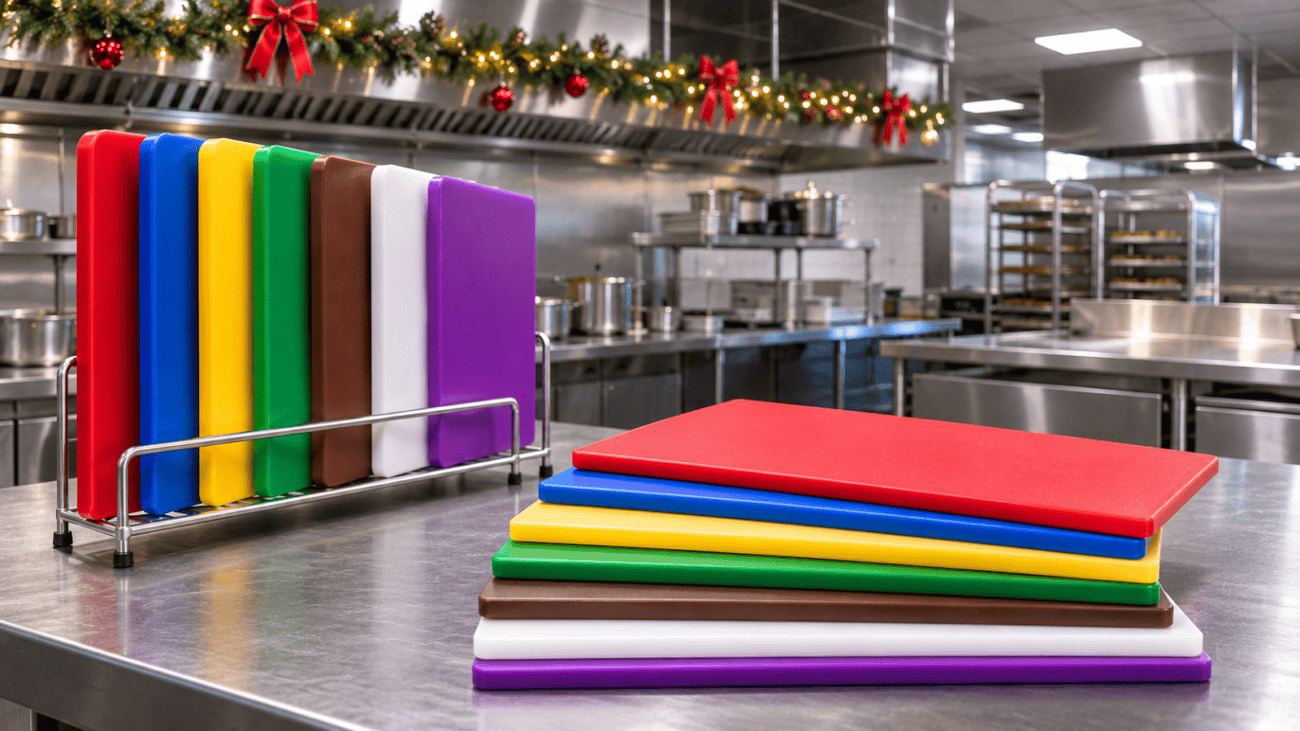
Walk each station and confirm it holds the colours it needs. The UK system runs:
- Red for raw meat
- Blue for raw fish
- Yellow for cooked meat
- Green for salad, fruit, and veg
- Brown for unwashed vegetables
- White for bakery and dairy
- Purple for allergen-free prep
A cooked meat chopping board in yellow matters most at Christmas, with all the turkey, ham, and gammon being carved. Make sure every station that handles cooked meat has its own.
Check 3: Enough Boards for Peak Covers
Peak covers need more boards than a normal week. A kitchen running one board per colour will run short the first busy night.
Count your boards against your December covers. You need spares for each colour, since a board pulled for washing can create a gap mid-service. A full colour coded chopping board set at each station, plus backups for the busiest colours, keeps prep moving. The red and yellow boards wear fastest over Christmas, so hold extra of those.
Check 4: Size and Fit for Temporary Stations
Christmas often means extra prep space. A spare table, a corner of the pass, a temporary carving station. Each one needs a board that fits.
A large chopping board suits a carving station, where whole joints and birds need room. A dedicated carving board with space for a turkey saves the meat from sliding off a cramped surface. Measure any temporary station and order boards cut to fit, so the extra space is actually usable.
Check 5: Washing, Drying and Storage
Clean boards are only clean if they are stored right. Boards should be stored upright with airflow between them, not stacked wet.
Check your wash and storage routine holds up under pressure:
- Boards washed and sanitised after every use
- Dried fully before storage
- Stored upright with a gap for air
- Never stacked damp, which breeds bacteria
Under December pressure, storage slips first. A quick reset of the routine now keeps standards from dropping when the kitchen is flat out.
Order Before the Rush
Order any replacement or extra boards in November, while you have time. December is the worst month to run short, and suppliers get busier as the month goes on. A set of catering chopping boards ordered now arrives in good time, cut to your stations and ready for the first busy service.
Go Into December Inspection-Ready!
A chopping board check is 20 minutes that protects your busiest month. You keep prep flowing, hold your hygiene standards, and face an EHO visit with nothing to hide. EHOs look for a proactive maintenance schedule, since reactive disposal is not a documented system, so a board check logged in November works in your favour.
Run the five checks this week. Pull the worn boards, fill the colour gaps, count against your covers, and order what you need before the rush. Your restaurant chopping boards should be ready before December starts, not scrambled for mid-service.
FAQs
How should a restaurant prepare its kitchen equipment before the Christmas rush?
Inspect every item in November, while there is time to replace it. For boards, check condition, colour coverage, quantity, and storage, then order any shortfall before December.
How often should commercial chopping boards be replaced?
Replace a board when it is deeply scored or after 3-5 years of heavy use. A groove deep enough to catch a fingernail means it is time to go.
How many chopping boards does a restaurant need for Christmas service?
Enough for every colour at every station, plus spares for the busiest colours. Red and yellow wear fastest over Christmas, so hold extra of those.
Is it safe to keep using a deeply scored plastic chopping board in a restaurant?
No. Deep grooves trap bacteria that washing cannot reach, which is a hygiene failure. Replace a deeply scored board before it reaches service.
What do EHOs look for on chopping boards during an inspection?
They check for deep scoring, warping, staining, and correct colour use. They also look for a proactive maintenance schedule, since reactive disposal is not counted as a system.
