
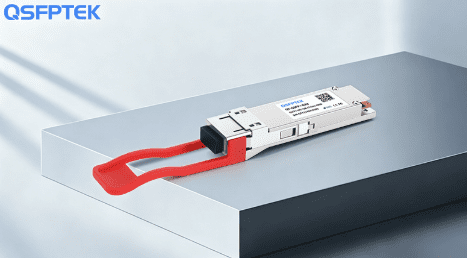
As network traffic continues to surge across enterprise, cloud, and telecommunications environments, the demand for reliable long-distance connectivity has become increasingly critical. While many deployments focus on short- and medium-range optical solutions, there remains a significant need for technologies that can efficiently bridge longer distances without introducing excessive complexity. In this context, 40G QSFP+ modules provide a versatile foundation for high-speed networking, supporting a range of transmission distances through different optical variants. Among these, 40GBASE-ER4 stands out as a specialized solution designed for extended reach.
In modern network design, selecting the appropriate optical module is not only about achieving a target data rate but also about matching transmission distance, cost, and infrastructure requirements. 40G QSFP+ modules are often deployed in data centers and enterprise backbones, but their ER4 variant addresses a different challenge—enabling stable 40G transmission over distances of up to 40 kilometers using single-mode fiber. This capability makes ER4 particularly valuable in scenarios where traditional short-range modules fall short.
Understanding when to use 40GBASE-ER4 requires a clear view of network architecture and application demands. While 40G QSFP+ modules such as SR4 and LR4 are sufficient for intra-data-center or campus-level links, ER4 is specifically engineered for longer connections, offering a balance between performance and reach. Identifying the right use cases for ER4 ensures that network investments are both efficient and future-ready.
Understanding 40GBASE-ER4 Technology
Key Characteristics of ER4 Modules
40GBASE-ER4 optical modules operate over single-mode fiber and use four wavelengths in the 1310 nm range, typically based on LAN-WDM technology. Each wavelength carries 10 Gbps, and together they deliver an aggregated 40 Gbps data rate. The use of wavelength division multiplexing allows ER4 modules to transmit data over a single pair of fibers, simplifying cabling compared to parallel optics solutions.
A defining feature of ER4 is its ability to support transmission distances of up to 40 km without the need for external amplification in most cases. This is achieved through higher optical output power and enhanced receiver sensitivity, enabling stable performance over longer spans. As a result, ER4 modules are well suited for applications that require extended reach while maintaining standard Ethernet interfaces.
Key Scenarios for Using 40GBASE-ER4
Metropolitan Area Network (MAN) Deployments
One of the primary use cases for 40GBASE-ER4 is in metropolitan area networks, where connections often span tens of kilometers between different locations within a city. These networks require reliable, high-capacity links to support services such as cloud access, content delivery, and enterprise connectivity. ER4 modules enable direct 40G links across metro distances without the need for more complex and costly transport systems, making them an efficient solution for urban network expansion.
Long-Reach Data Center Interconnects
As organizations distribute their data center infrastructure across multiple sites for redundancy and scalability, the need for long-reach interconnects becomes essential. In scenarios where data centers are located tens of kilometers apart, SR4 and LR4 modules are no longer sufficient. 40GBASE-ER4 provides the necessary reach to connect these facilities while maintaining high throughput and relatively low latency, supporting applications such as data replication, workload migration, and disaster recovery.
Enterprise Backbone Networks
Large enterprises with multiple campuses or remote offices often require high-speed backbone connections to ensure seamless communication across their network. When these locations are separated by significant distances, ER4 modules offer a practical solution for extending 40G connectivity over existing single-mode fiber infrastructure. This allows organizations to maintain consistent performance across their network without investing in more complex optical transport equipment.
Telecommunications and Service Provider Networks
Telecommunications operators and service providers frequently deploy long-distance optical links to connect central offices, aggregation points, and access networks. 40GBASE-ER4 modules can be used in these environments to deliver high-capacity links over intermediate distances, filling the gap between short-range data center optics and long-haul coherent solutions. Their compatibility with standard Ethernet equipment also simplifies integration into existing network architectures.
Advantages of 40GBASE-ER4
Extended Reach Without Complex Infrastructure
One of the most significant advantages of ER4 modules is their ability to achieve up to 40 km transmission using standard Ethernet interfaces. This eliminates the need for additional optical amplifiers or dispersion compensation modules in many deployments, reducing both cost and operational complexity.
Efficient Use of Single-Mode Fiber
By transmitting over duplex single-mode fiber, ER4 modules make efficient use of existing cabling infrastructure. This is particularly beneficial in environments where fiber resources are limited or where upgrading infrastructure would be costly and disruptive.
High Reliability for Critical Applications
ER4 modules are designed to deliver stable performance over long distances, making them suitable for mission-critical applications such as disaster recovery, financial transactions, and real-time data synchronization. Their robust design ensures consistent signal quality even in challenging network conditions.
Considerations Before Choosing ER4
Cost and Power Consumption
Compared to shorter-reach modules like SR4 and LR4, ER4 modules typically have higher upfront costs and power consumption. These factors should be carefully evaluated, especially in large-scale deployments where they can significantly impact overall operational expenses.
Distance Requirements
While ER4 supports up to 40 km, it may not be necessary for all deployments. Using ER4 in short-distance scenarios can result in unnecessary costs and inefficiencies. Therefore, accurate assessment of link distance is essential to ensure the right module is selected.
Compatibility and Network Design
Before deploying ER4 modules, it is important to ensure compatibility with existing network equipment and to consider the overall network design. Factors such as link budget, fiber quality, and connector types can all influence performance and should be taken into account during planning.
Conclusion
40GBASE-ER4 optical modules are a powerful solution for enabling 40 km transmission in modern networks, bridging the gap between short-range data center optics and long-haul transport technologies. They are particularly well suited for metropolitan networks, long-distance data center interconnects, enterprise backbones, and telecommunications infrastructure. However, their use should be carefully aligned with actual distance and performance requirements to ensure cost-effective deployment. By understanding when and where ER4 modules deliver the most value, network designers can build scalable, reliable, and future-ready optical networks.
