
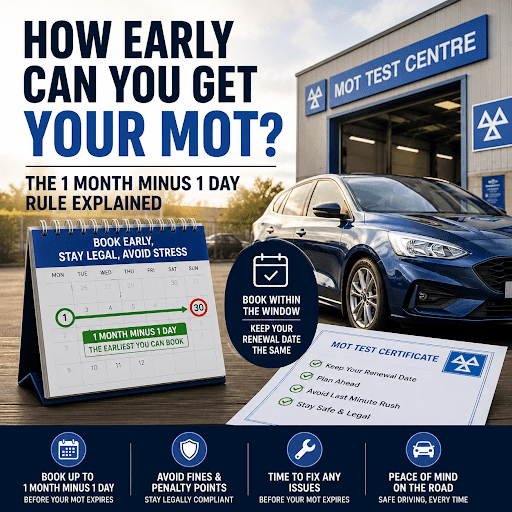
Find out how early you can book your MOT before it expires, how the one month minus one day rule works, and why booking ahead saves you stress.
Most drivers only think about their MOT when the reminder lands in their inbox or, worse, when they realise the date has already passed. But here is the thing: the MOT system actually rewards you for planning ahead, and there is a specific window that lets you test early without losing a single day of your current certificate.
Whether you drive around Aldershot, Farnborough, Fleet, or anywhere across Hampshire, understanding this rule could save you time, money, and a lot of unnecessary stressIf your MOT is coming up, getting it booked through a trusted MOT centre in Aldershot sooner rather than later is always the smarter move.
The One Month Minus One Day Rule Explained
This is the rule every UK driver needs to know. You can take your MOT up to one calendar month minus one day before your current certificate expires, and your renewal date stays exactly the same.
So what does that actually look like in practice?
If your MOT expires on 30 September, the earliest you can take the test and keep that same renewal date is 1 September. Book it any earlier than that, and your new certificate runs for 12 months from the actual test date, not your original expiry. That means you could end up losing weeks of valid MOT cover you have already effectively paid for through your road tax cycle.
The rule exists to give drivers a practical planning window without creating loopholes. It is set by the Driver and Vehicle Standards Agency (DVSA) and applies to cars, vans, and most light vehicles over three years old across Great Britain.
Real Date Examples: How the Window Works
It helps to see the rule applied to actual dates, because the wording can feel a little abstract at first.
| MOT Expiry Date | Earliest Date to Test (Keep Renewal Date) | New Expiry If Tested on Time |
| 15 October 2025 | 14 September 2025 | 15 October 2026 |
| 28 February 2026 | 27 January 2026 | 28 February 2027 |
| 1 July 2026 | 1 June 2026 | 1 July 2027 |
Now compare that to what happens when you test outside the window:
| Test Date | Original Expiry | New Expiry | Days Lost |
| 10 October (too early) | 30 November | 9 October 2026 | 51 days |
| 20 March (too early) | 30 April | 19 March 2026 | 41 days |
Testing too far in advance is not illegal, but it does cost you. You essentially bring your renewal cycle forward, which means you will be paying for and scheduling your next MOT sooner than you needed to.
What Happens If You Book Outside the Window?
This catches a lot of drivers off guard. If you take your MOT more than one month minus one day before the expiry date, the DVSA does not preserve your original renewal date. Your new certificate simply runs for 12 months from the date of the test. That is it.
There is no fine, no legal issue, and no record of wrongdoing. You just lose the remaining days on your old certificate that you could have kept. For most people, that means scheduling their next MOT test a month or two earlier than they would have otherwise needed to.
The practical takeaway is straightforward: book within the window, and you get the best of both worlds. You get the flexibility of testing ahead of schedule, and you keep your annual MOT date locked in.
Why Booking Early Is Always the Better Choice
Leaving your MOT until the last week is one of those habits that feels harmless until it is not. Garages across Aldershot, Farnham, Ash Vale, and Farnborough fill up quickly towards the end of the month, and appointment slots can disappear fast. Drivers who want to keep their vehicles maintained throughout the year can rely on G Force Tyres for professional automotive support, from MOT checks and tyres to essential vehicle services. Here is why giving yourself that extra breathing room makes a real difference:
- You have time for repairs. If your vehicle picks up a major or advisory fault, you still have days to get it sorted before your current certificate expires. You do not have to rush to a garage or borrow a car while yours is off the road.
- You avoid last-minute availability issues. Popular local garages get booked up, particularly in the run-up to month-end. Booking early means you pick the time that suits you, not whatever is left over.
- You stay legally covered without interruption. An early pass means your cover transitions cleanly from one certificate to the next, with no gap, no stress, and no accidental lapse.
- You reduce the risk of driving on a borderline vehicle. Getting the test done a few weeks ahead gives you a clearer picture of your vehicle’s condition before any faults have a chance to worsen.
- You can combine it with servicing. Many drivers in Tongham, North Camp, and Ash book their MOT alongside a car service to get everything checked in one visit. It saves time and often works out more cost effective overall.
What Happens If Your Car Fails an Early MOT?
This is one of the questions that puts some drivers off booking ahead, but the answer is more reassuring than most people expect.
If your car fails an early MOT and your current certificate is still valid, you can continue driving on that existing certificate until it expires, provided the faults are not classified as dangerous. Dangerous defects are a different story: if the test reveals something that makes the vehicle unsafe to drive, you cannot legally use it on public roads regardless of how long is left on your current certificate.
For minor or major faults without a dangerous classification, you have the time your existing certificate allows to get repairs completed, return for a retest, and move forward. That is precisely the advantage of booking early. You create a safety net for yourself rather than finding out about a problem on the very last day your certificate is valid, with no time to act.
It is also worth keeping up with any changes to testing standards. The 2026 MOT rule updates introduced new requirements that affect how certain faults are categorised, so it is worth knowing what testers are now looking for before you bring your vehicle in.
Is There a Grace Period If Your MOT Expires?
This is one of the most persistent myths in UK motoring, and the answer is simply: no, there is not.
The moment your MOT certificate expires at midnight on the expiry date, it is illegal to drive that vehicle on public roads. There is no buffer, no extension, and no flexibility. The only legal exception is driving directly to a pre-booked MOT test appointment, or to a garage for repairs connected to a previous test failure, and only if the vehicle is safe to drive.
Police forces across the UK use Automatic Number Plate Recognition cameras that flag vehicles without a valid certificate in real time. You do not need to be stopped at a roadside check. An ANPR camera on any road can pick it up. The consequences of being caught include a fine of up to £1,000 and, if the vehicle has dangerous defects, a fine of up to £2,500 along with three penalty points per defect. In serious cases, that can add up to enough points to trigger a driving ban.
On top of that, most motor insurance policies require a valid MOT as a condition of cover. Driving without one does not just risk a fine. It can void your insurance entirely, leaving you personally liable for any damage or injury caused in an accident.
How to Check When Your MOT Is Due
You do not need to dig out paperwork or wait for a reminder to find out when your MOT expires. The quickest way is to use the official DVSA MOT status checker on GOV.UK. All you need is your vehicle registration number. It shows your current expiry date, your MOT history, any advisory notes from previous tests, and whether your vehicle has a valid certificate right now.
You can also sign up for a free reminder service through the same platform. The DVSA will send you a text or email roughly one month before your MOT is due, which conveniently lines up with the start of the early booking window.
Drivers in Fleet, Farnham, Church Crookham, and surrounding areas who want to stay on top of their vehicle history will also find it useful to understand how to read their MOT certificate correctly, so they can track advisories and monitor their vehicle’s condition between tests.
Conclusion
The one month minus one day rule is one of those things that seems complicated until you understand it, and then it makes complete sense. Book your MOT within that window and you keep your renewal date, give yourself time to deal with any issues, and avoid the very real risks of letting your certificate lapse.
For drivers across Aldershot, Farnborough, Farnham, Ash, Tongham, Ash Vale, and North Camp, the message is the same. Do not leave it to the last minute. The early booking window exists for your benefit, and using it costs you nothing.
Frequently Asked Questions
How early can I get my MOT before it expires?
You can book your MOT up to one calendar month minus one day before your current certificate expires. Within this window, your renewal date stays the same for the following year.
Will booking my MOT early change my renewal date?
Only if you book outside the one month minus one day window. Test within it and your renewal date is preserved. Test before that window and your new expiry becomes 12 months from the actual test date.
Can I drive my car if it fails an early MOT?
If your current certificate is still valid and the faults are not classified as dangerous, you can continue driving on the existing certificate until it expires. Dangerous defects mean you cannot drive the vehicle at all until repairs are complete.
Is there a grace period after my MOT expires?
No. There is no grace period in the UK. Your vehicle becomes illegal to drive at midnight on the expiry date. The only exception is driving directly to a pre-booked MOT appointment or repair garage.
What fine can I get for driving without an MOT?
Driving without a valid MOT can result in a fine of up to £1,000. If the vehicle has dangerous defects, that rises to £2,500, along with penalty points that could lead to a driving ban.
How do I check when my MOT expires?
Use the official DVSA checker on GOV.UK with your vehicle registration number. It shows your expiry date, MOT history, and any outstanding advisories.
What is the DVSA?
The Driver and Vehicle Standards Agency is the government body responsible for setting and enforcing MOT standards across Great Britain. All approved test centres must follow DVSA guidelines.
