
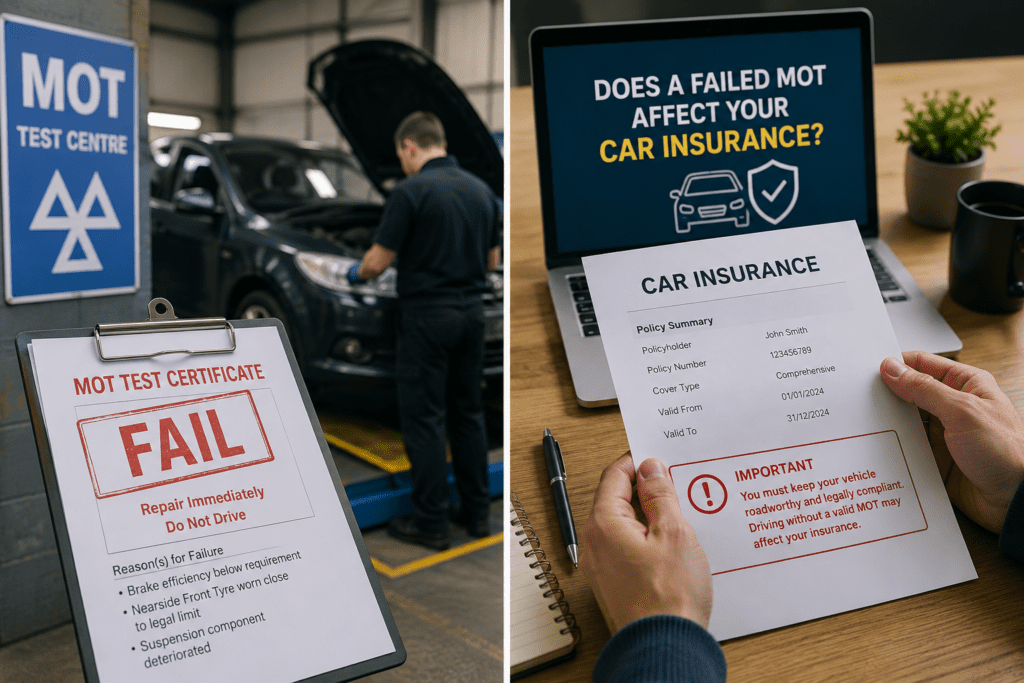
Find out how a failed MOT can affect your car insurance in the UK, what the law says, and what Guildford drivers should do next.
Failing an MOT is stressful enough on its own. But for many drivers, the question that follows almost immediately is this: does a failed MOT affect your car insurance? It is a fair concern, and the answer matters more than most people realise.
Your MOT test is not just an annual formality. It is the legal confirmation that your vehicle meets the minimum safety and environmental standards required to be driven on UK public roads. When that certificate lapses or a test is failed, the consequences can stretch well beyond a repair bill. For drivers in Guildford and the surrounding areas, understanding exactly how a failed MOT interacts with your insurance cover could save you from a very costly situation.
What a Failed MOT Actually Means
When your car fails its MOT, it receives one of two classifications depending on the severity of the issues found.
- Minor faults are recorded on the certificate but do not prevent you from driving. These are advisories that need attention soon.
- Major faults mean your car has failed outright. You are not permitted to drive it on public roads until the faults are repaired and it passes a retest.
- Dangerous faults are the most serious classification. Driving a vehicle with dangerous faults is illegal and carries significantly higher penalties.
The key distinction here is whether your previous MOT certificate was still valid at the point of failure. If your current MOT had not yet expired when you booked the test and your car fails, you can still drive it home, provided no dangerous faults are recorded. However, if your certificate had already expired and the car fails, you cannot legally drive it anywhere except back to a pre-booked repair appointment.
Does a Failed MOT Void Your Car Insurance?
This is the question most drivers want answered clearly, so here it is.
A failed MOT does not automatically void your insurance the moment the test result is issued. However, the moment you drive a vehicle without a valid MOT certificate on public roads, your insurance cover becomes extremely vulnerable. Most insurance policies include a clause requiring your vehicle to be roadworthy and legally compliant at all times. A failed MOT, particularly one with major or dangerous faults, gives insurers grounds to refuse a claim if an accident occurs.
Insurance policies are built on the assumption that the insured vehicle is legal and roadworthy. A failed MOT does not automatically invalidate insurance, but it can give insurers grounds to refuse a claim.
In practice, this means you could be paying your premium every month and still find yourself entirely without cover when it matters most, simply because your MOT had lapsed or you continued driving after a failure.
What Happens If You Drive Without a Valid MOT
Many drivers are unaware of just how serious the consequences are. It is against the law to drive a car without a valid MOT. If caught driving without one, a driver can be fined up to £1,000. Additionally, driving a car that has failed its MOT with dangerous faults may result in a fine of up to £2,500, as well as penalty points on the licence.
It does not end there. If caught and fined for driving without an MOT, a driver has effectively committed two offences. An additional £300 fine and six penalty points apply for driving without insurance cover.
There are also longer-term consequences that drivers often overlook:
- Your future insurance premiums may increase, as insurers can view driving without an MOT as negligent behaviour.
- Police have the power to impound cars found on the road without a valid MOT.
- A conviction for driving without insurance goes on your record and can affect your ability to get affordable cover in future years.
- Drivers risk fines, vehicle impoundment, penalty points, and potentially losing their driving licence if the vehicle is found to be dangerous.
The Only Legal Exception: Driving to a Pre-Booked Appointment
There is one situation in which you can legally drive a car that has failed its MOT or has an expired certificate. Automatic number plate recognition cameras can identify cars without an MOT. However, a driver is allowed to drive to a pre-booked MOT test, as long as they only drive to the MOT test centre and nowhere else.
This exception also applies to driving directly to a pre-booked repair garage. However, you must be able to demonstrate that the appointment was booked before you set off. If stopped by police and you cannot prove this, the exception does not apply. You should keep any booking confirmation accessible, whether on your phone or printed.
How to Know If Your Car Is at Risk of Failing
The best way to protect your insurance and avoid the stress of a failure is to stay ahead of common fault areas. Knowing what inspectors look for gives you the chance to address issues before test day. Seven signs your car could fail its MOT covers the most frequent failure points in clear detail, from tyre condition and brake performance to lighting faults and windscreen damage.
Regular maintenance also plays a significant role. A full car service before your MOT is due can catch developing problems early, reducing the risk of failure and keeping your vehicle in the condition your insurer expects it to be in.
What the MOT Checks and Why It Matters to Insurers
Understanding what the MOT actually tests helps explain why insurers take it so seriously. The inspection covers:
- Brakes and braking performance
- Tyres, including tread depth and condition
- Steering and suspension components
- Lights, indicators, and reflectors
- Seatbelts and restraints
- Exhaust emissions
- Windscreen and wipers
- Bodywork that could pose a hazard
Without a valid MOT certificate, a vehicle is not considered roadworthy. This can result in fines and penalty points, and it can also have a direct impact on car insurance. If a car is involved in an accident while it has no MOT, an insurer may reject the claim. Even if the driver was not at fault, the absence of a valid MOT means the car was not legally roadworthy, giving insurers grounds to refuse cover.
From an insurer’s perspective, the MOT is the baseline proof that your vehicle was fit for the road. Without it, that baseline disappears entirely.
What to Do Immediately After Failing Your MOT
If your car fails its MOT, the steps you take immediately afterwards make a significant difference to both your legal position and your insurance cover.
- Do not drive the vehicle unless your current certificate is still valid and no dangerous faults were recorded.
- Review the failure report carefully. Major and dangerous faults must be repaired before any retest.
- Book repairs promptly. The sooner faults are addressed, the sooner your car is legally compliant again.
- Arrange a retest once repairs are completed. Depending on timing, a partial retest covering only the failed items may be available.
- Inform your insurer if asked. If your policy requires you to maintain a roadworthy vehicle, continued driving without acting on a failure could breach your terms.
- Check your SORN options. If the car cannot be repaired immediately, a Statutory Off Road Notification removes it from public road use legally and protects you from further penalties.
You can also check when your car’s MOT is due directly through the government’s official vehicle enquiry service, which is free to use and requires only your registration number.
Does a Past Failure Affect Your Premium Going Forward?
This is a question that often comes up once a car has passed its retest. A past MOT failure that has since been repaired and passed should not directly affect a premium. Insurers are primarily concerned with the current legal status of the vehicle, not a historical failure that has been properly resolved.
Where it does become a problem is if the failure was not disclosed when relevant, if the car was driven while the issue was unresolved, or if a claim was made during that period. In those scenarios, an insurer has legitimate grounds to challenge the validity of the policy.
Transparency with your insurer is always the safer approach. If you are unsure whether a recent failure affects your policy terms, contact your provider directly before driving the vehicle.
New Cars and First MOT: A Common Point of Confusion
Some drivers, particularly those who have recently bought a new or nearly new vehicle, are unsure when their first MOT falls due. If you are in this position, it is worth getting clarity early rather than assuming your car is covered indefinitely. Understanding when a new car needs its first MOT prevents the kind of accidental lapse that catches drivers off guard and creates unnecessary insurance risk.
Conclusion
A failed MOT may not instantly cancel your car insurance, but the consequences of continuing to drive without addressing the failure can be severe. From voided claims to heavy fines, penalty points, and even vehicle seizure, the risks are real and well documented. The safest position for any driver is a simple one: keep your MOT current, act quickly when faults are identified, and never assume your insurance will protect you if your vehicle is not legally roadworthy.
For drivers in Guildford and the surrounding areas, staying on top of your MOT is one of the most straightforward ways to protect your cover, your licence, and your peace of mind.
Frequently Asked Questions
Does a failed MOT invalidate my car insurance immediately? Not automatically. However, if you continue driving with major or dangerous faults recorded, or if your certificate has already expired, your insurer can refuse to pay out on any claim made during that period.
Can I drive home after failing my MOT? Yes, but only if your existing MOT certificate has not yet expired and no dangerous faults were recorded. If the certificate has already lapsed and the car fails, you cannot legally drive it except to a pre-booked repair appointment.
Will failing an MOT increase my insurance premium? A past failure that has been repaired and retested should not affect your premium. However, driving without a valid MOT, or making a claim during that period, can impact your future insurability and costs.
What happens if I have an accident without a valid MOT? Your insurer may refuse your claim on the grounds that the vehicle was not legally roadworthy. You could also be personally liable for any third-party damages, in addition to facing fines and penalty points for driving without a valid certificate.
Is there a grace period after my MOT expires? No. There is no grace period in UK law. The moment your MOT certificate expires, it is illegal to drive the vehicle on public roads, except when travelling directly to a pre-booked MOT or repair appointment.
What is a SORN and when should I use it? A Statutory Off Road Notification tells the DVLA that your vehicle is not being used on public roads. If your car has failed its MOT and cannot be repaired immediately, declaring a SORN protects you from further penalties while the vehicle remains off road.
