
A conversion kit can cost far less than a new electric bike. That does not make conversion the cheaper decision. It makes it the cheaper starting point — which is not the same thing.
The reason is simple, and it is the idea this whole guide is built on: you are never comparing a kit against an e-bike. You are comparing a kit PLUS the bicycle you already own against a complete e-bike. The donor bike, not the kit price, usually decides which side wins.
| THE SHORT ANSWER
Conversion is usually cheaper when you already own a sound, comfortable bicycle that needs little work. It stops being cheaper the moment you have to buy a donor bike, or replace its brakes, wheels, tyres and drivetrain to make it safe at e-bike speeds. Compare total installed cost at equal capability — same battery energy, same legal category, same braking readiness — not the two price tags. The trap to avoid: the cheapest kit fitted to a bike not worth electrifying is the most expensive outcome in this comparison. |
Start With an Equal-System Comparison
Before comparing prices, decide what the finished bike must actually do. A 250W road-legal commuter, a cargo bike for hills and a high-power private-land build are three different products with three different budgets.
Then compare like for like. A new e-bike often includes lights, mudguards, a rack, hydraulic brakes and a calibrated display as standard. On a conversion, several of those are line items you may still have to buy.
The rule: compare complete systems at the same battery energy, the same legal category and the same braking readiness. Otherwise the cheaper option is simply the one missing parts.
an ordinary bike that now rides like an e-bike — and still looks like the bike its owner chose. [alt: converted hybrid bicycle with front hub motor and handlebar-mounted battery parked in a public square]
Framework A: The Three-Budget Model
Most buying guides discuss only the purchase budget. A realistic comparison separates three: purchase, adaptation and ownership. Conversion usually wins the first and loses ground in the second.
| Budget | Conversion includes | New e-bike includes |
| 1 · Purchase | Motor system, battery, controller, display, PAS sensor, wiring, mounting hardware | The complete bike, as specified, ready to ride |
| 2 · Adaptation | Tools or fitting labour, torque arms, brake upgrade, tyres, chain/freewheel, cable protection, battery mount | Usually nil — occasionally a rack, lights or a fitting fee |
| 3 · Ownership | Replacement batteries, electrical spares, mechanical wear, diagnosis time | Replacement batteries, servicing, dealer parts |
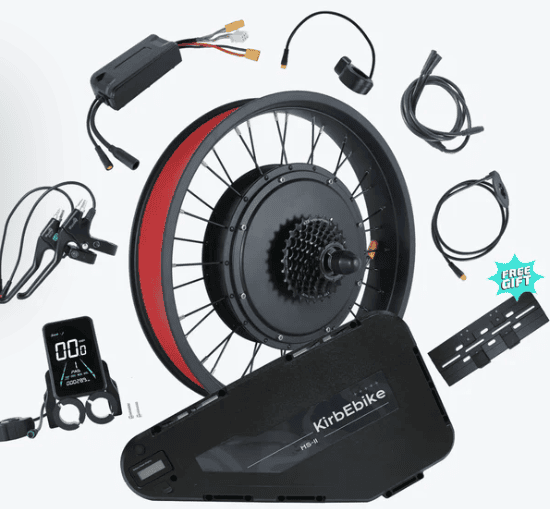
This is what a kit price actually buys. Anything not in this picture belongs in the adaptation budget. [alt: complete ebike conversion kit contents laid out — motor wheel, battery, controller, colour display, brake levers, pedal-assist sensor and wiring]
The adaptation budget is where comparisons usually go wrong. It is invisible on a product page and it is where a marginal donor bike quietly turns a bargain into a rebuild.
The Total Installed Cost Worksheet
Rather than trusting a headline figure, price your own build. Fill both columns with real quotes for the capability you actually want, then compare the totals.
| Cost line | Conversion | New e-bike |
| Kit (motor, controller, display, sensors, wiring) | — | included |
| Battery at your target watt-hours | — | included |
| Donor bicycle (only if you must buy one) | — | n/a |
| Brakes / rotors upgrade if required | — | usually included |
| Tyres, chain, freewheel or cassette | — | included |
| Torque arms & mounting hardware | — | n/a |
| Tools or professional fitting | — | usually nil |
| Lights, mudguards, rack if needed | — | often included |
| TOTAL INSTALLED COST | = your figure | = your figure |
Two rules make the worksheet honest. Count the donor bike at what you would otherwise sell it for, not at zero. And put every part you would have to buy anyway in both columns, so neither side gets a free pass.
Framework B: The Donor Value Test
Everyone repeats that conversion is cheaper “if you already have a bike”. Almost nobody says how to judge whether YOUR bike qualifies. These five checks decide it.
| # | Check | Pass looks like | Fail costs you |
| 1 | Structure | Frame and fork sound: no cracks, corrosion, damaged dropouts or suspect repairs | A new donor bike — the comparison is over |
| 2 | Fit & comfort | You already enjoy riding it for the distances you plan | You will not ride the finished bike |
| 3 | Braking | Discs, or rim brakes in good order with capacity for extra mass and speed | Brake upgrade + labour |
| 4 | Wheels & tyres | True wheels, sound spokes, tyres with load capacity left | Wheel or tyre spend |
| 5 | Drivetrain | Chain, freewheel/cassette and shifting in serviceable condition | Drivetrain refresh |
Score it honestly. Five passes and conversion is very likely the cheaper, better decision. Two or more fails and the adaptation budget has already eaten the saving — at that point a factory e-bike is usually the rational buy.
This is the practical form of the core idea: the kit price is the smaller variable. The bicycle you are starting from is the larger one.
When Conversion Is Genuinely Cheaper
Consider three riders. The first owns a well-maintained hybrid with a recent drivetrain and good brakes — she needs only the kit, battery and mounting hardware, and conversion wins comfortably.
The second owns a fifteen-year-old bike with worn rims, tired brakes and a stretched chain. By the time it is safe at assisted speed, he has bought most of a bike anyway. The third owns nothing and must buy a donor — for him a budget factory e-bike is usually cheaper and always simpler.
Electric assistance raises average speed and adds weight and torque. That is why brakes, spokes, tyres, dropouts and the drivetrain deserve inspection before, not after, the kit arrives.
Fit Is the Main Conversion Risk
A factory e-bike arrives with motor, battery and frame designed around each other. A conversion asks the buyer to prove that relationship. The checks are manageable — skipping them is what turns a good kit into a bad purchase.
A wheel size in a product menu is not a substitute for measuring dropout width, axle type and brake clearance. A battery photograph is not a substitute for the case outline, mounting rail and removal path.
High-torque hub systems deserve particular attention at the dropouts and torque arms. Carbon forks, damaged frames, unusual thru-axles and non-standard brakes need specialist confirmation rather than optimism.
Specification detail also affects the maths. Buyers comparing electric bike conversion kits with battery should confirm exactly what each variant includes and which wheel sizes it is built for before putting its price into any comparison — two listings at the same price can contain very different amounts of hardware, and the difference lands in the adaptation budget.
Factory Integration vs Modular Control
A new e-bike is easier to understand as one object: battery in the down tube, cables routed internally, sensors calibrated for its own motor. That integration is a genuine convenience asset.
A conversion trades some of that for control. You keep a frame that already fits, choose front-hub, rear-hub or mid-drive assistance, and decide the battery size yourself. Integration is convenience; modularity is control — neither is automatically superior.
Upgradeability Is Really About Replaceability
Upgradeability is usually illustrated with a bigger battery or a stronger controller. That is the less important half. The question that decides a five-year ownership is simpler: in year four, can you still buy a part that fits?
A modular conversion can accept a replacement pack of the same voltage, connector and discharge capability, and a display or controller can be changed if the protocol matches. Battery ranges that publish voltage, BMS continuous current, connector and case dimensions per model — the KirbEbike listings are a useful example of that level of detail — make this far easier to verify years later than a sealed proprietary pack does.
The limits are real, though. A higher-voltage battery still needs controller and display compatibility, and a larger controller can exceed the BMS or the motor’s thermal capacity. Factory e-bikes can be serviceable too — the risk appears when a proprietary battery is discontinued.
Maintenance and Warranty Are Different Experiences
A new e-bike usually offers one support path. If the display shows an error, a dealer inspects the system as a whole product, which removes the argument about whose part failed.
A conversion divides that responsibility: a bike shop services brakes and drivetrain, the kit supplier handles the electrics. Once a fault is identified, though, modularity pays — a failed display, cable or controller can often be replaced on its own.
Also check the donor bike’s own warranty. Modifying wheels, cranks or frame-mounted components can affect it, and that is worth knowing before the kit is fitted rather than after.
Ride Quality, Weight and Appearance
A factory e-bike normally wins on visual integration, because housings and cable paths were designed with the frame. A well-executed conversion can still look coherent: a frame-mounted battery keeps weight central and cables can follow existing brake or gear lines.
Compare complete-system weight rather than component weights. A light kit on a heavy donor can finish heavier than a purpose-built e-bike. And visible wiring is not a fault in itself — unsafe routing is, so cables must not pull under steering or rub a tyre.
UK and US Use Must Be Compared Like for Like
Legal category changes the whole comparison. In Great Britain, an EAPC must meet requirements including a maximum continuous rated motor power of 250W and assistance that stops at 15.5mph.
A switchable lower-power setting does not by itself certify a high-power vehicle for road use — current guidance considers the complete vehicle and its accessible modes. In the United States, rules vary by state and usually turn on class, power, assisted speed and throttle operation.
So legality belongs inside the fit question. A motor can fit a frame perfectly and still be the wrong system for the roads the owner intends to ride.
Which Option Fits Which Buyer?
| Choose a conversion kit if… | Choose a new e-bike if… |
| You own a sound bike that fits you well | You would need to buy a donor bike first |
| You want to choose battery size and motor position | You want integrated styling and calibrated sensors |
| You value replaceable parts over sealed integration | You want one warranty and one support contact |
| You are comfortable measuring and checking fit | You would rather not diagnose anything yourself |
| Your donor passes the five-point test above | Two or more Donor Value Test checks fail |
Five Questions That Decide the Answer
- Do you already own a bicycle that is structurally sound, comfortable and worth keeping?
- Can the motor, battery, brakes and drivetrain fit without major or uncertain modification?
- What is the complete installed, road-ready cost — not the advertised product price?
- Do you value integrated convenience now, or replaceable components later?
- Who will diagnose faults and supply parts after the first year?
If the first two cannot be answered confidently, the project is not ready for a kit purchase. If the donor is sound and long-term component control matters, conversion is usually the better value.
Frequently Asked Questions
Is an ebike conversion kit cheaper than buying an electric bike?
Often, when a suitable bicycle is already owned. Add battery, installation, tools, torque arms and any brake, tyre or drivetrain work first. If you must buy a donor bike as well, the total frequently approaches or exceeds a budget factory e-bike.
Can any bicycle be converted into an ebike?
No. Wheel size, dropout width, axle type, brakes, gears, frame material, battery space and structural condition all matter. Carbon forks, unusual thru-axles and damaged frames need specialist assessment.
Is a converted ebike reliable enough for commuting?
Yes, when the donor is sound, the electrical parts are matched and the installation protects connectors, wiring and mounting hardware. Reliability suffers when a marginal bike is asked to carry more speed and weight.
Does conversion affect the bicycle’s warranty?
It may. Modifying wheels, cranks, wiring or frame-mounted components can affect the original manufacturer’s warranty, so check before fitting.
Which option is easier to repair?
A factory e-bike is often easier to diagnose through one dealer; a modular conversion is often easier to repair by replacing one known component. It depends on documentation and parts availability.
Can I upgrade the battery later?
Usually, but the replacement must match controller voltage, full-charge input, BMS current, connector polarity, mounting rail and case dimensions. More amp-hours add range and weight.
Does a converted bike have lower resale value?
It can, particularly if the wiring is untidy or the buyer cannot verify the battery’s age. A documented conversion using serviceable, named components sells far better.
Should a conversion kit be professionally installed?
Professional fitting is sensible whenever you are unsure about dropouts, torque arms, brakes, battery mounting or electrical polarity. Straightforward front-wheel kits on suitable bikes are commonly owner-fitted.
Choose the Complete System, Not the Cheapest Box
A conversion is the stronger value when it electrifies a bicycle that already fits, is mechanically sound and can accept the system safely. It preserves a frame you like and gives you control over the parts.
A new e-bike offers better value than buying and rebuilding a donor, when you want integrated styling, or when a single support contact matters more than modularity.
The deciding question was never “are kits or e-bikes better?” It is whether this bicycle, this electrical system and this support plan add up to a bike you will keep riding. That is a harder comparison than reading two price tags — and a much more reliable one.
