
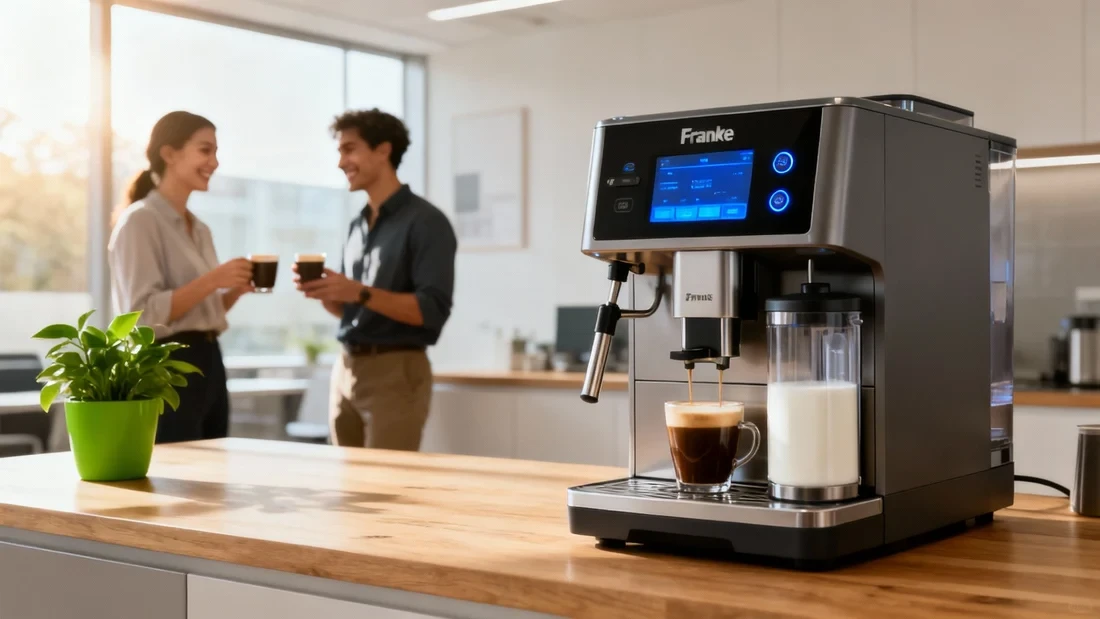
An office break room and a busy café counter ask completely different things from a coffee machine, even when both are pouring espresso from the same brand. Franke makes equipment for both worlds, but picking the wrong tier means either paying for capacity you’ll never use or watching a machine buckle under a lunch rush it wasn’t built for.
Smaller offices with under 50 daily cups do well with a compact Franke automatic coffee machine like the A-series, which handles milk drinks with minimal counter space and low maintenance. Cafés and high-traffic offices pushing 100+ cups a day need the S-series or a larger bean-to-cup unit built for continuous back-to-back brewing, faster steam recovery, and heavier daily cleaning cycles.
What Makes Franke’s Commercial Range Different
Franke didn’t design these machines by scaling up a home espresso maker. Every Franke commercial coffee machine in the current lineup is built around continuous grinding, brewing, and steaming cycles that would wear out consumer-grade parts within weeks. Sealed brewing units are rated for thousands of cycles, ceramic grinders replace steel blades that dull quickly, and milk systems can froth back-to-back drinks without needing a break to cool down.
Comparing the current models side by side is easier than taking anyone’s word for it. You can Learn More about the full range Coffee Seller stocks, including specs on daily cup capacity and bean hopper size.
Office vs Café: Why One Machine Rarely Suits Both
An office kitchen sees clustered demand, a rush around 9am, another around 2pm, and long quiet stretches in between. A café counter sees near-constant demand for eight or ten hours straight, often with several drinks queued at once. That difference changes what actually matters in a machine: recovery time between drinks, hopper size, and how much daily cleaning staff can realistically manage.
Working through this exact decision is something Coffee Seller helps businesses do every week, matching machine output to real usage patterns instead of guessing based on brand reputation alone.
What Offices Typically Need
Office coffee setups usually prioritize simplicity over sheer speed. Staff want a good latte or Americano without training, and facilities managers want low weekly maintenance.
- One-touch drink buttons that don’t require barista skill
- Smaller footprint that fits a break room counter, not a commercial kitchen
- Lower daily cup capacity, typically 30 to 80 cups
- Simple, infrequent descaling and cleaning cycles
- Quiet operation near open-plan seating
What Cafés Typically Need
Cafés run on speed and consistency, since customers are paying for both the drink and the wait time. A machine here has to hold its performance for hours without slowing down.
- High daily throughput, often 150 to 400+ cups
- Fast steam and water recovery between orders
- Dual or multiple brewing groups to serve several customers at once
- Larger bean hoppers to reduce mid-shift refills
- Programmable recipes for a wider drink menu
Best Franke Automatic Coffee Machine Options by Setting
Franke’s automatic coffee machine range spans compact single-boiler units up to high-volume, dual-outlet systems. Matching cup volume to the right tier avoids both overspending and underperforming.
| Setting | Daily Cup Volume | Best Fit Tier | Key Priority |
| Small office (10-30 staff) | Under 50 cups | Compact A-series | Simplicity, low upkeep |
| Mid-size office / lobby | 50-100 cups | Mid-tier bean-to-cup | Drink variety, speed |
| Café or coffee shop | 150-400+ cups | S-series high volume | Recovery time, durability |
| Hotel or large canteen | 400+ cups | Dual-outlet commercial units | Continuous output |
Choosing a Franke Coffee Machine for Office Use
A Franke coffee machine for office settings should be judged mainly on ease of use and how much attention it needs during the week, not raw output. Most offices overestimate their daily cup count and end up paying for capacity that sits idle most of the day.
A good rule of thumb: count actual cups poured over a normal week, divide by five, and add 20 percent for guests or busy days. That number, not the office headcount, should guide the machine tier.
Choosing a Franke Machine for Café Use
Cafés should weigh three things before anything else: how many drinks need to be made in a single busy hour, how many baristas will run the machine at once, and how much variety the menu promises customers. A machine that looks fine on a spec sheet can still create a bottleneck if it only has one steam wand during a morning rush with three staff working the counter.
Multi-group machines cost more upfront but reduce wait times enough to matter for repeat customers, particularly in locations near transit stops or office buildings where speed drives loyalty.
Maintenance Differences Worth Planning For
Higher volume machines need more frequent cleaning cycles, not because they’re lower quality, but because more milk and coffee pass through the same components each day. Offices with lighter use can often get away with weekly deep cleans, while cafés typically need daily cleaning routines built into closing procedures.
- Offices: weekly descaling, daily rinse cycle, monthly deep clean
- Cafés: daily cleaning cycle, weekly descaling, scheduled professional servicing
Frequently Asked Questions
1. What is the difference between an office and a café coffee machine?
An office machine is built for lower, clustered daily demand and simple one-touch operation, while a café machine is built for continuous high-volume output with faster recovery between drinks and a wider programmable menu.
2. How many cups per day can a Franke office machine handle?
Compact office models typically handle 30 to 80 cups per day comfortably, depending on hopper size and how often staff run milk-based drinks versus black coffee.
3. Is a bean-to-cup machine better than a pod machine for an office?
Bean-to-cup machines generally cost less per cup over time, produce fresher coffee, and reduce ongoing pod ordering, making them a better long-term fit for offices with steady daily use.
4. How often does a commercial Franke machine need servicing?
Most commercial units need descaling every one to two weeks depending on water hardness, plus a professional service visit two to four times a year to check seals, grinders, and brewing units.
5. Can one machine serve both a small café and an office kitchen?
A mid-tier bean-to-cup unit can often serve both if daily volume stays under 100 cups, but once demand pushes past that consistently, a higher-capacity S-series machine avoids slowdowns during peak hours.
6. What is a Franke automatic coffee machine?
It’s a self-contained unit that grinds beans, brews espresso, and often froths milk automatically at the touch of a button, without requiring a trained barista for each drink.
7. Do Franke machines require plumbing installation?
Many commercial models can run plumbed-in for continuous water supply and drainage, though smaller office units are often available with a water tank for locations without easy plumbing access.
8. What size hopper does a café-grade machine need?
Café-grade machines typically use hoppers holding 1.2 to 2.5 kilograms of beans to reduce how often staff need to refill during a busy shift..
Final Thoughts
Matching machine tier to actual daily demand saves money twice over: once by avoiding an underpowered machine that frustrates staff or customers, and again by not overpaying for café-grade output in a quiet office kitchen. Walking through real cup counts, peak-hour demand, and cleaning capacity before buying makes the decision far less of a guessing game.
Coffee Seller works with offices and café owners regularly to match Franke equipment to actual usage rather than brand assumptions, and can walk through current models, hopper sizes, and servicing plans for any setting being considered.
