
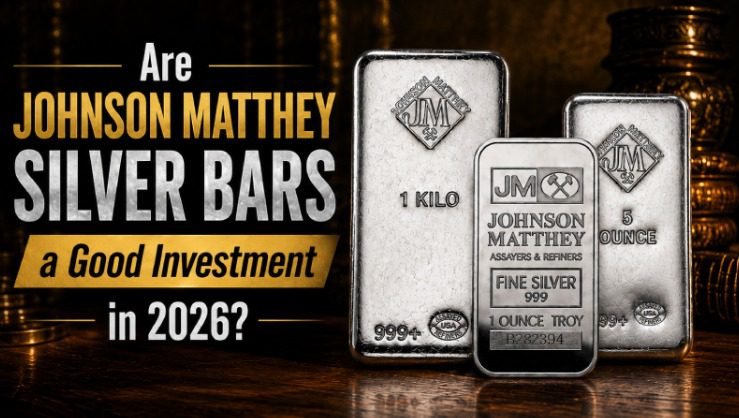
Only few trustworthy names appeal to silver stackers or collectors and Johnson Matthey’s name is one that has always resonated with them. However, since the production of the original bars stopped in 2015, and a new generation of silver Johnson Matthey bar is now hitting the shelves of dealers, investors are asking a fair question for 2026: is it still worth buying Johnson Matthey silver Bars?
Yes, but with some caveats. Let’s see what’s really going on, and what you need to know before buying JM silver.
A Brand Built Over Two Centuries
Johnson Matthey’s history in precious metals stretches back to 1817, when the company was founded as an assayer in London. Over the following two centuries, it grew into one of the most trusted refiners in the world, eventually supplying silver bars to banks, institutions, and individual investors across the UK, Canada, and the United States.
That reputation didn’t disappear when Johnson Matthey sold its bullion refining business to Asahi Holdings in 2015. If anything, it became more valuable. Every bar produced before that sale is now a fixed, non-renewable piece of supply — a refinery’s legacy frozen in metal form.
The Supply Story That Matters Most
This is the key reason why investors are interested in JM silver bars in 2026: the original vintage bars can’t be remade. After the takeover by the Asahi group the former Johnson Matthey facilities were used to produce silver with the Asahi name and accreditation and not Johnson Matthey’s. What this means is that the amount of genuine vintage JM bars available for sale anywhere, in any dealer’s inventories, or in anyone’s vault is set and nothing can be added or taken away.
Only supply can decrease from this point, it can melt, it can be stored for several times or it can be lost. If scarcity is a key factor for investors, that’s also a significant difference between those generic silver bars that can always be minted again.
JM-Branded Bars Are Back
Buyers researching this topic in 2026 will run into a complication worth understanding clearly. New silver bars carrying the Johnson Matthey name and logo have started appearing again, produced under a licensing arrangement by CNT Precious Metals, a US-based refiner. These are new-condition 5 oz and 10 oz poured bars, not the same product as vintage pre-2015 JM bullion.
This creates three distinct categories in the market:
- Vintage JM bars produced before 2015 at the original refineries, now carrying collector premiums.
- Asahi bars produced at the former JM facilities since 2015, with lower premiums but the same .999 purity and LBMA accreditation.
- New JM-branded bars from CNT Precious Metals, available since 2025 as fresh-condition product.
Anyone buying for the scarcity story specifically needs to confirm which category they’re getting. Reputable dealers will disclose this clearly on every listing.
What the Numbers Look Like
Typically vintage Johnson Matthey bars have traded at a premium of 10-30% over spot, depending on the weight, condition and the level of activity in a particular size on the secondary market. Smaller bars, especially smaller sizes such as 1 oz and 10 oz, are more likely to achieve premiums than larger bars, such as the 100 oz bar, which had a more consistent production and is more available.
It’s not only brand recognition that is that premium. It is a true liquidity. JM bars are easily recognized by dealers, depositories and other buyers around the world, making it easier and more frictionless to resell the bars than anonymous or less familiar bullion.
Who Actually Buys JM Silver, and Why
Three types of buyers tend to drive this market, each for a different reason.
- Investors focused purely on metal content like JM bars because the .999 fine silver purity removes any question at resale, no explanation needed, no discount applied for an unfamiliar brand.
- Stackers who care about premium preservation over time are drawn to the finite vintage supply, since that scarcity provides some structural support for the premium even as silver prices fluctuate.
- Collectors buy for provenance and history. A bar from a 200-year-old refinery that no longer makes silver carries a story that generic bullion simply doesn’t have, and that story tends to translate into stronger resale value at auction and through dealer buybacks.
Things to Check Before You Buy
Because vintage JM bars carry meaningful premiums, they also attract more sophisticated counterfeits than ordinary bullion. A few questions worth asking any dealer before purchasing:
- Does the bar undergo independent verification, such as XRF scanning or electrical conductivity testing, before it ships?
- Is the listing specific about whether the bar is vintage pre-2015 production, Asahi-era production, or new CNT-licensed JM product?
- Is condition disclosed honestly, including toning, contact marks, or surface wear typical of secondary market bullion?
- Is the bar IRA-eligible if that matters for your portfolio? (JM bars generally meet the .999 purity and LBMA-accredited refiner standard required for self-directed precious metals IRAs.)
The Bottom Line
For those who know what they’re purchasing, Johnson Matthey silver bars are still a worthwhile investment in 2026. The brand, limited availability and resale liquidity advantage afforded JM bars over general silver is why it might be worthwhile looking at it for the long term if you want to keep holding on to high quality silver bars.
There’s one thing that goes right – sourcing. There are now three varieties of “Johnson Matthey” products in circulation, vintage, Asahi, and new-licensed; and the only way to determine if what is being offered is the scarcity product you want or another is that you have to buy from a dealer who will certify each bar and be explicit regarding its production time.
