
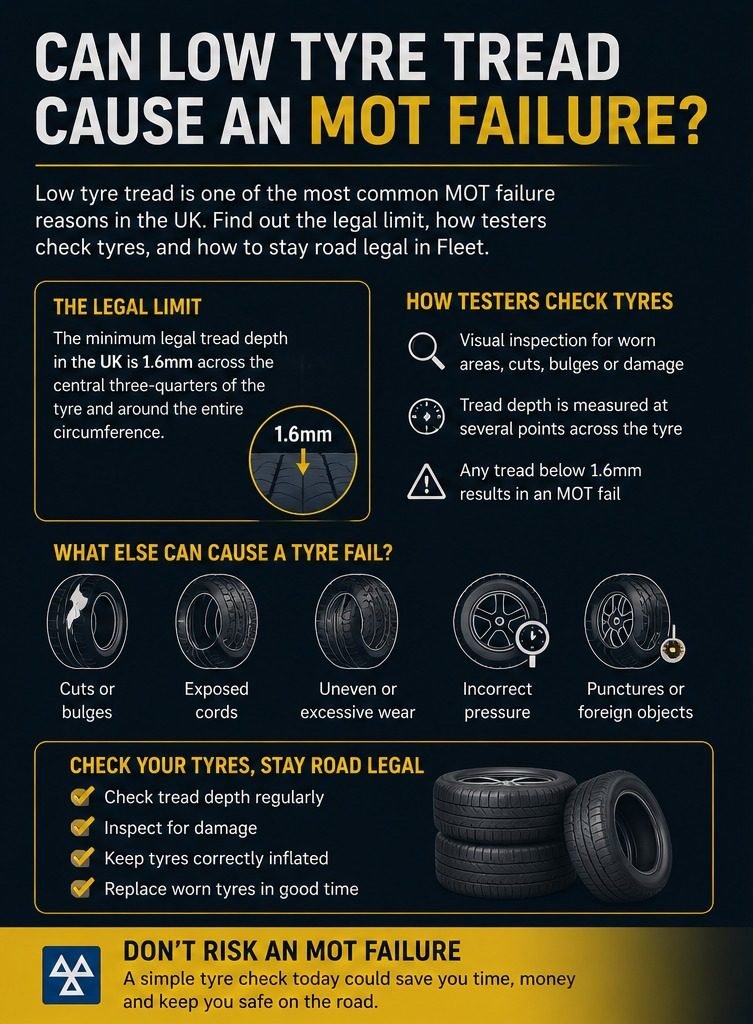
Low tyre tread is one of the most common MOT failure reasons in the UK. Find out the legal limit, how testers check tyres, and how to stay road legal in Fleet.
That sinking feeling when the tester points to your tyre and shakes their head. Worn tread is one of the most common reasons cars fail their MOT in the UK, and it is also one of the most avoidable. For drivers in Fleet, Aldershot, and Farnborough, a five-minute check before your test could save you the cost of a failure, a retest, and the hassle of being off the road. This guide explains the 1.6mm legal limit, exactly how testers measure it, and what to check before you book.
What Is the Legal Tyre Tread Depth in the UK?
This is the number every UK driver needs to know: 1.6mm. The legal minimum tread depth for car tyres in the UK is 1.6mm across the central three-quarters of the tyre’s width and around the entire circumference. This regulation is not a guideline or a recommendation. It is the law, and falling below it at your MOT will result in a failure.
That 1.6mm requirement applies to all four tyres on the vehicle without exception. A tyre could have 3mm of tread across most of its surface but a worn patch on one section that drops below 1.6mm, and that is still a fail. The measurement covers the full circumference, not just one point on the tyre. This is why a tyre that looks acceptable to the naked eye from a distance can still fail when a tester measures it properly with a depth gauge.
Tyre-related issues accounted for 13% of MOT failures in 2023 according to DVSA data, making worn or damaged tyres one of the most consistently problematic areas for UK drivers heading into their annual test. The good news is that most of these failures are entirely avoidable with regular, simple checks.
Why the 1.6mm Limit Exists
The legal limit is not an arbitrary figure. It exists because tyre tread plays a direct and critical role in keeping your vehicle safe, particularly on the wet roads that drivers in Hampshire, Hook, and Hartley Wintney encounter throughout most of the year.
The tread grooves on your tyres do one essential job: they channel water away from the contact patch between the rubber and the road surface. When those grooves wear down, less water is displaced with each revolution, grip deteriorates, and braking distances increase. In tests carried out by MIRA, cars with 1.6mm of tread had up to 44% longer braking distances in the wet than those with 3mm. That difference, measured in metres and fractions of a second, is the gap between stopping in time and not stopping in time.
At 1.6mm, braking distances in wet conditions can be up to 44 metres longer than with new tyres, roughly the equivalent of ten car lengths. On a busy A-road near Fleet or Church Crookham, that is the kind of margin that changes outcomes.
The 1.6mm mark is also where the law draws its line on financial penalties. If you are caught by the police with a tread depth below the legal requirement, you can face three penalty points and a £2,500 fine per tyre. With four illegal tyres, that rises to £10,000 and 12 points, enough to trigger a driving ban.
Tyre-related issues accounted for 13% of MOT failures in 2023 according to DVSA data. The good news is that most of these failures are entirely avoidable with regular, simple checks. At TJ Services, we see drivers in Fleet and Farnborough pass on tread depth but fail on a sidewall bulge they never noticed or vice versa. A proper pre-MOT check looks at both, not just the tread you can see from a standing position.
The 3mm Recommendation: Why Legal Is Not Always Safe
Passing the legal threshold does not automatically mean your tyres are performing well. This is a distinction that matters and one many drivers are never properly informed about.
The 1.6mm minimum is a legal floor, not a safety guarantee. Most tyre safety experts recommend replacing tyres at 3mm, nearly double the legal limit, because below that point wet braking performance begins to drop sharply. The reason comes down to water displacement. As tread grooves become shallower, the tyre’s ability to shift water reduces, grip deteriorates, and stopping distances lengthen well before the legal minimum is reached.
Think of it this way. A tyre at 2mm tread is technically road legal. It will pass your MOT. But in heavy rain on the way home from Yateley or Farnham, it is working with a significantly reduced margin compared to a tyre at 3mm or above. Drivers often assume tyre performance declines slowly and evenly, but research shows wet grip reduction accelerates as tread depth drops closer to the legal minimum.
Treating 3mm as your personal replacement point, rather than 1.6mm, is one of the most practical safety decisions a driver can make.
What the MOT Tester Actually Checks on Your Tyres
Tread depth is the headline check, but it is not the only thing your MOT tester looks at during the tyre inspection. Understanding the full scope of what gets examined can help you prepare properly and avoid surprises on the day.
A qualified MOT tester will give all your tyres a thorough examination to make sure they are not damaged, have the legal minimum tread depth, are inflated enough, and match the correct type needed for your vehicle. Here is a breakdown of what falls under that inspection:
Tread depth is measured using a calibrated depth gauge across the central three-quarters of the tyre width, around the full circumference. Any point that falls below 1.6mm causes a failure.
Sidewall condition is examined for structural damage. Damage to the tyre sidewall such as a lump, bulge, or tear caused by separation or partial failure risks overall tyre failure or a serious accident and could fail an MOT. A bulge in the sidewall, often caused by hitting a pothole or kerb, indicates that the internal structure of the tyre has already failed. It is not something that can be repaired. It means immediate replacement.
Cuts and exposed cords are also a failure point. Your tyres may fail if they have cuts or cracks, bulges in the sidewall, exposed cords, objects embedded in the tyre, or significant signs of separation or structural damage. The tester is looking for any breach in the tyre’s structure that compromises its ability to hold pressure and maintain grip.
Tyre matching matters on the same axle. Mismatched tyres of different types on the same axle can be flagged as a failure. For example, fitting a radial tyre on one side and a cross-ply on the other is a major defect under the DVSA inspection criteria.
Tyre pressure monitoring systems (TPMS) on vehicles registered from 2012 onwards are also checked. If a TPMS warning light is showing during the test as a malfunction on an eligible vehicle, it is marked as a major defect.
| Tyre Issue | MOT Outcome |
| Tread below 1.6mm in any required zone | Failure, major defect |
| Sidewall bulge or lump | Failure, major or dangerous defect |
| Exposed cords or ply visible | Failure, dangerous defect |
| Mismatched tyre types on same axle | Failure, major defect |
| TPMS warning light active (post-2012 vehicles) | Failure, major defect |
| Minor surface cuts not exposing cords | Advisory noted, usually passes |
| Tread between 1.6mm and 3mm, no damage | Passes with possible advisory |
How to Check Your Tyre Tread Before Your MOT

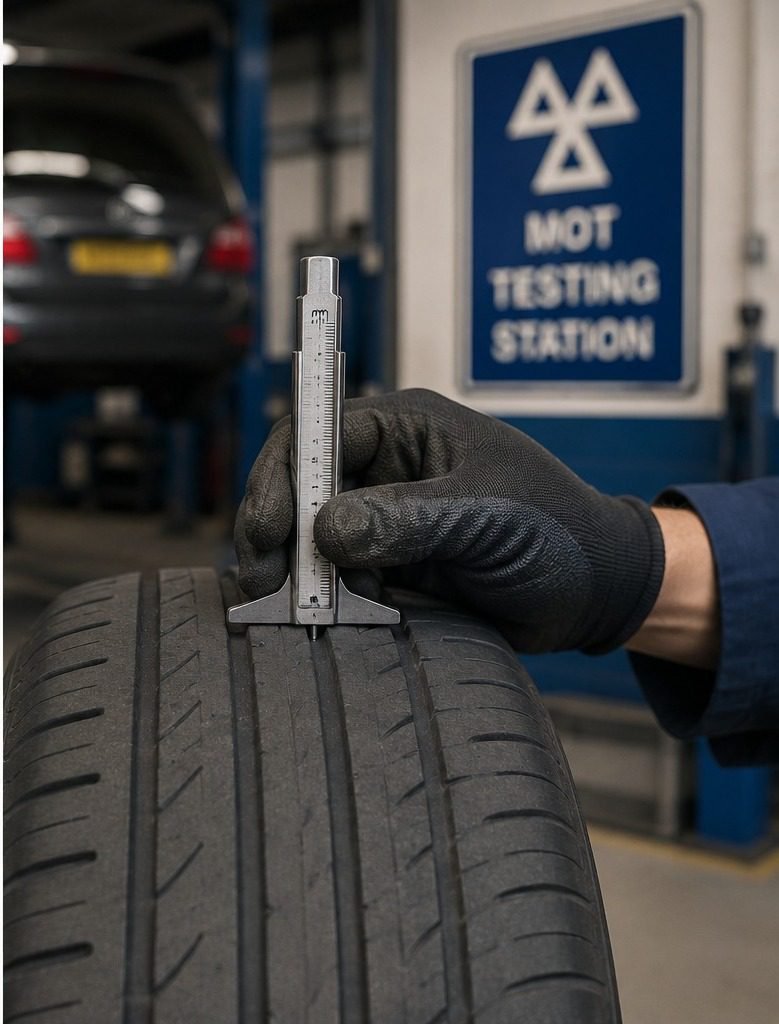
You do not need any specialist equipment to carry out a basic tread depth check at home. There are two methods that work well and take only a few minutes across all four tyres.
The 20p Coin Test
This is the simplest and most widely known method.
- Take a 20p coin and insert it into the main tread groove of the tyre.
- Make sure your eye level is in line with the tyre, not looking down at an angle.
- If the outer band of the coin disappears into the groove, your tread is above the legal minimum.
- If the outer band of the coin is clearly visible, your tread is at or below 1.6mm and the tyre needs replacing before your MOT.
Check multiple grooves across the width of the tyre and at several points around the circumference. As mentioned earlier, a tyre can pass at one point and fail at another.
A Tread Depth Gauge
These small tools cost very little and give you an exact reading in millimetres. Insert the probe into the tread groove and press the gauge flat against the tyre surface. The reading shows you precisely how much tread remains. Checking all four tyres and recording the lowest reading on each one gives you a clear picture of where you stand before booking your test.
Tread Wear Indicators
Modern tyres include small rubber bars inside the tread grooves. If they are level with the tread surface, it is time to replace the tyre. These indicators are moulded into the tyre at exactly 1.6mm depth. When the surrounding rubber has worn down to meet them, you are at the legal limit.
Tyre Wear Patterns to Watch For
Even if your overall tread depth is above the minimum, uneven wear patterns can reveal problems that may become MOT issues or, at the very least, advisory notes from your tester.
Centre wear occurs when a tyre has been consistently over-inflated. The central section wears down faster than the edges, which can take the tread below 1.6mm in the middle of the tyre even when the outer edges still look reasonable.
Edge wear is the opposite pattern and typically indicates under-inflation. The tyre’s edges make more contact with the road than the centre, wearing them down faster.
One-sided wear, where one edge of the tyre wears significantly faster than the other, usually points to a wheel alignment issue. If your car pulls to one side while driving, or you notice the steering wheel is not quite straight on a level road, misalignment is often the cause. Persistent misalignment not only wears tyres unevenly, it also affects handling and braking. A regular car service will typically include a check of tyre condition, inflation, and wear patterns, catching these issues before they become an MOT problem.
What Happens If Your Tyres Cause an MOT Failure?
If your tyres are the reason your vehicle fails its MOT, the process from that point follows the same steps as any other failure. You will receive a VT30 refusal certificate listing the specific tyre defects, and you will need to arrange for the tyres to be replaced before coming back for a retest. For a detailed walkthrough of what happens after a failure and how the retest process works, the MOT retest guide covers the key steps and timescales clearly.
The practical upside of a tyre failure, compared to some other failure categories, is that the remedy is straightforward. Once the tyres are replaced and the tread depth issue is resolved, the retest focuses only on the items that failed. You are not paying for a full test again provided you return within the 10 working day window and the repairs are handled correctly. If you are due for your MOT test in Fleet, booking your tyre check and test at the same garage keeps the process simple and your free retest valid.
Common Tyre Mistakes That Lead to MOT Failures
Many tyre failures at the MOT come down to the same handful of avoidable oversights. Being aware of them makes it much easier to stay on the right side of the test.
- Checking only the front tyres. All four tyres are inspected. Rear tyres are often overlooked because they are less visible during a casual walk around the car, but they wear over time too, particularly on front-wheel-drive vehicles where the rears can wear unevenly.
- Measuring tread in just one spot. The legal requirement is consistent tread across the full circumference. A tyre with good depth on most of its surface but a worn patch somewhere around the back can still fail. Always check in several positions around each tyre.
- Ignoring sidewall damage after a pothole. A sharp impact with a pothole or a kerb can cause internal damage that only shows up as a sidewall bulge days or weeks later. If your car has taken a hard knock recently, inspect the sidewalls carefully before your test.
- Leaving advisory notes unactioned. If your previous MOT certificate includes a tyre advisory, that note is there for a reason. Something that appears as an advisory one year will often turn into a minor or major defect at the next MOT if nothing is done. Addressing advisories promptly is far cheaper than addressing a failure.
- Mixing tyre structures on the same axle. This is an easy mistake to make if a spare tyre has been fitted in a hurry, or if a tyre is replaced without checking what is already on the opposite side of the axle. Mismatched structures are a failure category in their own right.
How Often Should You Check Your Tyres?
A monthly tyre check is the right habit for most drivers, along with a check before any long journey. This means looking at tread depth, checking for visible sidewall damage, and confirming that the tyres are correctly inflated according to the vehicle manufacturer’s recommendations.
In terms of miles a tyre should last, manufacturers generally accept that tyres have a lifespan of between 20,000 and 40,000 miles, though this can vary if you tend to drive on more uneven and challenging surfaces. Even if you drive limited miles each year, tyres should be replaced every five or six years.
Age matters as much as wear in some cases. Rubber degrades over time regardless of mileage, and a tyre that looks fine visually may have reduced structural integrity if it is approaching the end of its serviceable life. If you are unsure about the age of your tyres, the date of manufacture is moulded into the sidewall as a four-digit code, with the first two digits representing the week and the last two the year.
For drivers in Fleet, Aldershot, Farnham, and the surrounding areas, the mix of rural A-roads, motorway driving, and town centre roads means tyres do a varied job. That makes regular checks all the more worthwhile. Understanding the full range of faults that cause MOT failures, including those beyond tyres, is also useful preparation.
Conclusion
Low tyre tread is one of the most common, most preventable, and most expensive-feeling reasons to fail an MOT. The 1.6mm legal limit is clear, the consequences of ignoring it extend well beyond the test itself, and the checks you need to do beforehand take less than five minutes. Adopting a monthly tyre check routine, replacing tyres when the tread reaches 3mm rather than waiting for the legal minimum, and keeping an eye on sidewall condition after any significant road impact are the habits that keep you road legal, safe, and far less likely to face an avoidable failure when test day arrives.
For drivers in Fleet, Aldershot, and Farnborough who want certainty before their MOT, TJ Services offers tyre checks, replacements, and MOT preparation. Find TJ Services on Google to view our hours, read customer reviews, and get directions to our Fleet workshop.
Frequently Asked Questions
Does low tyre tread always fail an MOT?
Yes. If any tyre is found to have less than 1.6mm of tread, the vehicle will fail its MOT, making it illegal to drive until the issue is rectified. There is no discretion on this point. The 1.6mm rule is a hard legal threshold across the central three-quarters of the tyre and around its full circumference.
Can a tyre pass in one place but fail in another?
Yes, this is one of the most common misunderstandings. A tyre could have 3mm of tread across most of its surface but a worn patch on one section that drops below 1.6mm, and that is still a fail. The tester checks multiple points around the full circumference.
What is the 20p test for tyres?
Insert a 20p coin into the main tread groove of the tyre. If the outer band disappears, your tread depth is meeting the legal requirement. If the band is clearly visible, your tread depth is below the legal limit and the tyre needs replacing.
Can a sidewall bulge fail an MOT?
Yes, immediately and without exception. If an MOT inspector sees a bulge, tear, or nick in the sidewall that reveals structural damage, it will result in an immediate fail.
Is 2mm of tyre tread legal for an MOT?
Yes, 2mm is technically above the 1.6mm legal minimum and will not fail on tread depth alone. However, safety research shows performance in wet conditions is already compromised at this level compared to a tyre at 3mm or above.
Can mismatched tyres fail an MOT?
Yes. If you have mismatched tyre structures on the same axle, such as one radial and one cross-ply, this will be a reason for an MOT failure.
How far in advance should I check my tyres before an MOT?
Check your tyres at least two to four weeks before your test date. This gives you enough time to source and fit replacement tyres without rushing, and to address any other concerns that the check reveals.
