

Katie Springer has lived almost entirely outside the spectacle that made her father famous. As the only child of Jerry Springer and Margaret “Micki” Velton, she grew up connected to a politician, news anchor and television host whose name became synonymous with confrontational daytime television. Yet Katie chose a quieter path centered on education, disability support and family life.
Born in 1976 with serious medical challenges, Katie later became legally blind and has hearing loss in one ear. She worked with children with disabilities, inspired one of her father’s most personal television appearances and remained a trusted source of support throughout his public career. After Jerry Springer’s death from pancreatic cancer in 2023, she also took part in fundraising and awareness efforts in his memory.
Katie is not a conventional celebrity, and much of her adult life remains private. Her story matters because it reveals a side of the Springer family that rarely appeared on television: one shaped by resilience, practical generosity and a close father-daughter relationship that lasted until Jerry’s death.
Early Life and Family
Katie Springer was born in 1976 to Jerry Springer and Micki Velton. Her exact date of birth and birthplace have not been publicly confirmed. Depending on whether her birthday has passed, she is 49 or 50 years old in 2026.
She was the couple’s only child. Jerry and Micki had married in 1973, several years before Katie’s birth, and remained closely connected throughout his life. Although some older celebrity accounts have described uncertainty around the marriage, Katie later spoke of her parents as a lasting couple whose relationship endured for nearly five decades.
Katie’s childhood unfolded during a period when her father’s career changed repeatedly. Jerry had worked as a lawyer and political campaign adviser before winning election to the Cincinnati City Council. He served briefly as mayor of Cincinnati and later became a respected local television news anchor.
By the time The Jerry Springer Show became a national hit in the 1990s, Katie had already experienced several versions of her father’s public identity. To audiences, he became the calm host standing at the center of chaotic arguments and physical fights. To Katie, he remained a protective parent whose private personality was far less theatrical.
Medical Challenges and Her Parents’ Approach
Katie was born without nasal passages, a condition that required surgery shortly after her birth. She is also legally blind and deaf in one ear. These details became publicly known because Katie discussed them herself rather than through speculation about her health.
In a 2006 interview, she explained that her parents had made a deliberate decision not to raise her as though she were incapable. They acknowledged the practical effects of her disabilities but encouraged independence and expected her to build a full adult life.
That approach shaped the way Katie later described herself. She did not present her medical history as a tragedy or use it to seek attention. Instead, she credited her parents with teaching her that disability should not prevent her from working, living independently, forming relationships or pursuing personal goals.
Jerry often pointed to Katie’s determination when discussing his own insecurities. During his time on Dancing with the Stars, he said that watching his daughter face challenges throughout her life had made him less concerned about embarrassing himself in public. If Katie could move forward without allowing other people’s judgments to define her, he believed he could accept looking awkward on a dance floor.
Education and Work With Children
Reliable public reporting has not established where Katie attended school or whether she earned a specific college degree. Claims about named universities or professional qualifications should therefore be treated cautiously unless supported by a direct source.
What is confirmed is that she worked as an assistant teacher at Park School in Evanston, Illinois, during the early 2000s. The school served children with disabilities and focused on academic instruction, daily living skills and vocational development.
Katie’s role placed her in an environment where students required individualized support. Her own experience with visual and hearing impairments gave her a personal understanding of accessibility, but her work was practical rather than symbolic. She assisted children whose learning and communication needs differed from those found in a conventional classroom.
Some online profiles state that Katie remains a special education teacher. That has not been publicly confirmed. Her work at Park School is well documented, but there is no reliable recent information identifying her current employer, job title or professional schedule.
The distinction is important because Katie has never maintained a public career page or regularly discussed her employment. Her record shows meaningful work in disability education, but it does not support claims about an uninterrupted career timeline through 2026.
Katie’s Corner at Park School
Katie’s connection to Park School also led to one of Jerry Springer’s most substantial charitable gifts. In 2006, he donated approximately $230,000 to help create a multisensory facility known as Katie’s Corner.
The room was designed for students who benefited from carefully controlled sensory stimulation. It included lighting effects, projected images, vibrating furniture and equipment that responded to sound. Teachers could alter the environment depending on whether a student needed to calm down, become more alert or regain focus before returning to class.
At the time, such rooms were often known as Snoezelen environments, a concept first developed in the Netherlands. Park School officials described Katie’s Corner as an unusual addition to an American school and reported that some students returned to lessons more settled and prepared to participate.
The project also showed how Katie influenced her father’s charitable priorities. Jerry’s donation provided the funding and drew public attention, but the room carried Katie’s name because of her relationship with the school and her commitment to students with disabilities.
Staff members were careful not to claim that the room offered a cure or guaranteed results. Research involving children was still developing, and outcomes could vary from one student to another. Even so, the facility represented a practical investment in an educational setting where teachers needed more ways to respond to individual sensory needs.
Growing Up With The Jerry Springer Show
The Jerry Springer Show began in 1991 as a relatively conventional talk program focused on politics and social issues. Its ratings improved after producers shifted toward sensational relationship conflicts, confrontations and fights. By the late 1990s, it had become one of the most recognizable and criticized programs on American daytime television.
Katie remained outside the production. She was not a regular guest, employee or public spokesperson for the show. Still, she saw how criticism of the program often became personal criticism of her father.
At age 15, Katie wrote a letter defending Jerry after Chicago media figures used the label “King of Sleaze” to describe him. She argued that people could dislike the program without assuming that the man hosting it lacked intelligence or character.
The letter later gained renewed attention through the Netflix documentary Jerry Springer: Fights, Camera, Action, released in January 2025. For viewers who knew Jerry mainly through old clips, Katie’s words offered a family perspective on the distance between his television image and private life.
Her defense should not be interpreted as proof that every criticism of the show was unfair. Former participants, staff members and media critics have raised serious questions about exploitation, production methods and the treatment of vulnerable guests. Katie’s position was more personal: she believed the harshest descriptions of the show did not accurately describe her father as a human being.
That distinction remained central to the way she spoke about him. Jerry could understand that the program was outrageous while still seeing it as a job that supported his family and funded causes he cared about. Katie knew the public persona, but she also knew the man who read history books, watched baseball and preferred a quiet day at home.
Marriage to Adam Yenkin
Katie Springer married Adam Yenkin in December 2006. Their relationship has remained private, and little verified information is available about Adam’s career, education or personal background.
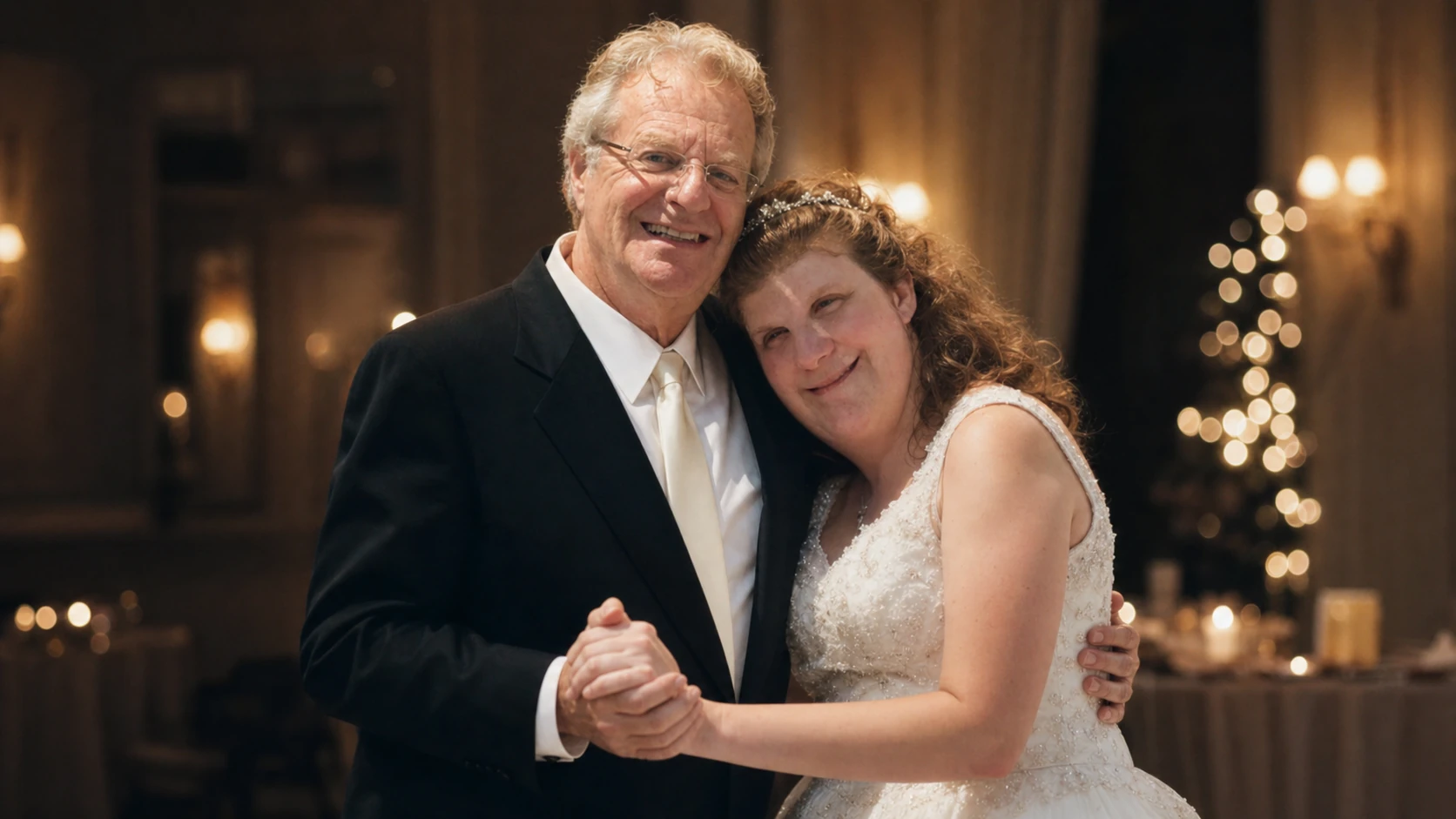
The wedding became connected to one of the most memorable episodes of Jerry Springer’s later television career. Earlier that year, he agreed to compete on the third season of Dancing with the Stars, despite having little confidence in his dancing ability.
Jerry’s main goal was not to win the competition. He wanted to learn a waltz so that he could perform a proper father-daughter dance at Katie’s wedding. His professional partner, Kym Johnson, helped him prepare for the routine while he remained on the program.
The story gave viewers a rare glimpse of Jerry as a father rather than a television provocateur. He was willing to appear uncomfortable and risk public embarrassment because the effort mattered to Katie. After leaving the competition, he continued practicing, and the two performed their dance at the wedding.
Katie and Adam later had a son named Richard, who was born in 2008. Family tributes have also referred to him as Ricky. Jerry spoke warmly about becoming a grandfather and described time with his grandson as one of the greatest pleasures of his later life.
Further details about Katie’s marriage and son are private. The family has not publicly documented its home life, and Richard has not been raised as a public figure.
Her Relationship With Jerry Springer
Katie consistently described Jerry as a generous and attentive father. She acknowledged that his television work could appear absurd, but she also understood that he used the financial success it brought to provide security for his family and support charitable projects.
One story she told after his death illustrated the scale of his generosity. Katie once casually mentioned that she might look at a condominium near her apartment in Evanston. Within days, Jerry contacted her to say that he had arranged for a two-bedroom unit in a new development.
Katie recalled the incident with affection and humor, saying it taught her to be careful about mentioning something she might want. The story showed a father who sometimes moved faster than she expected when he saw an opportunity to make her life easier.
She also defended his ability to empathize with people. Long before his death, Katie suggested that the qualities audiences saw in quieter moments—listening, patience and emotional awareness—were closer to his real character than the confrontations associated with his show.
Their relationship did not require Katie to imitate his career. She did not become a presenter, reality television personality or entertainment executive. Jerry appeared to respect her choice to build a life away from publicity, while she supported him through the highs and criticism of his public work.
Jerry Springer’s Death
Jerry Springer died on April 27, 2023, at the age of 79. His family later confirmed that he had pancreatic cancer and that the illness progressed quickly.
The short period between diagnosis and death left Katie and other relatives with little time to understand the disease or connect with support organizations. She later said that the family had not known about the Pancreatic Cancer Action Network, commonly known as PanCAN, while Jerry was undergoing treatment.
His death brought renewed attention to Katie because she was his only child and one of the people able to speak about the private man behind the public image. She described him as loving, generous and far quieter than viewers of his show might have assumed.
Her comments did not attempt to rewrite his career or deny its controversies. Instead, they added a family record to the public one. Jerry was both a major figure in tabloid television and a father whose relationship with his daughter had shaped many of his personal decisions.
Pancreatic Cancer Advocacy
On April 27, 2024, exactly one year after Jerry’s death, Katie took part in PanCAN PurpleStride Chicago. Using her married name, Katie Yenkin, she organized Team Jerry and walked with relatives and supporters in his memory.

She also spoke during the event’s opening ceremony. Her participation helped raise attention and money for pancreatic cancer research, patient services and public education.
Pancreatic cancer is often diagnosed after it has advanced because early symptoms can be difficult to recognize and there is no standard screening test for the general population. Katie’s involvement reflected what many grieving families experience: learning about the disease and available support only after a loved one has already died.
There is no evidence that Katie turned this appearance into a permanent paid advocacy role or established her own foundation. Her documented contribution was focused and personal. She formed a fundraising team, spoke publicly and used her father’s name to help other families find resources that the Springers had not known about during his illness.
Public Attention After the Netflix Documentary
The 2025 Netflix documentary Jerry Springer: Fights, Camera, Action renewed interest in the rise and consequences of her father’s talk show. The two-part production revisited the program’s production culture, extreme episodes and place in television history.
Katie’s teenage letter appeared in coverage surrounding the documentary, introducing her to viewers who had not followed Jerry’s family life. Searches for her name increased as people tried to learn more about the daughter who had defended him during the height of his controversial fame.
Despite that renewed attention, Katie did not launch a media career or begin making frequent public appearances. As of 2026, no verified announcement has connected her to a television series, book, podcast or entertainment project.
Her current employment and place of residence are also not publicly confirmed. The available evidence suggests that she continues to protect her privacy rather than use the documentary’s attention to build a public profile.
Net Worth and Income Sources
Katie Springer’s net worth has not been publicly disclosed. Websites that assign her a specific figure generally do not provide reliable financial records, and their estimates should not be treated as established fact.
Her documented work as an assistant teacher would have provided employment income, while her father’s success gave the family considerable financial security. Jerry earned money from television hosting, political commentary, acting appearances, speaking engagements and other media work. He also made substantial gifts to Katie, including helping her obtain a condominium.
That family support does not make it possible to calculate Katie’s personal wealth. There are no confirmed reports detailing her inheritance, investments, property holdings or present salary.
The most accurate conclusion is that she appears to have benefited from her father’s financial success but has not publicly presented herself as an entrepreneur or celebrity business figure. Any precise net worth claim would be speculation.
Public Image and Legacy
Katie’s public image has been shaped less by personal fame than by the contrast between her private life and her father’s television persona. She is often described through her connection to Jerry, but the known details of her life show interests and priorities of her own.
Her work at Park School linked her personal experience of disability with direct service to children. Katie’s Corner showed that her influence could also produce lasting support for the students and teachers around her.
Her marriage and motherhood remained mostly outside the press, while her appearances connected to Jerry revealed a close and affectionate relationship. She inspired his decision to compete on Dancing with the Stars, defended him as a teenager and later honored him through cancer fundraising.
Katie’s story also illustrates the limits of public biography. Readers may want a complete account of her schooling, career and current life, but she has never made those details broadly available. Respecting that privacy is more accurate than filling the gaps with unsupported claims.
Frequently Asked Questions
Who is Katie Springer?
Katie Springer, also known as Katie Yenkin, is the only child of the late television host and former Cincinnati mayor Jerry Springer and his wife, Micki Velton. She is known for her past work with children with disabilities and for her close relationship with her father.
When was Katie Springer born?
Katie Springer was born in 1976. Her exact birth date has not been publicly confirmed, so she is 49 or 50 years old in 2026.
What disabilities does Katie Springer have?
Katie is legally blind and deaf in one ear. She was also born without nasal passages and required surgery shortly after birth.
What does Katie Springer do for a living?
Katie worked as an assistant teacher at Park School in Evanston, Illinois, where she supported children with disabilities. Her current occupation is not publicly confirmed.
Is Katie Springer married?
Yes. Katie married Adam Yenkin in December 2006. The couple has kept most details of their relationship private.
Does Katie Springer have children?
Katie and Adam Yenkin have one publicly known child, a son named Richard, who was born in 2008. He has also been referred to by the nickname Ricky.
What is Katie Springer’s net worth?
Katie Springer’s net worth is not publicly known. Although she received financial support from her successful father, there is not enough verified information to calculate her personal wealth.
Conclusion
Katie Springer’s life has never followed the path expected of a celebrity’s child. While Jerry Springer became famous through political office, local news and one of television’s most controversial talk shows, Katie built a private adult life focused on work, marriage and family.
Her medical challenges are part of her biography, but they do not define its limits. She lived independently, supported children with disabilities and helped inspire a school facility that gave students another way to manage their sensory needs.
Her strongest public legacy may be the relationship she shared with her father. Through a teenage letter, a wedding dance and later cancer advocacy, she offered glimpses of Jerry Springer that his television image rarely allowed audiences to see.
Katie remains a private person as of 2026. What is publicly known presents a consistent picture: a daughter who valued her family, pursued meaningful work and chose personal substance over inherited fame.
