
Introduction
Link building is still one of the most important parts of SEO in 2026, but the way it works has changed. In the past, many websites tried to rank higher by collecting as many backlinks as possible. Some used directory links, low-quality guest posts, exact-match anchor text, private blog networks, and paid backlinks to manipulate rankings.
That old approach is risky now.
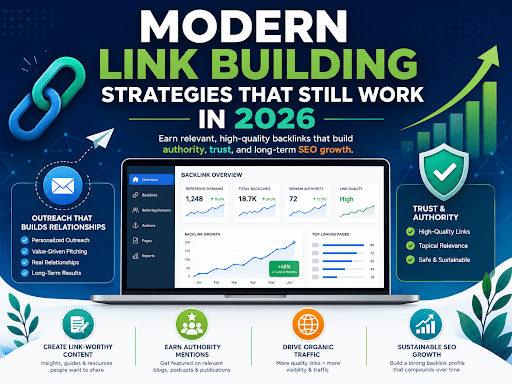
Modern link building is not about chasing random backlinks. It is about earning relevant, trustworthy, and useful links that make sense for real users. Search engines have become much better at understanding link quality, topical relevance, link placement, anchor text, and unnatural link patterns. This means a few strong backlinks from respected websites can be more valuable than hundreds of weak links from unrelated sources.
In 2026, successful link building depends on value. You need content worth linking to, outreach that feels natural, relationships with real websites, and a strategy that supports long-term organic growth.
The goal is simple: build backlinks that help users, build trust, and show search engines that your website is a useful resource in your niche.
In this guide, you will learn modern link building strategies that still work in 2026, why link quality matters, which tactics to avoid, and how to build a safe backlink strategy for sustainable SEO results.
What Is Link Building in SEO?
Link building is the process of getting other websites to link to your website. These links are called backlinks, inbound links, or external links.
A backlink can act like a recommendation. When another website links to your page, it may show that your content is useful, trustworthy, or relevant to a topic.
For example, if a digital marketing blog writes an article about SEO tools and links to your guide about keyword research, that is a backlink. If a journalist mentions your brand in a news article and links to your homepage, that is also a backlink. If an industry resource page includes your guide as a helpful reference, that is another backlink.
Backlinks can help SEO because they support authority, discovery, and relevance. However, not every backlink is valuable. A link from a trusted website in your industry is usually much better than a link from a random website with no real audience.
Modern link building is focused on earning backlinks naturally through useful content, smart promotion, digital PR, and genuine relationships.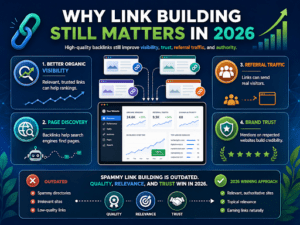
Why Link Building Still Matters in 2026
Some people say link building is dead, but that is not true. What is dead is spammy link building.
High-quality backlinks still matter because they can help search engines and users understand that your website is credible. If trusted websites mention and link to your content, it can strengthen your online authority.
Backlinks can help your website in several ways.
First, backlinks can improve organic visibility. When your website earns links from relevant and trusted sources, it may have a better chance of ranking for competitive keywords.
Second, backlinks help search engines discover pages. If a website links to your page, search engines may find and crawl that page more easily.
Third, backlinks can bring referral traffic. A link from a popular blog, news site, directory, resource page, or industry publication can send real visitors to your website.
Fourth, backlinks build brand trust. When your business is mentioned on respected websites, users may see your brand as more reliable.
In 2026, link building is not only about ranking. It is also about brand awareness, referral traffic, trust, authority, and long-term SEO growth.
What Has Changed in Modern Link Building?
Link building has changed because search engines are better at detecting low-quality tactics. They can now evaluate links more intelligently.
Here are the biggest changes.
Quality Matters More Than Quantity
In the past, some websites focused on getting as many backlinks as possible. Today, quality is much more important.
One backlink from a trusted industry website can be more valuable than many links from weak, unrelated, or spammy sites.
Relevance Is More Important
A backlink should make sense in context. If your website is about SEO tools, a link from a digital marketing blog, SaaS website, business publication, or SEO resource page is relevant. A link from an unrelated gambling, fashion, or random coupon site may not help much.
Anchor Text Must Look Natural
Overusing exact-match anchor text can look manipulative. A natural backlink profile includes branded anchors, URL anchors, partial-match anchors, and natural phrases.
Paid Links Need Proper Handling
Paid, sponsored, affiliate, or advertorial links should be clearly qualified. Trying to use paid links to pass SEO value can create risk.
Content Quality Is Essential
You cannot build strong links to weak content. If your page is thin, generic, outdated, or copied, people will not want to link to it.
Relationship Building Matters More
Modern link building works best when you build real relationships with publishers, bloggers, journalists, businesses, and industry experts.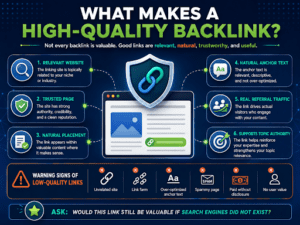
What Makes a Backlink High Quality?
Before you start link building, you need to understand what a good backlink looks like.
A high-quality backlink usually has these qualities:
- It comes from a relevant website
- It appears on a trustworthy page
- It is placed naturally within useful content
- It uses natural anchor text
- It can send real referral traffic
- It is not part of a spammy link scheme
- It helps users discover something useful
- It comes from a website with real content and audience
- It supports your brand or topic authority
A low-quality backlink usually has these warning signs:
- It comes from an unrelated website
- It appears on a page filled with random outbound links
- It uses over-optimized anchor text
- It is clearly paid without proper disclosure
- It comes from a link farm
- It is hidden in a footer, sidebar, or irrelevant page
- It has no real value for users
- The website publishes low-quality guest posts at scale
The best question to ask is: Would this link still be valuable if search engines did not exist?
If the answer is yes, it is probably a good link opportunity.
Modern Link Building Strategies That Still Work in 2026
Now let’s look at practical link building strategies that still work today.
1. Create Linkable Assets
A linkable asset is a piece of content that naturally attracts backlinks because it provides real value.
Most websites do not link to basic sales pages. They usually link to useful resources, research, tools, statistics, guides, templates, or original insights.
Examples of linkable assets include:
- Original research reports
- Industry statistics pages
- Free tools
- Calculators
- Templates
- Checklists
- Complete guides
- Data studies
- Infographics
- Case studies
- Glossaries
- Comparison resources
For example, if your website is about SEO tools, you could create a page like:
- 100 SEO Statistics Every Marketer Should Know
- Free Keyword Research Checklist
- Complete Backlink Audit Template
- SEO Strategy Checklist for New Websites
- Best Free SEO Tools for Beginners
These types of pages are useful because bloggers, journalists, and marketers often need references to support their own content.
To make a linkable asset stronger, make it original, easy to read, visually clear, and regularly updated.
Using premium SEO tools access can also help marketers research content gaps, build better linkable assets, and find topics that naturally attract backlinks.
2. Use Digital PR for High-Authority Backlinks
Digital PR is one of the strongest link building methods in 2026. It focuses on earning media coverage, brand mentions, and links from trusted websites.
Digital PR works because it gives publishers something newsworthy or useful to talk about.
Examples of digital PR campaigns include:
- Industry surveys
- Data reports
- Expert commentary
- Trend analysis
- Local business stories
- Product launches
- Creative campaigns
- Research-based insights
- Newsworthy statistics
- Founder stories
- Community initiatives
For example, an SEO tools website could publish a study about “The Most Common SEO Mistakes Small Businesses Make.” Marketing blogs and business publications may link to the report if the data is useful.
A travel website could create a report about the most searched travel destinations. A finance website could publish a budgeting survey. A real estate website could analyze property price trends.
Digital PR is powerful because it can earn links from high-authority websites that are difficult to get through normal outreach.
The key is to create something that is actually interesting, not just promotional.
3. Publish Original Research and Statistics
Original data is one of the best ways to attract backlinks.
Writers need statistics to support their articles. If your website becomes a reliable source of data, people may link to you naturally.
You can create original research by using:
- Customer surveys
- Industry polls
- Internal data
- Public data analysis
- Case studies
- Market research
- Tool-based insights
- Expert interviews
For example, you could publish:
- SEO Tool Usage Statistics
- Keyword Research Trends in 2026
- Link Building Statistics for Digital Marketers
- Small Business SEO Survey
- Content Marketing Benchmarks
Make your statistics easy to cite. Use clear headings, charts, tables, and short summaries.
Also, keep your data updated. Outdated statistics lose value over time.
4. Build Backlinks Through Expert Quotes
Journalists, bloggers, and content writers often need expert opinions. If you provide a useful quote, they may mention your name, brand, and website.
This strategy works well because it is based on expertise.
For example, if you are experienced in SEO, you can provide expert comments on topics like:
- AI in SEO
- Keyword research
- Link building
- Technical SEO
- Content optimization
- Organic traffic growth
- SEO tools
- Google updates
Your quote should be clear, specific, and useful. Avoid generic comments like “SEO is important.” Instead, share practical insight.
A better quote could be:
“In 2026, link building works best when it is connected to original content. Websites that publish useful data, templates, and research have a stronger chance of earning natural backlinks than websites that only send cold outreach emails.”
This type of quote gives value and is more likely to be used.
5. Use Broken Link Building
Broken link building is still effective when done properly.
A broken link is a link that points to a page that no longer exists. This creates a poor user experience for the linking website. If you find a broken link and offer a useful replacement, the website owner may update the link to your page.
The process is simple:
- Find relevant websites in your niche
- Check their pages for broken outbound links
- Identify broken links related to your content
- Create or use a suitable replacement page
- Contact the website owner politely
Your outreach message should be helpful, not pushy.
Example:
Hi [Name],
I was reading your article about [topic] and noticed that one of the resources you linked to no longer works.
The broken link points to: [old URL]
I have a similar updated resource here that may be useful for your readers: [your URL]
Hope this helps.
Best,
[Your Name]
Broken link building works best when your replacement content is genuinely relevant and high quality.
6. Reclaim Unlinked Brand Mentions
Sometimes websites mention your brand but do not link to your website. These are called unlinked brand mentions.
For example, a blog may write “seotoolsgroupbuy.us is known for SEO tools,” but they may not include a clickable link.
In this case, you can contact the website and politely ask them to add a link.
This is one of the easiest link building strategies because the website already knows or mentions your brand.
You can look for unlinked mentions of:
- Your brand name
- Your website name
- Your product names
- Your founder name
- Your unique content titles
- Your original research
A simple outreach message:
Hi [Name],
Thank you for mentioning [Brand Name] in your article. I really appreciate it.
Would you be able to add a link to our website so readers can find us more easily?
Here is the URL: [URL]
Thanks again.
This strategy works especially well for established brands, but even small websites can use it.
7. Analyze Competitor Backlinks
Competitor backlink analysis helps you find websites that already link to similar content in your niche.
If a website links to your competitor, it may also be interested in your content if you provide something useful.
Look for:
- Blogs linking to competitor guides
- Resource pages listing competitors
- Review sites mentioning competitors
- Directories in your niche
- Guest posts by competitors
- Broken competitor pages with backlinks
- Comparison pages
- Roundup articles
The goal is not to copy every backlink. The goal is to understand what kind of content earns links in your industry.
For example, if your competitor’s most linked page is a statistics article, you may create a better and more updated statistics page. If many competitors get links from resource pages, you can reach out to similar pages with your own useful resource.
Competitor backlink research gives you a practical roadmap for link building.With competitor backlink analysis tools, marketers can review referring domains, discover link gaps, and identify websites that may be suitable for outreach. 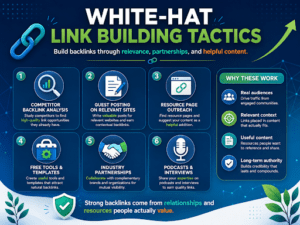
8. Guest Posting on Relevant Websites
Guest posting still works in 2026, but only when done with quality and relevance.
A good guest post should be written for real readers, not only for backlinks.
High-quality guest posting includes:
- Publishing on relevant websites
- Writing original and helpful content
- Avoiding keyword-stuffed anchor text
- Linking only where it makes sense
- Choosing websites with real audiences
- Providing practical examples and insights
Bad guest posting includes:
- Publishing thin articles at scale
- Using the same article on many sites
- Writing only for backlinks
- Linking with exact-match anchors repeatedly
- Using low-quality guest post farms
Before pitching a guest post, study the target website. Understand their audience and suggest a useful topic.
Example pitch:
Hi [Name],
I enjoyed your recent article about [topic]. I would love to contribute a practical guest post for your readers.
Here are a few topic ideas:
- [Topic idea 1]
- [Topic idea 2]
- [Topic idea 3]
I can make the article original, useful, and tailored to your audience.
Best,
[Your Name]
Guest posting should help you build authority, relationships, and referral traffic.
9. Get Listed on Resource Pages
Resource pages are pages that collect helpful links about a topic. They are often used by bloggers, universities, organizations, and industry websites.
Examples:
- Best SEO resources
- Useful digital marketing tools
- Free marketing templates
- Small business resources
- Recommended tools for bloggers
- Helpful guides for website owners
If you have a useful guide, tool, template, or checklist, you can ask to be included.
Search for phrases like:
- “best [topic] resources”
- “[topic] useful links”
- “[topic] recommended tools”
- “[topic] resources”
- “submit a resource”
When reaching out, explain why your resource is helpful and how it benefits their readers.
Do not ask for a link only for SEO. Show real value.
10. Create Helpful Tools and Templates
Free tools and templates can attract backlinks because people love resources that save time.
Examples:
- SEO audit checklist
- Keyword research template
- Content calendar template
- Backlink tracking sheet
- Meta title preview tool
- Blog outline template
- Technical SEO checklist
- Competitor analysis template
If your tool solves a real problem, people may link to it in tutorials, guides, and resource lists.
For example, a “Free SEO Audit Checklist” can earn links from marketing blogs, agencies, freelancers, and business websites.
Tools and templates also bring referral traffic because users come back to use them again.
11. Use Internal Link Building
Not all link building is external. Internal links are also important.
Internal linking means linking from one page on your website to another page on your website.
Internal links help:
- Users discover related content
- Search engines understand your site structure
- Important pages receive more visibility
- Topic clusters become stronger
- Orphan pages get discovered
For example, from an article about “link building,” you can link to:
- Keyword research guide
- Semantic SEO article
- Backlink analysis guide
- SEO strategy guide
- Digital PR article
Use descriptive anchor text. Instead of writing “click here,” write “read our complete keyword research guide.”
Internal links are fully under your control, so use them wisely.
12. Build Industry Partnerships
Partnerships can create natural backlink opportunities.
You can build relationships with:
- Suppliers
- Clients
- Agencies
- SaaS tools
- Bloggers
- Influencers
- Event organizers
- Local businesses
- Industry communities
- Podcast hosts
Partnership backlinks may come from:
- Partner pages
- Case studies
- Testimonials
- Interviews
- Event pages
- Collaboration articles
- Tool integrations
- Resource lists
For example, if you provide a testimonial for a tool you use, the company may publish your testimonial with a backlink to your website.
Partnership links are often natural because they come from real business relationships.
13. Publish Case Studies
Case studies are powerful because they show real results. They can earn backlinks from people who want examples, proof, and practical lessons.
A good case study should explain:
- The problem
- The strategy
- The process
- The results
- The tools used
- The lessons learned
For example:
- How We Increased Organic Traffic by 120%
- How a Small Business Improved Rankings With Keyword Research
- How a Backlink Audit Helped Recover SEO Performance
- How Content Clusters Improved Search Visibility
Case studies are link-worthy because they are unique. Competitors cannot easily copy your real data and experience.
14. Build Links Through Podcasts and Interviews
Podcasts, webinars, and interviews are excellent for authority building.
When you appear as a guest, the host often publishes a show notes page with your bio and website link.
This strategy works well for founders, marketers, consultants, agency owners, and niche experts.
You can pitch yourself as a guest by offering a useful topic.
Example:
Hi [Name],
I enjoyed your podcast episode about [topic]. I would love to share practical insights with your audience about modern link building strategies that still work in 2026.
I can cover topics like digital PR, linkable assets, competitor backlinks, and avoiding spammy link building.
Best,
[Your Name]
Podcasts and interviews also build brand trust because people hear your expertise directly.
15. Refresh and Promote Old Content
Many websites already have content that could earn backlinks but is outdated or not promoted properly.
Updating old content can make it more link-worthy.
You can improve old content by:
- Adding new examples
- Updating statistics
- Improving visuals
- Adding expert quotes
- Expanding thin sections
- Adding FAQs
- Improving structure
- Adding internal links
- Updating screenshots
- Rewriting outdated advice
After updating the content, promote it again through outreach, social media, newsletters, and communities.
A refreshed article can attract new backlinks because it becomes more useful and current.
Link Building Tactics to Avoid in 2026
Modern link building should be safe and user-focused. Avoid tactics that can create risk.
Do not rely on:
- Private blog networks
- Paid links that pass ranking value
- Spammy guest post farms
- Automated comment links
- Irrelevant directory submissions
- Exact-match anchor text abuse
- Link exchanges at scale
- Hidden links
- Hacked links
- Low-quality profile links
- Mass forum spam
- AI-generated outreach spam
If a link exists only to manipulate rankings and provides no value to users, it is risky.
The safest approach is to build links that make sense even without SEO benefits.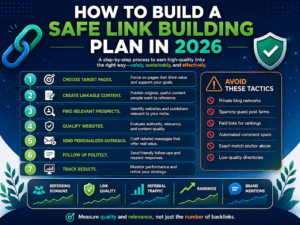
How to Create a Modern Link Building Plan
A good link building campaign needs structure.
Here is a simple plan.
Step 1: Choose Your Target Pages
Decide which pages need backlinks. These may include:
- Pillar guides
- Statistics pages
- Tools
- Templates
- Service pages
- Product pages
- Research reports
Informational pages often attract links more easily than commercial pages.
Step 2: Create Linkable Content
Make sure the page is worth linking to. Add examples, data, visuals, templates, FAQs, and practical advice.
Step 3: Find Link Prospects
Look for websites that may be interested in your content.
Examples:
- Blogs
- Journalists
- Resource pages
- Industry websites
- Partner websites
- Podcast hosts
- Competitor backlink sources
Step 4: Qualify Prospects
Check whether each website is relevant, trustworthy, and active. Avoid spammy sites.
Step 5: Send Personalized Outreach
Write short, helpful, and personalized emails. Explain why your resource is useful.
Step 6: Follow Up Politely
Send one or two follow-ups if needed. Do not spam people.
Step 7: Track Results
Track links earned, response rates, referral traffic, rankings, and link quality.
How to Measure Link Building Success
Link building takes time, so you need to track the right metrics.
Important metrics include:
- Number of referring domains
- Quality of backlinks
- Relevance of linking websites
- Anchor text distribution
- Referral traffic
- Organic rankings
- Organic traffic
- Brand mentions
- Link placement
- Conversions from referral traffic
- Lost backlinks
Do not judge success only by the number of backlinks. A smaller number of high-quality links can be more valuable than many low-quality links.Reliable SEO campaign tracking tools can help users monitor backlinks, rankings, referral traffic, and lost links to measure the real impact of link building.
Link Building Checklist for 2026
Use this checklist before starting your campaign:
- Create a high-quality target page
- Choose relevant linkable assets
- Research competitor backlinks
- Find resource pages
- Look for unlinked brand mentions
- Identify broken link opportunities
- Prepare personalized outreach emails
- Avoid spammy link sources
- Use natural anchor text
- Track new and lost backlinks
- Build internal links
- Update old content
- Focus on relevance and trust
- Measure referral traffic and rankings
- Repeat what works
Frequently Asked Questions
Does link building still work in 2026?
Yes, link building still works in 2026 when it focuses on quality, relevance, and real value. Spammy link building is risky, but high-quality backlinks are still useful for SEO, referral traffic, and authority.
What is the best link building strategy?
The best strategy depends on your niche, but linkable assets, digital PR, original research, broken link building, expert quotes, and competitor backlink analysis are some of the most effective methods.
Are backlinks still important for SEO?
Yes, backlinks are still important because they can help build authority, trust, and visibility. However, quality matters much more than quantity.
Is guest posting still good for link building?
Guest posting can still work if it is done on relevant websites with high-quality content. Low-quality guest posting only for backlinks should be avoided.
What is a high-quality backlink?
A high-quality backlink comes from a relevant, trustworthy website and is placed naturally inside useful content. It should help users, not just search engines.
Should I buy backlinks?
Buying backlinks to manipulate rankings is risky. If a link is paid, sponsored, or part of an advertisement, it should be properly qualified. It is safer to earn links through useful content and genuine outreach.
How many backlinks do I need?
There is no fixed number. It depends on your competition, niche, content quality, and target keywords. Focus on earning better links, not just more links.
What is broken link building?
Broken link building is a strategy where you find broken links on other websites and suggest your relevant content as a replacement.
What is digital PR link building?
Digital PR link building means earning backlinks through newsworthy stories, original research, expert commentary, surveys, and media outreach.
How long does link building take to show results?
Link building can take weeks or months to affect rankings. It depends on the quality of links, competition, website authority, and overall SEO strategy.
Final Thoughts
Modern link building in 2026 is about trust, relevance, and value. The old shortcuts are no longer reliable. Websites that rely on spammy backlinks, low-quality guest posts, and manipulative anchor text can create long-term SEO risk.
The best link building strategies are built around helpful content, real relationships, original research, digital PR, expert insights, and useful resources.
If you want backlinks that actually help your website, focus on creating something worth linking to. Then promote it to the right people in the right way.
A strong backlink strategy does not happen overnight. It requires planning, consistency, patience, and quality. But when done correctly, link building can help your website grow authority, improve organic visibility, attract referral traffic, and build a stronger online brand.
In 2026, the websites that win at link building will not be the ones with the most links. They will be the ones with the most relevant, trusted, and useful links.
