
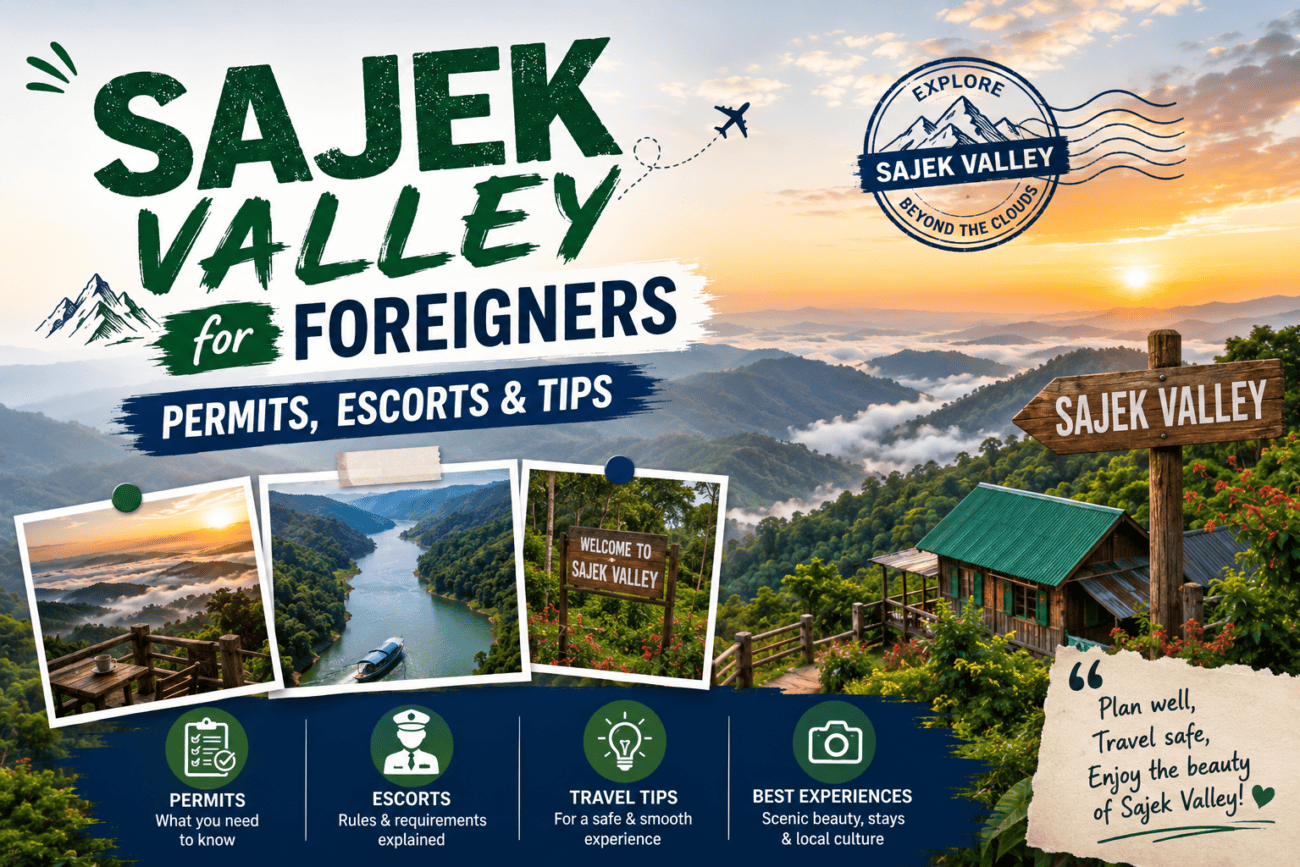
Sajek Valley is one of Bangladesh’s most spectacular destinations, with rolling hills, cloud seas that roll straight through the villages, and a landscape that looks nothing like the flat delta most visitors associate with the country. But foreigners can’t just show up. Sajek sits inside a restricted-travel region with its own permit and escort rules, and most travel guides either skip this entirely or explain it so vaguely that visitors end up turned back at the checkpoint.
This is a complete, foreigner-specific walkthrough: the permit process, exactly how the army escort system works, and the full trip logistics from Dhaka to the valley and back.
The short version of why these rules exist: Sajek sits in the Chittagong Hill Tracts, a region of Bangladesh with a distinct administrative history and its own special travel regulations for both security coordination and cultural sensitivity around the indigenous communities who live there. This guide sticks to the practical side of that — what it means for your trip — rather than the politics behind it.
Where Is Sajek Valley and Why Does It Have Special Travel Rules?
Location and geography
Sajek Valley sits in Baghaichari Upazila, Rangamati District, in Bangladesh’s southeastern Chittagong Hill Tracts—close to where Bangladesh, India’s Mizoram state, and Myanmar converge. The valley sits at roughly 1,800–2,000 feet above sea level, which is dramatic by Bangladeshi standards, since most of the country is a low-lying delta at or near sea level. That elevation is exactly why Sajek is famous for its “sea of clouds”; the valley genuinely sits inside the cloud layer on the right mornings.
Why the Chittagong Hill Tracts requires permits and escorts
The Chittagong Hill Tracts has held special administrative status within Bangladesh for decades, with its own regulatory framework distinct from the rest of the country. In practical, traveler-relevant terms: this means foreign visitors need prior permission to enter, and travel along certain roads, including the road into Sajek, is coordinated through an army escort system rather than open, unrestricted access.
Who this affects
This is the part that trips up the most first-time foreign visitors: the rules for foreigners are meaningfully stricter than for domestic Bangladeshi travelers. A Bangladeshi tourist typically just registers their name at the army camp on arrival. A foreign national needs a formal permit obtained in advance from a government office — skipping this step, assuming the domestic process applies to you, is the single most common planning mistake.
The Foreigner Permit Process — Step by Step
Where to apply
Foreign nationals need a permit from the Office of the Deputy Commissioner, Rangamati, before entering the Chittagong Hill Tracts, this covers Sajek specifically since it falls within Rangamati district. Rangamati’s district administration has moved this process online in recent years, through a digital application system built to remove the older manual paperwork process, so check the current Rangamati Deputy Commissioner’s foreigner portal for the live application form before you travel.
How far in advance to apply
Guidance commonly cited by experienced travelers and tour operators is to apply at least one week ahead of your travel date. Processing times can shift, so treat one week as a floor, not a guarantee—applying with more buffer, especially around holidays or peak season, is the safer move. Always verify current processing timelines directly through the official portal or a local operator before finalizing your travel dates.
What documents you’ll likely need
Expect to provide your passport details, visa information, and your intended travel dates and itinerary as part of the application. Exact document requirements can be updated by the district administration, so confirm the current checklist on the official application portal rather than relying on an older blog post, including this one.
What happens if you arrive without a permit
Be clear-eyed about this: if you show up at the Baghaihat checkpoint without a valid permit, you will be turned back. This isn’t a soft guideline enforced loosely—it’s a hard checkpoint requirement. This isn’t meant to scare you off the trip; it’s meant to make sure you don’t spend a full day traveling from Dhaka only to be sent home from the checkpoint.
Can a tour operator arrange this for you?
Yes, and it’s the route many foreign travelers choose instead of navigating the government portal solo. A reputable local operator can handle the permit application on your behalf as part of a booked package, which removes most of the friction described above. What an operator generally can’t do is guarantee approval or override the district administration’s timeline — they can smooth the process, not bypass it. If your travel dates are fixed and non-negotiable, working with an operator who has done this repeatedly is worth the added cost.
How the Army Escort System Works?
Why the escort exists and what it actually looks like?
The escort exists as a coordinated safety and security measure for the final stretch of road into Sajek, it’s a supervised convoy of vehicles moving together through the hill roads at a scheduled time, not an armed guard trailing you individually through the valley once you’ve arrived. Once you’re in Sajek itself, you move around freely; the escort only applies to the approach road with Sajek Valley Tour Package.
Escort timing — the two daily departure windows
This is the detail that catches out more first-time visitors than anything else in this guide. The army escort from the Dighinala/Baghaihat checkpoint into Sajek runs on a fixed twice-daily schedule—commonly cited as roughly 10:00 AM and 3:00 PM, with a similar structure for the return convoy out of Sajek. Confirm the exact current times with your operator or at the checkpoint itself before you travel, since schedules can shift, but plan around the existence of two fixed windows, not a flexible drop-in system.
What this mean for your itinerary planning?
Here’s the single most important logistics point in this entire guide: you must plan your travel day around the escort timing, not the other way around. If you miss the morning convoy, you wait for the afternoon one; if you miss the afternoon one, you wait until the next day. That’s not a minor inconvenience — it can cost you an entire day of your trip. Build your Dhaka-to-Dighinala travel schedule with enough buffer that you’re comfortably at the checkpoint well before a departure window, not cutting it close.
What happens on the escort?
In practice: your vehicle joins a convoy of others heading the same direction at the checkpoint, you pass through Baghaihat together, and the convoy moves as a group along the hill road into Sajek with no unscheduled stops along the way. It’s a straightforward, well-established process, the friction almost always comes from travelers not knowing the timing in advance, not from the escort itself being difficult.
How to Actually Get There — Full Route From Dhaka
Planning your first Chittagong Hill Tracts trip with Green Belt Bangladesh
Step 1 — Dhaka to Khagrachari
Multiple bus operators run both AC and non-AC night buses from Dhaka to Khagrachari, a common overnight option that lets you arrive in the morning ready to continue. Exact travel time varies by route and traffic, but budget roughly 8–10 hours for this leg.
Step 2 — Khagrachari to Dighinala
From Khagrachari, local transport covers the roughly 23-kilometer stretch to Dighinala, where you’ll need to register your details at the army checkpoint—this is also your staging point for catching the escort convoy.
Step 3 — Dighinala to Sajek via army escort
From Dighinala, the escort convoy carries you the remaining stretch through Baghaihat, Machalong Bazar, and Ruilui Bazar into Sajek itself. The Khagrachari-to-Sajek distance is roughly 70 kilometers total, and the drive typically takes 2–3 hours once you’re moving with the convoy—winding hill roads mean this isn’t a fast, straight run even though the distance looks short on a map.
Alternative starting points
If you’re already in the south of the country, Chittagong city is a practical alternative starting point instead of Dhaka. Multiple daily bus services connect Chittagong to Khagrachari, with the journey typically taking 4–5 hours—meaningfully shorter than starting from Dhaka.
Realistic total journey time end-to-end
Budget a full day of travel each way if you’re starting from Dhaka—overnight bus to Khagrachari, onward transport to Dighinala, and then whichever escort window you catch. This is exactly why the escort timing matters so much for your planning: arriving at Dighinala mid-afternoon after a delayed bus, for instance, could mean missing the day’s final window entirely.
How Many Days Do You Need?
-
Minimum viable trip
One night in Sajek is technically possible, but not recommended. Given the travel time required just to reach the checkpoint and catch an escort window, a one-night trip effectively gives you a single afternoon and a single morning in the valley—not much margin if anything about your travel day runs late.
-
The recommended sweet spot
Two nights and three days total, including travel, is the consensus minimum most experienced visitors and guides recommend for a relaxed, unhurried pace that actually lets you see Sajek’s main viewpoints without rushing.
-
The ideal trip for photographers and cloud-chasers
Three nights gives you a genuinely comfortable pace: a full day to explore without pressure, plus a dedicated sunrise cloud-viewing session that isn’t squeezed in around a tight departure schedule. If catching the valley’s famous cloud sea at its best is your main goal, the extra night buys you a second sunrise attempt in case the first morning’s weather doesn’t cooperate.
Best Time to Visit
-
Best season for the “clouds rolling through the valley” effect
The period running from just after monsoon season into the cooler months is generally considered the strongest window for Sajek’s signature cloud-sea effect, when mist rolls directly through the villages and viewpoints at elevation.
-
Weather variability
Sajek has a genuine reputation for shifting between hot sun, thick mist, and sudden rain within the same day, pack layers and rain protection regardless of season, rather than assuming one weather condition will hold for your whole visit.
-
Off-season considerations
During monsoon season itself, road conditions on the hill route can deteriorate and visibility drops, which affects both the journey and what you’ll actually see once you arrive. If your trip has any flexibility, avoiding the peak of monsoon is worth prioritizing over other scheduling factors.
Where to Stay and What to Expect
-
Types of accommodation
Sajek’s most iconic stays are bamboo-and-thatch cottages with private valley-view balconies—the image most people associate with Sajek photos. Simpler local guesthouses are also available at lower price points if the view-focused cottages are outside your budget.
-
Booking in advance vs on arrival
Booking is strongly recommended, especially around weekends and public holidays, when domestic tourism to Sajek surges and the popular cottages fill up fast. Given that you’re already coordinating a permit and escort timing around your trip, booking accommodation ahead removes one more variable from an already logistics-heavy plan.
-
What amenities to realistically expect
Set expectations accordingly: electricity can be limited or generator-based rather than constant grid power, water availability varies by property, and food options are generally simple local fare rather than extensive menus. This is remote hill terrain, not a resort town, part of the appeal but worth knowing before you arrive.
What to See and Do in Sajek
-
Konglak Para
The highest point in the area and generally considered the best spot for catching the cloud-sea effect at sunrise when conditions are right.
-
Ruilui Para
The main village hub of Sajek, and the base for most accommodations — also a strong spot for sunrise and sunset viewpoints without needing to travel far.
-
Sajek Helipad
A panoramic viewpoint offering sweeping views across the surrounding hills, popular for both sunrise and general daytime photography.
-
Hanging bridge and nearby waterfalls
If time allows, waterfalls like Richang or Hazagarh Jhorna near Dighinala are worth building into your itinerary, particularly if you have a spare few hours during the Dighinala leg of your journey rather than rushing straight through.
-
Indigenous community villages
Sajek and the surrounding hills are home to indigenous communities, including Lusai, Pankhua, and Tripura peoples, among others. Approach these villages as a chance for genuine cultural exposure and respectful interaction, not as a photo backdrop or spectacle—more on etiquette below.
Practical Foreigner Logistics
Mobile signal and connectivity
Expect patchy or limited signal throughout much of the hill tracts, including within Sajek itself. Plan around this rather than assuming constant connectivity—download offline maps and let people know your rough schedule before you lose reliable signal.
Cash and ATMs
Carry cash from Khagrachari or Dhaka before heading further into the hills — ATMs are unreliable or simply absent once you’re in Sajek itself, and you don’t want to discover this after arrival.
Language
English support is limited outside organized tours, particularly among transport and checkpoint staff. Hiring a local guide or booking through an operator largely solves this gap, since guides working with foreign travelers typically speak functional English.
SIM cards and data for arriving foreign travelers
If you’re arriving from abroad, sorting a local SIM card in Dhaka before heading toward the hill tracts is far easier than trying to do so once you’re already in a more remote area—plan this as part of your Dhaka arrival logistics, not something to handle en route.
Safety and Etiquette for Foreign Visitors
-
Is Sajek actually safe?
The army escort system exists as a longstanding, functional safety measure for the approach road, and it’s worth understanding it that way rather than as a red flag about the region’s safety. Beyond the standard travel caution any destination warrants, securing valuables, and avoiding isolated areas after dark, Sajek doesn’t present unusual risk for tourists traveling through the proper permit and escort process.
-
General travel caution
Standard practical advice applies here as it would anywhere: keep valuables secure, avoid wandering into isolated areas after dark, and stay with your group or guide on unfamiliar routes.
-
Respecting indigenous communities
The Lusai, Pankhua, Tripura, and other communities who call this region home are not a tourist attraction, they’re residents going about daily life in a place tourism has arrived relatively recently. Ask before photographing individuals, be a considerate guest if invited into a community space, and treat villages as places people live rather than sights to check off a list.
-
A special warning: avoid hurling food or cash at kids from cars
Rather than being a general travel suggestion, this is a real, persistent local annoyance that merits its own mention. In an attempt to show kindness, some tourists toss coins or snacks to kids waiting by the side of the road as their car passes. However, locals frequently characterize this as detrimental rather than beneficial because it can hurt kids who are scrambling for objects thrown from moving cars and treats them more like a photo opportunity than like children. If you want to be giving, do it right: pause, give goods to someone directly, or even better, donate to a community project or local guide.
Sample Itinerary (2 Nights / 3 Days)
-
Day 1 — Travel day
Overnight bus from Dhaka arrives in Khagrachari in the morning. Onward local transport to Dighinala, checkpoint registration, and catching the escort convoy (morning or afternoon window, depending on your arrival time). Arrive in Sajek, settle into your accommodation, and take an easy first evening to recover from the journey.
-
Day 2 — Full exploration day
Visit Konglak Para for valley views, Ruilui Para for the village hub and viewpoints, and the Sajek Helipad for panoramic photography. Close the day with sunset from one of the elevated viewpoints.
-
Day 3 — Sunrise cloud viewing and return
Early sunrise session at Konglak Para or another elevation point for the best shot at the cloud-sea effect, then catch the return escort convoy out of Sajek, retrace the route back through Dighinala and Khagrachari, and begin your journey back to Dhaka.
Frequently Asked Questions
Do foreigners need a special permit to visit Sajek Valley?
Yes. Foreign nationals need a permit from the Office of the Deputy Commissioner, Rangamati, obtained in advance, this is a stricter requirement than what applies to domestic Bangladeshi travelers.
Can I visit Sajek Valley without an army escort?
No. The final stretch of road from Dighinala into Sajek is only accessible via the scheduled army escort convoy, which runs on fixed daily windows.
How long does the Sajek Valley permit take to process?
Commonly cited guidance suggests applying at least one week ahead of travel, though you should confirm current processing times directly with the Rangamati Deputy Commissioner’s office or a local operator before finalizing your dates.
Is Sajek Valley safe for foreign tourists?
Yes, when traveling through the proper permit and escort process, the escort system is a longstanding, functional safety measure rather than a sign of danger, and standard travel caution otherwise applies.
How many days should I spend in Sajek Valley?
Two nights and three days total (including travel) is the recommended minimum for a relaxed pace; three nights is ideal if you want a backup sunrise attempt for the cloud-sea effect.
What is the best time of year to see the clouds in Sajek?
The period just after monsoon season into the cooler months is generally considered the strongest window for the valley’s famous cloud-sea effect.
Final Thoughts
As far as foreign visitors go, Sajek Valley is a very particular experience that’s best navigated by either asking plenty of questions in advance or delegating the complex but ultimately simple foreign permit and army escort logistics to a local agency. In reality, the only real challenge presented by Sajek Valley tourism is applying for and timing your trip around a foreign visitor permit, and once that’s done, the only real obstacle is the hike up to the valley itself. If you want to be able to leave all of the permit application and timing headaches to someone else, Sajek Valley Tour Package can build a personalized schedule around your arrival window and needs as a foreign visitor. Contact today and let them take the stress out of your Sajek Valley adventure.
