
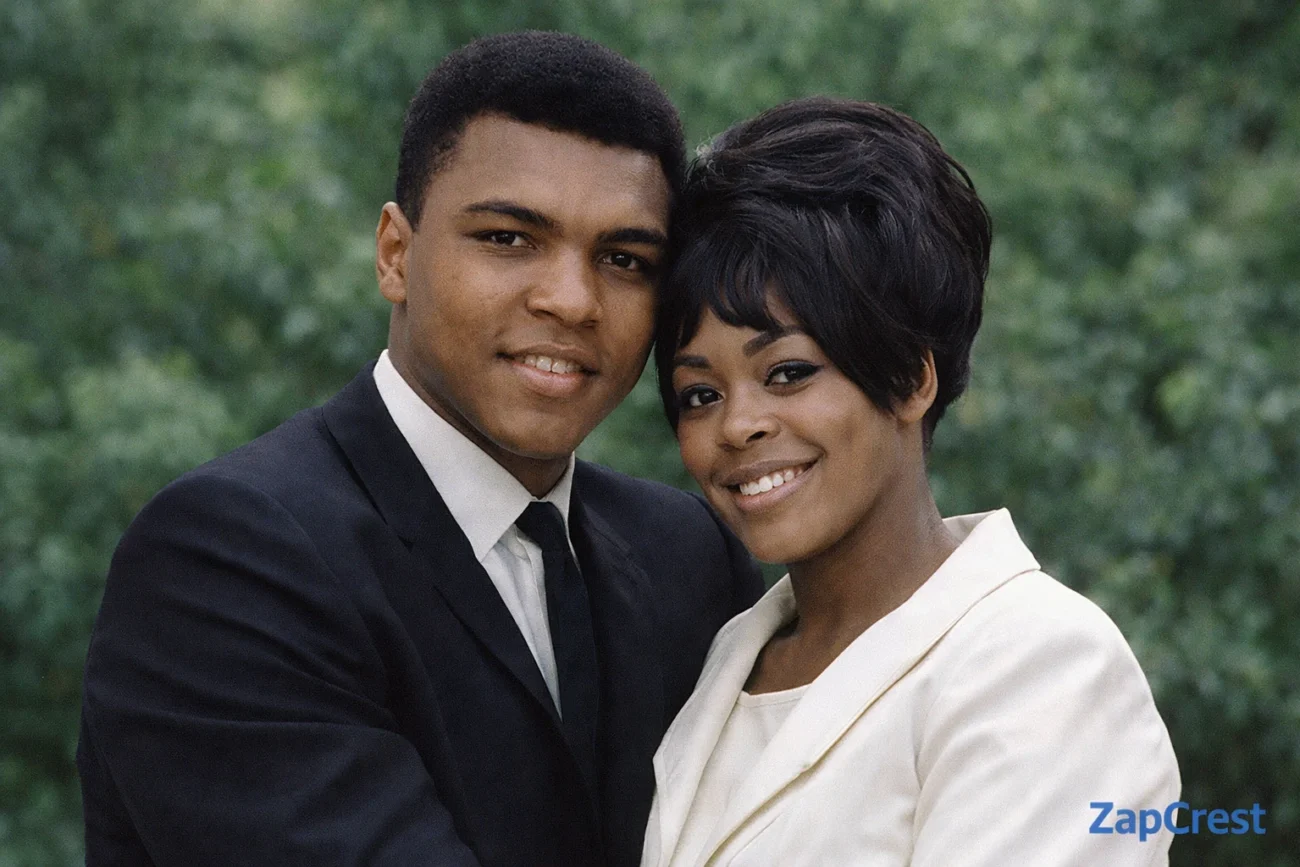
Sonji Roi entered the public eye at a moment when the world was already watching Muhammad Ali with intense fascination. Their brief marriage, which unfolded just as Ali transformed from Cassius Clay into a global icon and political figure, placed her at the center of a cultural turning point. For many, her name is remembered only in connection with that union. Yet even in the fragments left behind, her story offers a more complex and human perspective on fame, identity, and the cost of being close to history in motion.
What makes Sonji Roi compelling is not just who she married, but when she married him. In 1964, Ali was not only the heavyweight champion of the world, he was also redefining himself in public, rejecting his birth name and embracing the teachings of the Nation of Islam. Roi became part of that transformation almost overnight. Her life, before and after that moment, has never been fully documented, and that absence of detail has shaped how she is remembered as much as the facts themselves.
Early Life and Background
Reliable information about Sonji Roi’s early years is limited, and that scarcity has led to conflicting details in public records. Most widely cited sources place her birth on November 23, 1945, though some genealogical databases suggest a later year. What is consistent is that she grew up in the United States, likely in the Midwest, and later spent time in Chicago, which would remain connected to her life in later years.
Unlike many figures tied to major celebrities, Roi did not come from a documented entertainment or athletic background. There is no strong public record of formal training in music or acting during her youth, nor are there detailed accounts of her family life. This lack of detail reflects both the era and her position at the time. She was not a public figure when she met Ali, and few journalists had reason to document her early life in depth.
What can be said with some confidence is that Roi was living and working independently as a young woman in her late teens or early twenties when she met Ali. Reports from the period describe her as a cocktail waitress, a detail that appears consistently across contemporary coverage. It places her in a working-class setting, far removed from the world stage she would briefly occupy after their marriage.
Meeting Muhammad Ali
Sonji Roi met Muhammad Ali in 1964, during a period when his life was changing rapidly. At the time, he had just defeated Sonny Liston to become the heavyweight champion of the world. Within days, he announced his affiliation with the Nation of Islam and rejected the name Cassius Clay. The shift was sudden, controversial, and closely followed by the media.
Their relationship moved quickly. Accounts from the time suggest that Ali and Roi married within weeks of meeting, a timeline that has been described as both impulsive and reflective of the intensity of Ali’s life at that moment. They were married on August 14, 1964, in Gary, Indiana, a city that often appears in reports about the wedding.
The speed of the relationship has often been framed as romantic or reckless, depending on the perspective. But there is a broader context. Ali was in the middle of redefining his identity, and his personal life was intertwined with that process. Roi entered that space without the support system or public preparation that might have come with marrying a more established figure.
Marriage and Cultural Tension
The marriage between Sonji Roi and Muhammad Ali lasted less than two years, but it has remained one of the most discussed aspects of her life. The primary source of tension appears to have been Ali’s growing commitment to the Nation of Islam, which prescribed strict rules around behavior, dress, and lifestyle.
Roi did not adopt those expectations in the way Ali’s new religious environment demanded. Reports from the period suggest that she continued to live in a more conventional social world, which included attending clubs and dressing in ways that conflicted with the movement’s teachings. These differences created a gap that quickly widened.
The truth is that their marriage was not just a private relationship. It was a public symbol of Ali’s transition, and that added pressure made ordinary disagreements more consequential. The divorce, which was finalized in early 1966, has often been summarized as a clash between personal freedom and religious discipline. That summary, while simplified, captures the core dynamic without relying on unverified anecdotes.
Life After the Divorce
After her separation from Ali, Sonji Roi attempted to build a public identity independent of her former husband. For a brief period in the mid-1960s, she pursued a career in music and made appearances on television. These efforts suggest a desire to redefine herself and take advantage of the visibility her marriage had brought.
She appeared on popular talk shows of the era, including programs hosted by Merv Griffin and Mike Douglas. These appearances were typical platforms for emerging entertainers, and they indicate that Roi was actively trying to establish herself in the entertainment industry. Around the same time, she released a small number of music singles under the name Sonji Clay.
The available records of her music career are limited but verifiable. Discographies list several singles released between 1966 and 1969, though none achieved major commercial success. Still, the effort itself is meaningful. It shows that she was not content to remain a footnote and was willing to pursue her own ambitions, even in a competitive and unforgiving industry.
Retreat from Public Life
After the late 1960s, Sonji Roi largely disappeared from the public spotlight. Unlike many figures connected to high-profile celebrities, she did not continue to give interviews or maintain a visible presence in entertainment or media. This retreat has contributed to the sense of mystery that surrounds her life.
There are no widely documented long-term careers, business ventures, or public projects associated with her after this period. Some sources suggest she lived a relatively private life in Chicago, though detailed accounts of her later years are scarce. This absence of information has allowed speculation to fill the gaps, but responsible reporting must acknowledge the limits of what can be confirmed.
The truth is that Roi’s decision, whether deliberate or circumstantial, to step away from public life stands in contrast to the enduring fame of Muhammad Ali. While Ali remained a global figure for decades, Roi’s story became quieter, preserved mainly in archival references and brief mentions in biographies of her former husband.
Personal Life and Relationships
Public information about Sonji Roi’s personal life after her divorce from Ali is minimal. There are references to her using the name Sonji Clay-Glover, which suggests a later relationship or marriage, but details about that part of her life are not widely documented in reliable sources.
There is no confirmed public record of children, and no detailed accounts of her family life have been consistently reported. This lack of information is not unusual for individuals who were briefly in the public eye during the 1960s and then chose or were forced into privacy.
What’s clear is that Roi did not continue to build a public identity around her connection to Ali. Unlike some former spouses of famous figures, she did not write memoirs, give extensive interviews, or attempt to shape her narrative in the media. That silence has left much of her personal story beyond the reach of public knowledge.
Public Image and Cultural Memory
Sonji Roi’s public image has been shaped largely by how she fits into the story of Muhammad Ali. In many biographies and documentaries, she appears briefly, often as a contrast to the disciplined lifestyle that Ali later embraced. This framing, while convenient, risks reducing her to a symbol rather than a person.
Cultural portrayals have attempted to give her more dimension. In the 2001 film Ali, she was portrayed by actress Jada Pinkett Smith, bringing her character to a wider audience. The film presents her as lively, independent, and unwilling to conform to expectations imposed by Ali’s evolving beliefs.
But film and theater are interpretations, not records. They draw on available information but also fill in gaps with creative choices. As a result, they can shape public perception in ways that are not fully grounded in documented fact. Roi’s real personality, thoughts, and experiences remain only partially visible through the historical record.
Final Years and Death
Sonji Roi died on October 11, 2005, in Chicago, Illinois. She was 59 years old at the time of her death. Reports from the Associated Press described her death as resulting from natural causes, though a family member suggested she may have suffered a heart attack.
No autopsy was publicly reported, and the exact cause of death has not been definitively established in widely accepted records. This uncertainty is another example of how incomplete documentation shapes her story. Even at the end of her life, details remain limited.
Her death did not generate widespread media coverage, reflecting how far she had moved from public attention. Still, her connection to Muhammad Ali ensured that her passing was noted in major outlets, preserving her place in the broader narrative of his life.
Legacy and Historical Significance
Sonji Roi’s legacy is closely tied to a specific moment in American history. Her marriage to Muhammad Ali took place during a period of social and cultural change, and her experience reflects the personal impact of those larger forces.
She represents a side of Ali’s life that is often overshadowed by his achievements and activism. Through her, readers can see how his transformation affected those closest to him, not just his public image. That perspective adds depth to the understanding of Ali as a person, not just a legend.
At the same time, Roi’s story stands on its own as an example of how individuals can be briefly elevated into the spotlight and then fade from view. Her attempt to build a career, her retreat into privacy, and the limited record of her later years all speak to the challenges of navigating fame without control over the narrative.
Frequently Asked Questions
Who was Sonji Roi?
Sonji Roi was the first wife of Muhammad Ali. She gained public attention during their marriage in the mid-1960s and later pursued a brief career in music and television before stepping away from public life.
How long were Sonji Roi and Muhammad Ali married?
They were married from August 1964 until early 1966. Their relationship developed quickly and ended within less than two years, largely due to differences related to Ali’s religious commitments.
Did Sonji Roi have a career in entertainment?
Yes, she briefly pursued a career as a singer and appeared on television talk shows in the mid-1960s. She released a few singles, though she did not achieve major commercial success.
What was the cause of Sonji Roi’s death?
She died in 2005 in Chicago, and her death was reported as due to natural causes. Some reports suggest a possible heart attack, but this was not officially confirmed in widely accepted records.
Did Sonji Roi remarry?
There are indications that she later used the name Sonji Clay-Glover, which suggests she may have remarried. However, detailed information about her later relationships is not widely documented.
Why is Sonji Roi still remembered today?
She is remembered primarily because of her marriage to Muhammad Ali during a critical period in his life. Her story provides insight into the personal side of his transformation and remains part of his broader historical narrative.
Conclusion
Sonji Roi’s life resists easy storytelling. The facts that can be confirmed are clear but limited, and much of what people think they know comes from repetition rather than evidence. That makes her story both challenging and important to tell with care.
She lived briefly in the glare of global attention and then stepped away from it, leaving behind a record that is incomplete but still meaningful. Her marriage to Muhammad Ali connected her to a turning point in history, but it does not fully define her life.
What remains is a portrait shaped by both presence and absence. Sonji Roi was there when the world was changing around Ali, and her experience reflects the personal cost of that change. Even with gaps in the record, her story continues to matter because it reminds us that history is not only made by the people at the center, but also by those who stand beside them, even for a short time.
