
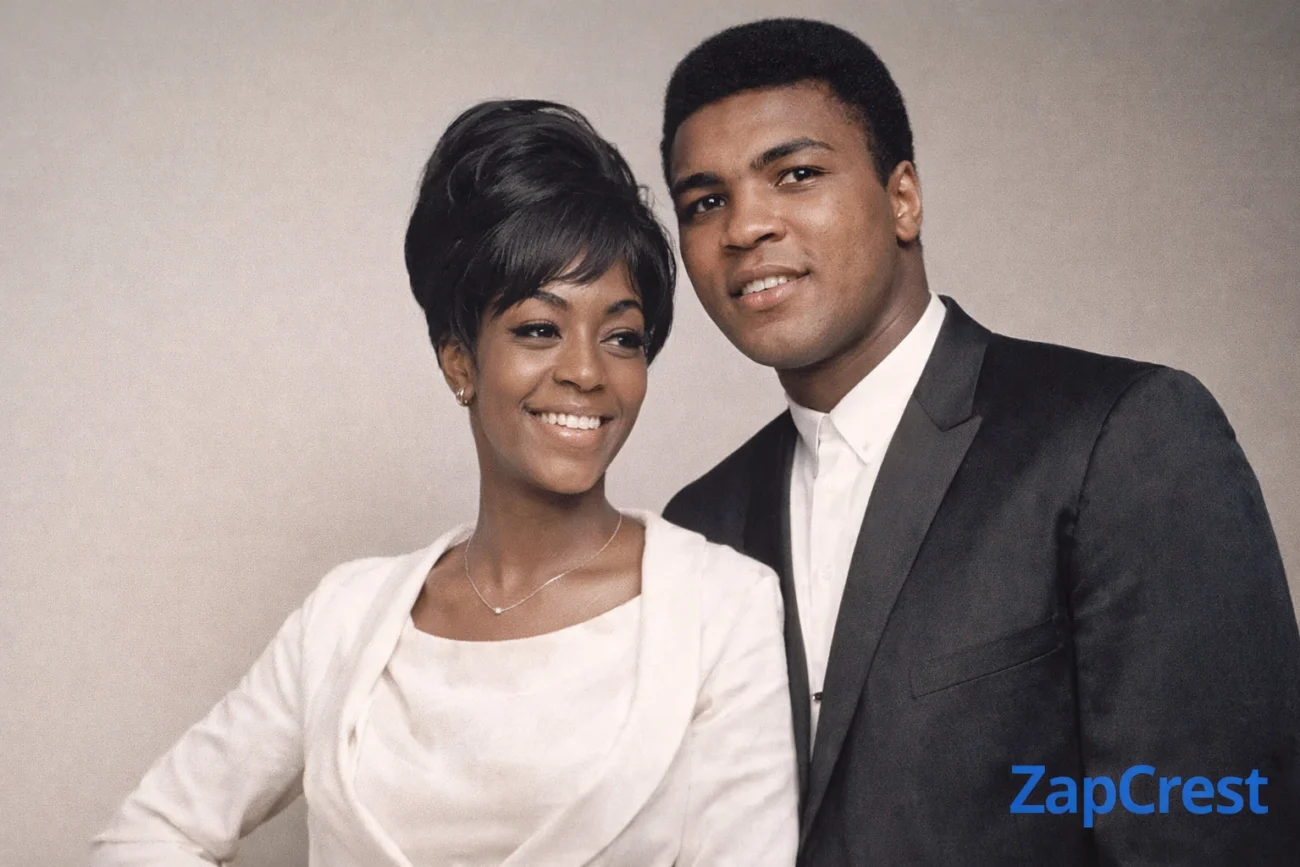
In the summer of 1964, as Cassius Clay was transforming himself into Muhammad Ali and the world watched with fascination and confusion, a young woman from Chicago stepped briefly into the center of that storm. Her name was Sonji Roi, and for a short time she stood beside one of the most famous athletes in history. Their marriage lasted barely more than a year, yet it has lingered for decades as a symbol of something larger than celebrity—a moment when love, identity, faith, and public expectation collided in full view.
Sonji Roi is often remembered in a single line: Muhammad Ali’s first wife. But that label obscures as much as it reveals. She was a model, a nightclub worker, a would-be singer, and a woman navigating sudden visibility at a time when the rules around race, religion, and gender were being rewritten. Her story is not one of sustained fame but of brief, intense exposure followed by a long retreat into private life. That contrast is part of what makes her life compelling even now.
Early Life and Family Background
The early life of Sonji Roi remains partly obscured, shaped by inconsistent records and the limited attention paid to her before her marriage. Most accounts agree that she was born in the mid-1940s, though sources differ on the exact year, with some placing it in 1945 and others in 1948. She grew up in Chicago, a city that would remain central to her life even after her brief national visibility.
Accounts of her childhood suggest she experienced loss at a young age, with some reports indicating that she lost her parents early and had to support herself. While details vary, the general picture is of a young woman who entered adulthood without the safety net that might have smoothed her path. That background helps explain her early independence and her move into work that placed her in public-facing environments.
By her late teens and early twenties, Roi was working in Chicago’s nightlife scene, including as a cocktail waitress. At the same time, she pursued modeling, appearing in publications such as Tan magazine, which catered to Black audiences during a period when mainstream fashion media often excluded them. That combination of nightlife work and modeling gave her both visibility and a degree of financial independence.
A Chance Meeting at a Turning Point
Sonji Roi met Cassius Clay in 1964, at a moment when his life was undergoing rapid and public transformation. Clay had just defeated Sonny Liston to become heavyweight champion of the world, and within days he announced his affiliation with the Nation of Islam. The young fighter was in the process of redefining himself, both personally and politically, and the country was paying close attention.
Their meeting is often described as immediate and intense. Introduced through mutual connections in Chicago, Roi quickly caught Clay’s attention. Contemporary accounts describe a whirlwind courtship, with the two marrying on August 14, 1964, in Gary, Indiana. The speed of the relationship was striking even by the standards of celebrity culture, and it set the tone for what followed.
For Roi, the marriage meant stepping almost overnight into a global spotlight. She was no longer just a model or a waitress; she was the wife of the heavyweight champion, a figure whose every move was being scrutinized. Photographs from the period show her accompanying Clay to events, standing beside him in airports, and appearing at his fights. For a brief period, she was part of the public image of a man who was rapidly becoming a cultural icon.
Marriage in the Public Eye
The marriage between Sonji Roi and Muhammad Ali unfolded under intense scrutiny, and it quickly became clear that their expectations did not align. Ali’s association with the Nation of Islam brought with it a set of beliefs and practices that shaped his personal life, including expectations about modesty, behavior, and the role of a wife.
Roi, who had built her identity in a more secular and fashion-conscious environment, struggled to conform to those expectations. Reports from the time and later interviews suggest that she continued to wear the clothing she preferred, including styles that Ali and his religious advisors considered inappropriate. This tension became a central point of conflict within the marriage.
But the issue went beyond clothing. The marriage reflected a deeper clash between two ways of living. Ali was increasingly committed to a disciplined, faith-driven life shaped by the Nation of Islam, while Roi appeared reluctant to adopt those beliefs fully. Their private disagreements became public as Ali spoke openly about his expectations and frustrations.
Despite the tension, accounts of their time together also describe moments of affection and connection. Ali was known for his charisma and humor, and some recollections suggest that he was deeply drawn to Roi in the early stages of their relationship. That complexity makes the story harder to reduce to simple categories of right and wrong.
The Breakup and Divorce
By mid-1965, less than a year after their wedding, the marriage was unraveling. Ali filed for an annulment, claiming that Roi had agreed to convert to Islam but had not followed through. Whether that promise was clearly made or understood remains a matter of interpretation, but it became a key point in the legal and personal dispute.
Roi, for her part, expressed frustration with the influence of the Nation of Islam on her husband. In reported comments, she suggested that the organization had changed him, framing the conflict as one between personal freedom and external control. These opposing perspectives highlight how differently the two experienced the same relationship.
The divorce was finalized in early 1966, bringing an end to a marriage that had lasted little more than a year. By then, Ali’s life had moved in a new direction, and Roi’s role in his story was already being reframed as a brief and turbulent chapter. For her, the end of the marriage marked both a personal loss and a turning point.
Life After Muhammad Ali
After the divorce, Sonji Roi did not disappear immediately from public view. Instead, she made a visible effort to build a career of her own, separate from her identity as Ali’s former wife. In 1966, she appeared on the cover of Jet magazine as she launched a singing career, signaling her intention to remain in the public eye.
She performed under the name Sonji Clay, releasing a small number of singles in the late 1960s. While these recordings did not achieve major commercial success, they demonstrate that she pursued her ambitions with seriousness. She also appeared on television programs such as The Mike Douglas Show and The Merv Griffin Show, using those platforms to promote her work.
What’s surprising is how quickly that public presence faded. By the end of the decade, Roi’s appearances became less frequent, and she gradually withdrew from the spotlight. Unlike many figures connected to major celebrities, she did not continue to trade on her association with Ali for long-term fame.
This retreat may have been a choice or simply the result of limited opportunities. The entertainment industry of the time offered few sustained paths for women in her position, especially those without strong institutional backing. Whatever the reason, Roi’s public career remained brief, and she spent most of her later life away from national attention.
Personal Life and Later Years
Details about Sonji Roi’s later life are limited, reflecting her decision to live more privately. She is believed to have returned to Chicago, where she had spent her early years, and remained there for much of her life. Reports indicate that she later used the name Sonji Clay-Glover, suggesting that she may have remarried, though details about that relationship are not widely documented.
Her absence from the public record does not mean her life was uneventful, but it does mean that much of it unfolded outside the view of media and historians. This lack of information has contributed to the sense of mystery surrounding her, as well as the tendency for her story to be overshadowed by her brief connection to Ali.
Sonji Roi died on October 11, 2005, in Chicago. She was reported to be 59 years old at the time of her death, though, as with her birth date, some details remain uncertain due to conflicting records. Her death received limited media attention, reflecting the distance she had placed between herself and the public sphere in her later years.
Public Image and Cultural Legacy
Sonji Roi’s public image has been shaped largely by her association with Muhammad Ali, but over time, that image has evolved. Early portrayals often emphasized her as a glamorous but incompatible partner, a narrative that fit neatly into broader stories about Ali’s life. More recent perspectives have taken a more balanced view, recognizing the complexity of her position.
In films and documentaries about Ali, Roi is often depicted as a figure caught between love and expectation. The 2001 film Ali, for example, portrayed her as a vibrant and independent woman who struggled to adapt to the constraints placed on her. While dramatizations inevitably simplify reality, they have helped keep her story in public consciousness.
Her legacy also reflects broader themes about women connected to powerful men. Roi’s life illustrates how easily individual stories can be reduced to supporting roles in larger narratives. At the same time, her attempts to build a career and her eventual withdrawal from the spotlight suggest a desire to define herself on her own terms.
Money, Career Earnings, and Net Worth
There is no widely verified figure for Sonji Roi’s net worth, and any estimates should be treated with caution. Her income likely came from a combination of modeling work, nightclub employment, and her brief music career. Unlike her former husband, she did not have a long-term platform that generated significant wealth or sustained public income.
Her marriage to Muhammad Ali did not result in lasting financial prominence, at least not in a way that has been publicly documented. Divorce settlements from that period are not fully detailed in public records, and there is no clear evidence that she benefited financially in a substantial or enduring way.
What can be said with some confidence is that Roi’s financial life did not mirror the fame associated with her brief time in the spotlight. Her story is less about wealth and more about visibility, independence, and the challenges of building a life after sudden public attention.
Why Her Story Still Resonates
Sonji Roi’s life continues to attract attention because it intersects with one of the most important cultural figures of the 20th century. But her story also stands on its own as an example of how personal relationships can reflect larger social forces. Her marriage to Ali occurred at a moment when questions of identity, faith, and public image were especially charged.
There is also a human element that draws readers back. Roi was young, independent, and suddenly thrust into a role that came with expectations she had not fully embraced. Her decision not to conform, and the consequences that followed, give her story a sense of individuality that goes beyond the usual celebrity narrative.
Not many people know this, but her brief attempt to build a music career and her later retreat from fame suggest a life that cannot be fully captured by a single relationship. She was part of a larger story, but she was also navigating her own path, with its own ambitions and limits.
Frequently Asked Questions
Who was Sonji Roi?
Sonji Roi was a Chicago-born model and nightclub worker who became widely known after marrying Muhammad Ali in 1964. She was his first wife and was briefly part of his public life during a crucial period of his career. Beyond that relationship, she pursued a short-lived career in music and television before withdrawing from the spotlight.
How long were Sonji Roi and Muhammad Ali married?
They were married on August 14, 1964, and their relationship began to break down within a year. By mid-1965, they had separated, and their divorce was finalized in early 1966. The marriage lasted a little over a year, though its impact has lasted much longer in public memory.
Why did Sonji Roi and Muhammad Ali divorce?
Their divorce was largely driven by differences over religion and lifestyle. Ali’s commitment to the Nation of Islam came with expectations about how his wife should dress and behave, which Roi did not fully accept. The disagreement became central to their relationship and ultimately led to its end.
Did Sonji Roi have children?
There is no widely confirmed record that Sonji Roi had children. Public documentation of her personal life after her divorce from Muhammad Ali is limited, and details about any later family relationships remain unclear.
What did Sonji Roi do after her divorce?
After her divorce, she attempted to build a career as a singer and appeared on television shows to promote her work. She released a small number of music singles in the late 1960s but did not achieve major commercial success. Over time, she stepped away from public life.
When did Sonji Roi die?
Sonji Roi died on October 11, 2005, in Chicago. She was reported to be 59 years old at the time of her death, though there are some inconsistencies in public records regarding her exact birth year.
Is Sonji Roi portrayed in films about Muhammad Ali?
Yes, she has been portrayed in dramatizations of Ali’s life, including the 2001 film Ali. These portrayals often focus on her role during his early career and the challenges within their marriage, helping to keep her story visible to new audiences.
Conclusion
Sonji Roi’s life does not fit neatly into the usual categories of celebrity biography. She was neither a long-term public figure nor a complete unknown, but something in between—a person who experienced a sudden burst of attention and then stepped away from it. That arc makes her story both harder to document and more compelling to revisit.
Her brief marriage to Muhammad Ali placed her at the center of a cultural shift, even if only for a moment. The choices she made, and the ones she resisted, reflect the pressures of that time in a way that still feels relevant. She was not simply shaped by events; she responded to them in ways that reveal her own sense of self.
The truth is, Sonji Roi’s story is as much about absence as it is about presence. The gaps in the record remind us how easily lives can fade from view once they no longer serve a larger narrative. Yet those gaps also invite a more careful kind of attention, one that respects both what is known and what remains uncertain.
What remains is a portrait of a woman who lived briefly in the glare of history and then chose a quieter path. Her name endures not only because of who she married, but because her life offers a glimpse into the human side of a moment that changed American culture.
