
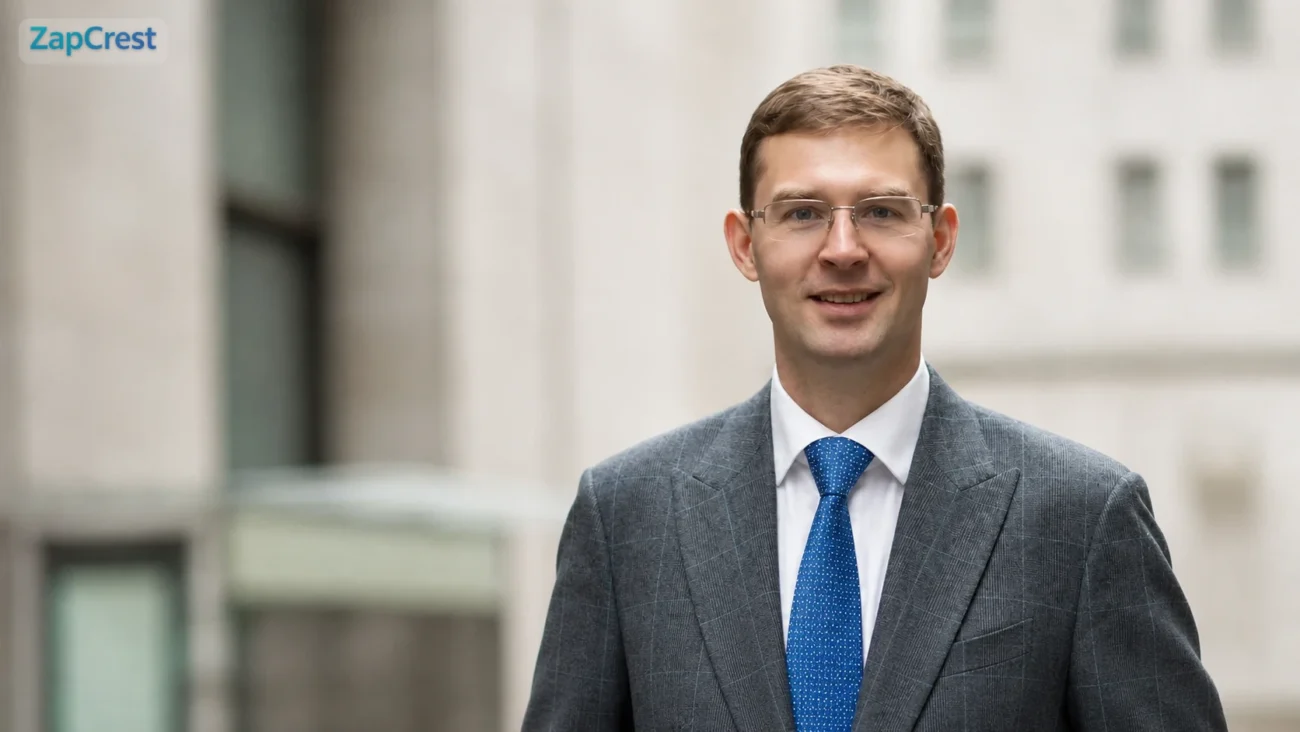
Timur Turlov is a Russian-born Kazakhstani entrepreneur and financier best known as the chairman and chief executive officer of Freedom Holding Corp. (Nasdaq: FRHC). Born on November 13, 1987, he is 38 years old as of 2026. A July 2026 SEC proxy statement says Turlov owned approximately 66.5% of Freedom Holding’s common stock, making him its controlling shareholder and the company a Nasdaq “Controlled Company.”
His public role now extends beyond finance. Turlov is president of the Kazakhstan Chess Federation, president of the Karaganda Regional Association of Football, and a candidate for FIDE president in an election scheduled for September 26, 2026. In March 2026, Kazakhstan also awarded him the Order of Parasat for contributions to the country’s socio-economic development.
Turlov’s career is often summarized as the story of a brokerage he founded in 2008 and later took to Nasdaq. The documented history is more complicated. His brokerage activity dates to 2008, but the present Freedom Holding structure developed through subsequent acquisitions and a 2015 reverse acquisition. Its shares were uplisted to Nasdaq in 2019, rather than entering the exchange through a conventional initial public offering.
Early Life and Education
Turlov’s full name is Timur Ruslanovich Turlov. The strongest available evidence supports a birth date of November 13, 1987, although sources disagree over his exact birthplace. It is therefore more accurate to describe him simply as Russian-born rather than choosing between conflicting reports of Moscow and the surrounding region.
Freedom’s biographical material says Turlov became interested in financial markets early and began working at World Capital Investments at age 16. It later places him in the brokerage operation of Uniastrum Bank. Those early employment details principally come from company-associated biographies and are best understood as Turlov’s documented public career account rather than independently established employment records.
His formal education is better anchored. Freedom’s 2026 SEC proxy states that he graduated in 2009 from the Russia State Technic University named after K. E. Tsiolkovsky with a bachelor’s degree in economics and management.
By the time he completed that degree, Turlov had already begun building the brokerage business that would eventually become associated with the Freedom name.
How the Freedom Business Developed
Turlov and Freedom date the origin of his own brokerage venture to 2008. That year is meaningful as the beginning of his entrepreneurial story, but it should not be confused with the legal creation of today’s Nasdaq-listed Freedom Holding Corp.
SEC corporate-history filings provide a more detailed sequence. In 2010, Turlov acquired a Moscow company called Beliy Gorod Ltd. It was renamed Freedom Finance the following year. In 2013, that Russian operation acquired a Kazakhstan brokerage from unrelated third parties, expanding the developing group in the market that would later become central to Freedom’s identity.
The structure changed more significantly in 2015. Freedom’s operations became connected to the U.S.-registered public company formerly known as BMB Munai through a reverse acquisition. Turlov became chairman and CEO in November 2015 and has remained in those positions since.
That distinction matters because the public-company story did not begin with a simple 2008 incorporation followed by a traditional stock-market flotation. Freedom grew through operating businesses, acquisitions and a public-company restructuring.
The Nasdaq uplisting
Another commonly repeated shortcut concerns Freedom’s move to Nasdaq.
Freedom’s own SEC-filed October 2019 announcement described the transaction as an uplisting to the Nasdaq Capital Market. Its shares had previously traded on the OTCQX market, and Nasdaq trading under the ticker FRHC began in October 2019.
Calling that event an “IPO” obscures the actual sequence. Freedom was already publicly traded before its Nasdaq debut; the 2019 milestone moved its shares to a larger U.S. exchange.
For Turlov, the Nasdaq listing substantially increased the visibility of a business that had grown from brokerage operations in the former Soviet region into a broader financial-services group.
How Much of Freedom Holding Does Turlov Own?
Turlov remains the dominant shareholder of Freedom Holding.
The company’s July 2026 SEC proxy reported that he beneficially owned 42,405,112 shares, or 69.2% of the company, as of March 31, 2026. After Freedom issued additional shares in July, the same filing said his ownership had declined to approximately 66.5% as of July 29, 2026.
That newer percentage is the more appropriate figure for a current profile.
Because Turlov controls more than half of Freedom’s voting power, the company qualifies as a “Controlled Company” under Nasdaq rules. In practical terms, his fortune and public profile are consequently tied closely to the performance and valuation of Freedom Holding.
Freedom24, Freedom Finance and the group’s banking, insurance and brokerage companies sit within a wider corporate structure. It is therefore more precise to say that Turlov controls the listed parent, Freedom Holding Corp., rather than describing every Freedom-branded subsidiary as a company he personally owns directly.
Freedom Holding’s Scale in 2026
Freedom has developed well beyond a single brokerage business.
For the quarter ended June 30, 2026, the company reported $732.5 million in net revenue, $31.7 million in net income, approximately $14.05 billion in total assets and $1.54 billion in shareholders’ equity.
Those are Freedom Holding figures, not measures of Turlov’s personal income or assets.
The business now includes brokerage, banking, insurance and other financial and digital services, particularly across Kazakhstan and other markets in Central Asia and Europe.
Expansion into Turkey became one of its most visible developments in 2026. Freedom completed the acquisition of a 99.32% stake in Turkish Bank A.Ş. on July 31, with Turlov joining the bank’s board. On August 19, Freedom announced that Freedom Yatırım had received an operating licence from Turkey’s Capital Markets Board.
The company described the brokerage approval as an unusually significant foreign licensing milestone in Turkey. That superlative comes from Freedom itself, but the acquisition and licence are documented corporate developments.
Turlov has also discussed expansion beyond Turkey. In a February 2026 interview with Reuters, he said Freedom was considering a secondary share offering in Hong Kong and exploring additional growth in markets including Europe and Pakistan. Those were plans rather than completed transactions as of August 2026.
Citizenship and the Exit From Russia
Turlov’s nationality has changed during his career, which explains why current and older profiles sometimes describe him differently.
SEC filings show that he was previously a Russian citizen. An April 2022 filing also referred to citizenship of Saint Kitts and Nevis while describing his application for Kazakhstan citizenship.
Later filings state that Turlov renounced Russian citizenship and became a citizen of Kazakhstan in June 2022. Current profiles should therefore describe him as a Kazakhstan citizen or Russian-born Kazakhstani businessman, rather than simply calling him Russian.
The citizenship change came during a broader reorientation of Freedom’s operations after Russia’s full-scale invasion of Ukraine and the resulting sanctions environment.
Freedom subsequently divested its Russian businesses. In February 2023, the company announced that the operations had been sold for approximately $140 million to Maxim Povalishin and rebranded as Tsifra.
Turlov told Reuters in February 2026 that Freedom did not plan a rapid return to Russia even if geopolitical circumstances changed and Western sanctions were eventually lifted.
Regulatory Scrutiny and the Hindenburg Report
Freedom Holding’s growth has been accompanied by significant regulatory and public scrutiny.
In August 2023, short seller Hindenburg Research published a report alleging sanctions evasion, weaknesses in anti-money-laundering controls, questionable accounting and other misconduct involving Freedom. Hindenburg disclosed that it held a short position in Freedom’s stock, meaning it had a financial interest in the share price falling.
Those allegations should not be treated as proven findings.
Freedom rejected the report. Its independent directors subsequently commissioned Morgan Lewis and Forensic Risk Alliance to conduct an external review. A January 2024 announcement filed with the SEC said that review found the allegations it examined were generally unsupported by the evidence available.
The review was not absolute. It also said some claims could not be assessed because they were too vague, dated or lacked enough information. More importantly, it was commissioned by Freedom’s independent directors; it was not an SEC investigation or government exoneration.
The SEC investigation and 2026 Wells Notices
The SEC chronology is separate from Hindenburg’s report and actually begins earlier.
Freedom’s fiscal-2026 Form 10-K states that the company and certain officers or directors had received SEC subpoenas and information requests dating back to 2021. The matters included settlement practices, relationships with certain institutional market-maker customers, accounting for internalized trades, disclosures and internal controls.
That timing means it would be inaccurate to say the 2023 Hindenburg report triggered all U.S. regulatory scrutiny.
On March 11, 2026, SEC staff sent Wells Notices to Freedom Holding and Turlov. A Wells Notice informs a recipient that SEC staff has made a preliminary determination to recommend an enforcement action.
It is not itself a charge, a court ruling or a finding that securities laws were violated.
Freedom said on June 4, 2026 that the investigation remained ongoing and that the Wells process had not concluded. No later authoritative resolution was identified in the material reviewed through August 24, 2026.
That leaves an important distinction: Freedom and Turlov had not been formally cleared through the Wells process, but the Wells Notices also did not establish liability.
Ukraine Sanctions
Turlov was placed on a Ukrainian sanctions list on October 19, 2022. Freedom’s SEC filings confirm his inclusion and record the company’s position that the measure was unjustified.
For current status, the evidence requires more care. OpenSanctions’ mirror of data attributed to Ukraine’s National Security and Defense Council displays the measure with an end date of October 19, 2027. However, the live official Ukrainian registry entry was not independently verified in the available source record.
The defensible conclusion is therefore that Turlov was sanctioned by Ukraine in 2022, while claims about the measure remaining active through a particular date should be attributed to the sanctions-register mirror rather than presented as independently verified official status.
Chess and the 2026 FIDE Election
Chess has become one of Turlov’s most visible activities outside finance.
He has served as president of the Kazakhstan Chess Federation since 2023. His involvement has coincided with Kazakhstan’s growing presence in international chess events and development programs, while also extending Turlov’s profile into global sports administration.
His role in the 2026 FIDE presidential election changed during the campaign.
On June 29, Freedom announced that Turlov intended to seek the position of FIDE deputy president. That plan was subsequently superseded.
On July 28, FIDE announced that its Electoral Commission had validated a ticket with Turlov as candidate for president and former world chess champion Viswanathan Anand as candidate for deputy president.
The election is scheduled for September 26, 2026, in Samarkand, Uzbekistan. As of August 24, Turlov is therefore a candidate for the presidency—not the elected FIDE president or president-elect.
His Role in Football
Turlov is also involved in football administration, although some published biographies overstate his position.
Current records from the Kazakhstan Football Federation identify him as president of the Karaganda Regional Association of Football. FIFA identifies Marat Omarov as president of Kazakhstan’s national football federation.
That makes descriptions of Turlov as “president of the Kazakhstan Football Federation” inaccurate for his current role.
His broader involvement has included youth-football initiatives, but the regional association presidency is the safest formal title to use as of August 2026.
The Order of Parasat
On March 20, 2026, Turlov received Kazakhstan’s Order of Parasat, according to the country’s government.
Prime Minister Olzhas Bektenov presented the award on behalf of President Kassym-Jomart Tokayev as part of state recognition for contributions to Kazakhstan’s socio-economic development.
The award adds another dimension to Turlov’s standing in Kazakhstan. His public role there now combines control of a major financial group with participation in chess, football and other institutional projects.
Timur Turlov’s Net Worth
Turlov’s wealth is primarily associated with his ownership of Freedom Holding rather than a publicly disclosed salary or fixed cash fortune.
Forbes estimated Timur Turlov’s net worth at approximately $7.3 billion as of August 24, 2026.
That figure is an estimate, not an audited statement of his personal assets. It can change significantly because a large portion of his wealth is tied to the market value of his Freedom Holding stake.
For the same reason, Freedom’s revenue, assets and banking deposits should not be treated as Turlov’s personal wealth. Nor would simply multiplying his shares by FRHC’s stock price produce a complete net-worth calculation, because that would leave out other assets, liabilities and valuation considerations.
Why Turlov Matters in 2026
By 2026, Turlov’s story is no longer only about building a brokerage.
He still controls more than two-thirds of Freedom Holding, while the company is expanding internationally through developments such as the Turkish Bank acquisition and Freedom Yatırım licence. He has discussed possible further capital-market expansion in Hong Kong and growth in additional countries.
At the same time, his institutional profile in Kazakhstan has grown. He leads the national chess federation, holds a regional football leadership position and received one of the country’s state orders in March.
His FIDE campaign takes that public role onto an international stage. The September 2026 election will determine whether he moves from national chess administration to the presidency of the sport’s global governing body.
The unresolved SEC process creates a separate thread that remains important to any current assessment of his career. As of August 24, 2026, Freedom’s latest explicit statement said the investigation and Wells process had not concluded. That status should be kept separate both from Hindenburg’s earlier allegations and from Freedom’s commissioned review of those allegations.
Conclusion
Timur Turlov has built his public career around the expansion of the Freedom financial group, moving from a brokerage venture that he dates to 2008 to control of a Nasdaq-listed company with operations spanning banking, brokerage, insurance and international markets.
The record is more nuanced than the shorthand often attached to his biography. Freedom’s current public-company structure emerged through later acquisitions and a reverse acquisition; its 2019 Nasdaq debut was an uplisting rather than a conventional IPO; and Turlov is now a Kazakhstan citizen rather than a Russian citizen.
At 38, he remains Freedom Holding’s chairman, CEO and approximately 66.5% controlling shareholder while expanding his role in Kazakhstan’s public institutions and international chess. His candidacy for FIDE president, Freedom’s push into Turkey and the unresolved U.S. regulatory process make 2026 an unusually consequential period in a career that now reaches well beyond brokerage.
