
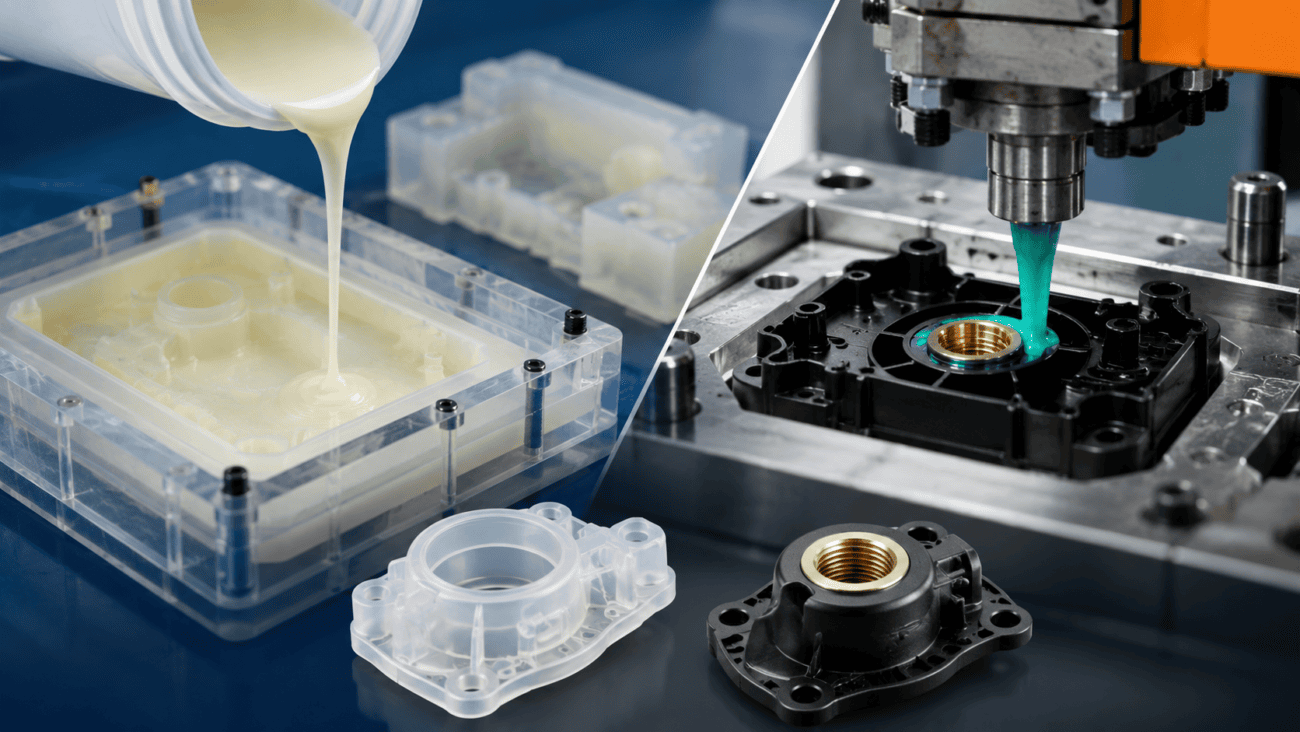
Successful product manufacturing requires careful planning, accurate prototyping, and efficient production methods. Before launching a product, companies need to verify dimensions, test materials, evaluate assembly, and identify potential weaknesses. Modern manufacturing technologies make these steps easier and more cost-effective. Two useful solutions are vacuum casting service and insert molding service, which can support manufacturers from early-stage development to production.
Vacuum Casting Service for Accurate Prototypes
A vacuum casting service is a versatile manufacturing method used to produce prototypes and small quantities of components. It is particularly valuable when businesses need realistic physical parts before investing in expensive production molds.
The process starts with a master model based on a CAD design. The master can be produced using CNC machining or 3D printing, depending on the required precision and surface finish. A flexible silicone mold is then created around the master model, capturing its geometry and surface details.
Once the silicone mold has cured, the master is removed. A suitable material, often polyurethane resin, is prepared and poured into the mold under vacuum conditions. The vacuum helps remove trapped air, reducing the possibility of bubbles and voids.
After the material cures, the finished part is carefully removed from the mold. Depending on the application, it may be trimmed, sanded, polished, painted, or coated to achieve the required appearance.
Key Benefits of Vacuum Casting
Vacuum casting is particularly useful for prototypes, engineering samples, presentation models, and low-volume production. Manufacturers can create multiple components without investing in expensive permanent tooling.
The process can reproduce complex shapes, fine details, textures, and smooth surfaces. This makes it suitable for automotive components, electronics housings, medical products, consumer goods, and industrial equipment.
Physical prototypes allow engineers to test dimensions, fit, assembly, appearance, ergonomics, and functionality. They can discover problems that may not be obvious in a digital model and make improvements before mass production.
Vacuum casting also provides flexibility when companies need to test several design variations. Instead of committing to one final design immediately, manufacturers can compare different versions and select the most effective solution.
Understanding Insert Molding Service
An insert molding service is a specialized process that combines a preformed insert with a molded plastic component. The insert is placed inside a mold, and molten plastic is injected around it. After cooling, the insert becomes securely integrated into the finished part.
Inserts can be made from metal, plastic, or other engineered materials. Metal inserts are often used to provide threaded connections, mounting points, electrical contacts, or additional structural support.
Insert molding is commonly used in automotive parts, electrical connectors, switches, medical devices, consumer products, and industrial components.
Benefits of Insert Molding
One major advantage of insert molding is reduced assembly. Instead of producing a molded plastic component and installing the insert afterward, manufacturers can integrate both elements during the molding process.
This can reduce labor requirements, assembly time, and the number of separate components. It can also improve consistency because the insert is positioned accurately within the mold during production.
Insert molding can also strengthen critical areas. Metal inserts can provide durable fastening points that withstand repeated tightening, mechanical loads, and vibration.
How the Processes Can Work Together
Vacuum casting and insert molding can support different stages of the same project. During early development, vacuum casting can help engineers validate the overall shape, dimensions, and assembly of a product.
If the final design requires insert molding, prototype testing can help determine insert locations, clearances, material thickness, and other important factors. Resolving these issues before production tooling is manufactured can save time and reduce costs.
Conclusion
A reliable vacuum casting service provides an effective solution for creating detailed prototypes and low-volume components, while a professional insert molding service allows manufacturers to integrate inserts directly into molded products. Both technologies can improve product development and manufacturing efficiency. By combining careful prototyping with appropriate production techniques, businesses can reduce risks, simplify assembly, control costs, and deliver high-quality products more efficiently.
