
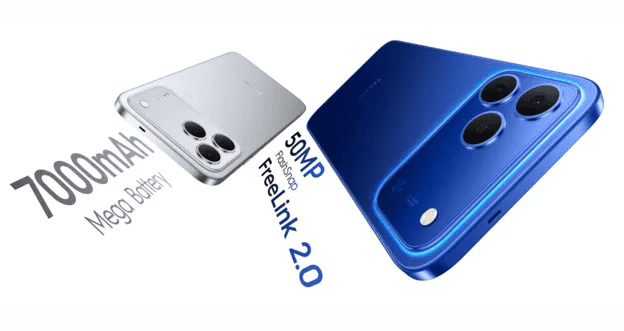
You are on an online store where you compare two phones that are in your budget. Phone A says 108MP whereas phone B says it has a 50MP camera. Phone A costs less and everything in your gut says 108MP is better as a bigger number means a better camera. But the reviews say phone B takes better photos and nothing on the spec sheet explains why.
This article tells you which phone specifications make a mobile the best Android phone in Pakistan and where the camera quality varies.
Why a 108MP Camera Can Take Worse Photos Than a 50MP Camera
A megapixel has one million pixels which means a 50MP camera captures 50 million tiny squares of colour and light to create a photo. On the other hand, a 108MP camera takes 108 million pixels. It is true that more pixels means more detail but only up to a point that most buyers will never actually notice in daily use.
Here is what the megapixel number does not tell you:
- How large the individual pixels are
- How much light the sensor captures
- How the lens focuses
- How the software processes the image after the shot is taken
A phone with 12 megapixels and a large sensor may produce better photos than a phone with 108 megapixels and a small sensor. If you take a 108MP phone with a tiny sensor, that phone produces 108 million very small, light-starved pixels; however, a 50MP phone with a large sensor produces 50 million bigger and sharper pixels.
Smartphones also rely heavily on pixel binning, the process by which a phone combines four pixels closer to create one final, higher-quality pixel. A 48MP camera binning pixels will produce a 12MP image, producing a richer, brighter result than a non-binned 12MP sensor.
The Camera Specification Almost Nobody Checks Before Buying a Phone
A larger sensor collects more light, which means better dynamic range, lower noise in low-light conditions, and more natural background separation. A 50MP sensor on a 1-inch sensor outperforms a 200MP sensor on a 1/2-inch sensor in real photography.
The sensor is like a window where a bigger window lets in more light and makes everything inside look clearer and more natural. A smaller window produces a darker, noisier result regardless of how many individual panes of glass it contains.
For Pakistani buyers, low light photography matters most, occasions like:
- Mehndis
- Eid celebrations
- Indoor family gatherings
- Wedding halls with mixed lighting.
Sensor size is the single spec that predicts performance in these situations better than megapixels, aperture, or any AI feature. When comparing two phones, if one has a larger sensor, it will almost always produce better photos at family events.
Why Some Phones Take Better Night Photos Even With Fewer Megapixels
A smaller f/ number means a bigger, better aperture. f/1.8 lets in more light than f/2.2. This is like saying a wider door lets more people through; the door width is bigger even though the number is smaller.
A smaller f/ number means a larger aperture and more light reaching the sensor. Modern flagship phones reach apertures of f/1.5 or even wider, making them excellent for night photography. An f/1.8 aperture lets in roughly 50% more light than an f/2.2 aperture in the same shooting conditions.
Aperture also controls background blur, known as bokeh. A wider aperture produces more background blur behind a subject, which is what gives portrait photos that professional, subject-separated look that Pakistani users actively want for event photos, Eid portraits, and social media content.
When comparing two phones, the one with the lower f/ number will always produce brighter photos in the same conditions. This is the second most important spec after sensor size.
The Hidden Feature That Makes Night Photos Look Sharper
OIS stands for Optical Image Stabilisation. EIS stands for Electronic Image Stabilisation. They both claim to make photos and videos less shaky. They work completely differently, and the difference in output quality is significant.
OIS is a mechanical system that physically compensates for hand movement during photography, the camera module actually moves to counter vibrations. EIS is a software-based approach that crops and digitally adjusts the frame to reduce apparent shake. OIS is the real thing and EIS is a workaround that comes at a cost.
EIS crops the image to create its stabilisation buffer where you lose a portion of the frame in every photo and video. On a 50MP sensor with EIS, you might be getting a 40MP-equivalent image after the crop.
Smartphones add EIS alongside OIS for perfect results, especially in video recording, meaning the best outcome is a phone with OIS as the hardware foundation and EIS as an additional software layer.
The Next Time You Compare Two Phones, Ignore the Megapixel Number First
A camera spec sheet can make almost any phone look impressive, but photo quality is determined by far more than the megapixel number printed on the box. A high-resolution camera phone with a small sensor, narrow aperture, and no optical stabilisation will often produce weaker results than a lower-megapixel camera built on better hardware.
For Pakistani buyers, the most important camera specifications are sensor size, aperture, and OIS. These are the features that make the biggest difference at weddings, family gatherings, Eid celebrations, indoor events, and night photography where lighting is rarely perfect.
When comparing phones, focus on how much light the camera can capture and how well it can keep images sharp, rather than chasing the highest megapixel count. If a phone combines a large sensor, a wide aperture, and optical image stabilisation, it is far more likely to deliver consistently better photos in everyday use.
