
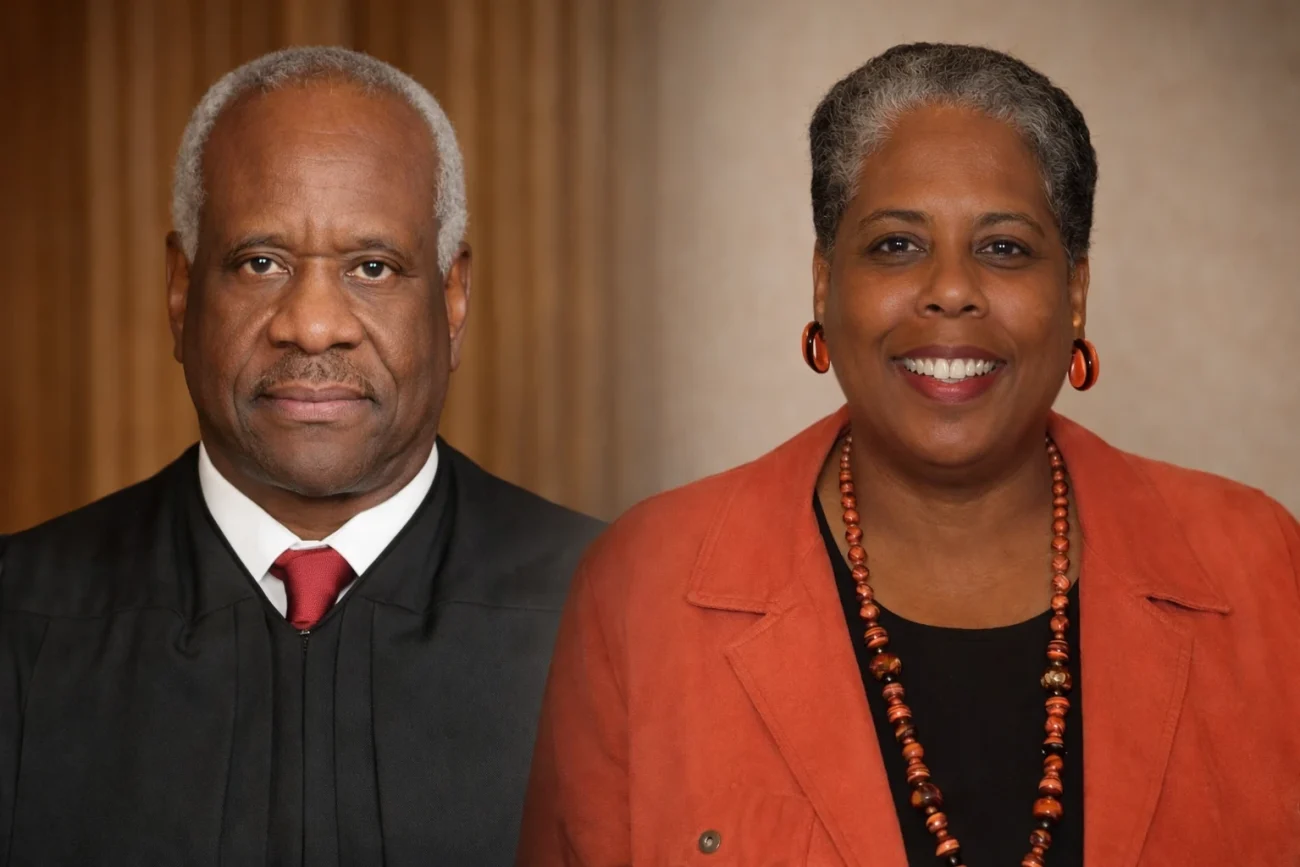
Not many people know this, but Ambush was there before the courtroom battles, before the Senate hearings, before Clarence Thomas became a name that could split a room. She was part of the early years, when his life was still taking shape and nothing about his future was guaranteed. By all accounts, theirs was a young marriage rooted in shared ambition, faith, and the kind of optimism that tends to come with being in your early twenties.
The truth is, what happened to Clarence Thomas’s first wife is not a story of scandal or public collapse. It’s a story of a marriage that ended, a family that changed, and a woman who chose privacy in a world that increasingly punishes it. That choice—quiet, deliberate, and consistent—has defined how history remembers her.
Early Life and Family Background
Kathy Grace Ambush grew up in the United States during a period of enormous cultural change. While detailed records of her childhood are limited, what’s known places her in a traditional American upbringing that emphasized education and stability. Anyone who has traced her early path will tell you that she followed a fairly conventional route, attending school and later enrolling at Anna Maria College in Massachusetts.
That’s where her life intersected with Clarence Thomas. He was attending the College of the Holy Cross, just a short distance away, and their relationship developed during those formative college years. It wasn’t unusual for students in nearby institutions to meet and build relationships, but what stands out here is timing. They met at a moment when both were still figuring out who they would become.
Friends and contemporaries from that era have described Thomas as serious and driven, someone already wrestling with questions about identity, faith, and purpose. Ambush, by contrast, has largely remained undefined in public records, which can make her seem like a shadow figure. But that’s misleading. She was part of the same environment, navigating the same expectations, and building a life that, at the time, looked like it would be shared long-term.
Their decision to marry came quickly by modern standards. On June 5, 1971, the day after Thomas graduated from Holy Cross, they were married. That detail alone tells you something about the urgency and commitment of that moment. This wasn’t a delayed plan; it was a step into adulthood taken together.
Marriage to Clarence Thomas
The early years of their marriage coincided with a period of transition for Clarence Thomas. After Holy Cross, he went on to attend Yale Law School, one of the most prestigious institutions in the country. That kind of move changes everything about a young couple’s life, from finances to social circles to long-term expectations.
Kathy Ambush was part of that transition. While Thomas immersed himself in legal studies and began building the connections that would shape his career, she was managing the realities of married life during a demanding period. Anyone who has lived through graduate school alongside a spouse knows how much strain it can place on a relationship, even when things are going well.
In 1973, the couple welcomed their son, Jamal Adeen Thomas. His birth added another layer to their lives, one that required balancing ambition with responsibility. Raising a child while pursuing a legal career is never simple, and for Thomas, those years were marked by both professional development and personal struggle.
By the late 1970s, Thomas had begun moving into government roles, including positions within the federal system that would eventually lead to national prominence. But here’s where it gets complicated. Success in public life doesn’t always translate into stability at home, and by Thomas’s own later account, this period was marked by internal conflict and personal challenges.
The Breakdown of the Marriage
By 1981, Kathy Ambush and Clarence Thomas had separated. Three years later, in 1984, their divorce was finalized. The timeline is clear, even if the details remain largely private. What’s surprising is how little public conflict accompanied the end of their marriage, especially given Thomas’s later prominence.
Clarence Thomas has spoken about that period in his life, particularly in connection with his 2007 memoir, My Grandfather’s Son. In interviews tied to the book, including one with ABC News, he described leaving his first wife and child as “the worst thing” he had done. He also acknowledged struggles with alcohol and a deep sense of guilt tied to his own father’s absence during his childhood.
That perspective offers some insight, but it’s only one side of the story. Kathy Ambush has never publicly offered a detailed account of the marriage or its end. That absence of commentary has shaped how the story is told, often leaving Thomas’s reflections as the primary narrative.
The truth is, marriages end for many reasons, and not all of them translate neatly into public explanation. What can be said is that the separation marked a turning point for both individuals. For Thomas, it was part of a period of personal reckoning. For Ambush, it was the beginning of a life lived largely outside public view.
Life After Divorce
After the divorce in 1984, Kathy Ambush made a decision that continues to define her public identity: she stepped away. While Clarence Thomas’s career accelerated—eventually leading to his appointment to the U.S. Supreme Court in 1991—Ambush did not follow that trajectory into the spotlight.
Instead, she appears to have focused on private life, raising her son and maintaining a distance from the political and media attention surrounding her former husband. That choice stands out, especially in an era when proximity to power can easily be turned into visibility or influence.
There are occasional references to her involvement in community or church-related activities, but these details are scattered and not consistently documented in major sources. What remains consistent is the absence of public controversy tied to her name. She did not write a tell-all book, give high-profile interviews, or attempt to shape public perception of her past.
That kind of restraint is rare. It suggests a deliberate boundary, one that separates her personal history from the public narrative surrounding Clarence Thomas. For many observers, that decision has become one of the most defining aspects of her story.
Relationship With Her Son Jamal
Jamal Adeen Thomas remains a central figure in understanding Kathy Ambush’s life after her marriage. Born in 1973, he grew up during a period of change for his parents, eventually living with Clarence Thomas after the divorce, according to Thomas’s own account.
That arrangement might seem unusual, but family dynamics rarely follow a single script. What matters is that both parents remained connected to their son’s life, even as their own relationship ended. For Ambush, motherhood likely became an anchor during a time of transition.
Anyone who has spoken about Jamal’s upbringing points to the complexity of being raised in proximity to a figure who would become nationally prominent. Yet, through it all, Ambush maintained her privacy, allowing her son to navigate his own path without constant public scrutiny tied to her.
This part of the story often gets overlooked, but it’s essential. The end of a marriage doesn’t end a family. It reshapes it, sometimes in ways that only the people involved fully understand.
Clarence Thomas’s Rise and Her Absence From It
When Clarence Thomas was nominated to the Supreme Court in 1991, the confirmation hearings became one of the most contentious political events of the decade. Allegations from Anita Hill dominated headlines, and the proceedings were broadcast across the country.
Kathy Ambush was not part of that public moment. By then, she had been divorced from Thomas for several years, and she did not step forward to comment or participate in the national conversation. That absence is striking when you consider how often former spouses are drawn into such moments.
Instead, Virginia “Ginni” Thomas, whom Clarence married in 1987, became the public partner associated with his career. Over time, Ginni Thomas developed her own political identity, especially within conservative circles. The contrast between the two women could not be sharper.
Where Ginni Thomas embraced public life, Kathy Ambush avoided it. That difference has shaped how each is remembered, even though both played roles in different chapters of Clarence Thomas’s life.
Financial Standing and Public Recognition
There is very little verified public information about Kathy Ambush’s financial standing. Estimates of her net worth vary widely, and without reliable disclosures, any precise figure would be speculative. What can be said is that she did not build a public-facing career that would place her wealth or earnings under regular scrutiny.
Unlike many individuals connected to high-profile figures, Ambush has not used that connection to pursue media opportunities, speaking engagements, or business ventures. That choice has likely contributed to the limited information available about her finances.
In terms of recognition, she occupies an unusual space. Her name is widely known in connection with Clarence Thomas, yet she has no independent public platform tied to that recognition. It’s a kind of visibility without presence, where people know of her but know very little about her life.
Lesser-Known Details About Kathy Ambush
What’s surprising is how much of Kathy Ambush’s story exists between the lines rather than in headlines. For example, she married Clarence Thomas at a moment when both were still defining their futures, which makes her part of a formative chapter often overlooked in political biographies.
Another detail that stands out is her consistent absence from controversy. In decades of intense scrutiny surrounding Clarence Thomas, her name has rarely been pulled into disputes or media cycles. That kind of distance doesn’t happen by accident; it reflects a sustained choice to remain outside the narrative.
There’s also the fact that she has never publicly contested Thomas’s version of events regarding their marriage. Whether that reflects agreement, disagreement, or simply a desire for privacy is not something the public can fully know. But the silence itself speaks to a boundary she has maintained for years.
Finally, her story challenges a common assumption. People often expect the former spouse of a powerful figure to either stay connected to that power or publicly reject it. Ambush did neither. She moved on, quietly, and stayed there.
Frequently Asked Questions
Who is Clarence Thomas’s first wife?
Kathy Grace Ambush is Clarence Thomas’s first wife. They met during college in Massachusetts and married on June 5, 1971. Their relationship began before Thomas entered national public life, making her part of his early personal history.
Why did Clarence Thomas and Kathy Ambush divorce?
The exact reasons for their divorce have not been fully detailed by both parties. Clarence Thomas later described personal struggles, including guilt and alcohol use, as factors during that period. Kathy Ambush has not publicly shared her perspective on the marriage’s end.
Did Kathy Ambush remarry after her divorce?
There are scattered reports suggesting she may have remarried, but there is no widely confirmed public record that provides clear details. She has maintained a private life, which limits the availability of verified information about her personal relationships after the divorce.
Where is Kathy Ambush now?
Kathy Ambush is believed to be living a private life in the United States. She has stayed out of public attention for decades and does not appear in major political or media circles connected to Clarence Thomas.
Does Kathy Ambush have any public role today?
No, she does not hold a visible public role tied to Clarence Thomas’s career or politics. Her life after the divorce has been largely separate from the public narrative surrounding the Supreme Court and its justices.
Conclusion
Kathy Grace Ambush’s story resists the kind of tidy narrative people often expect. She was there at the beginning of Clarence Thomas’s adult life, shared a marriage and a child with him, and then stepped away before his rise to national prominence. That sequence alone would be enough to keep her name in the margins of history.
But here’s the thing. The absence of spectacle doesn’t make her story less meaningful. If anything, it highlights a different kind of strength, one rooted in privacy and distance from public conflict. In a culture that often rewards visibility at any cost, her decision to remain out of the spotlight feels almost radical.
There’s also something quietly powerful about the way her life unfolded after the divorce. She did not attempt to reshape public opinion or claim a place in the ongoing narrative around Clarence Thomas. Instead, she built a life that exists largely outside that narrative, even as interest in her continues.
So when people ask what happened to Clarence Thomas’s first wife, the answer isn’t hidden or mysterious. She lived her life on her own terms, away from cameras and headlines. And in a world that rarely allows that kind of exit, that may be the most remarkable part of her story.
